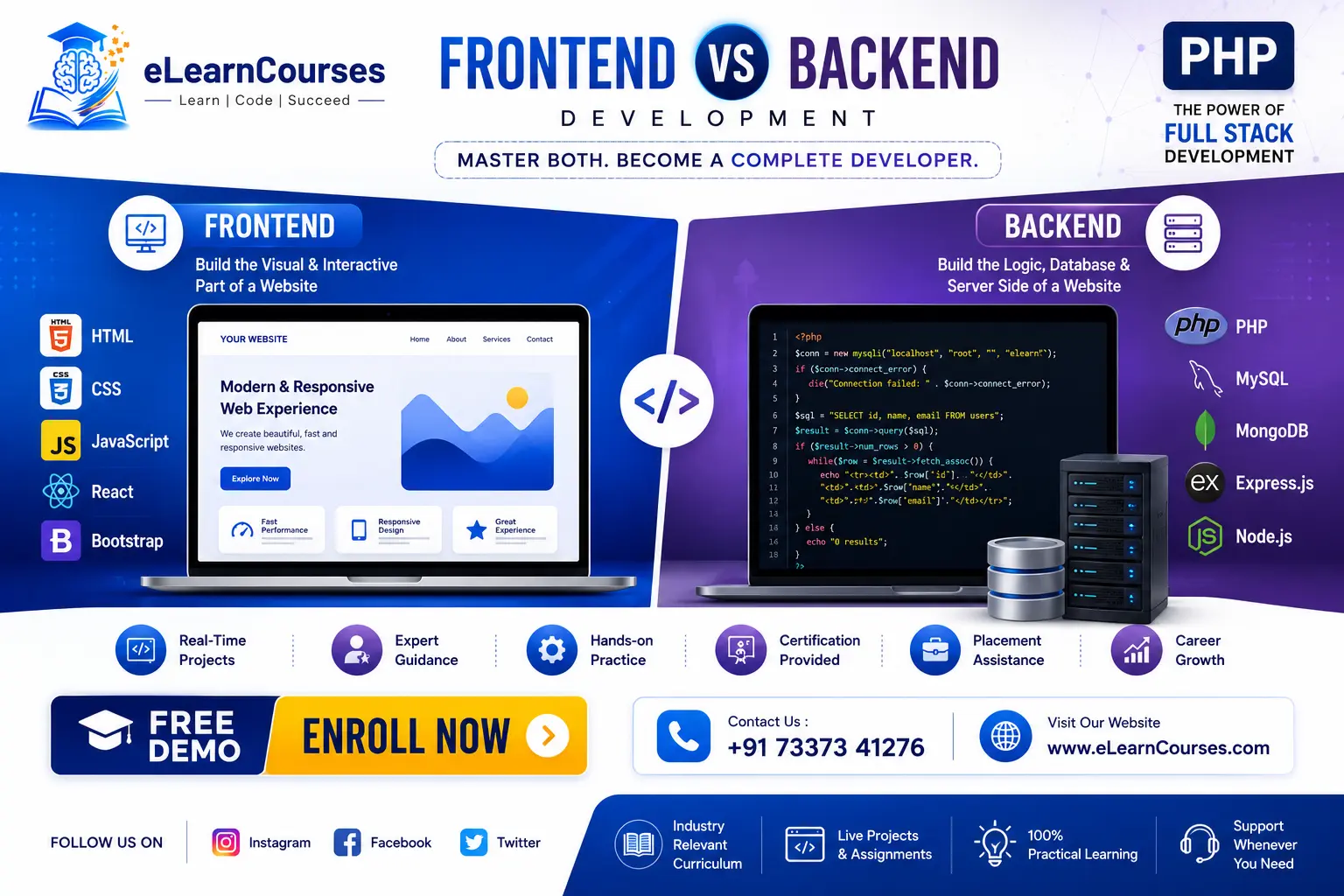
Frontend vs Backend Development: The Critical Difference (2026)
Introduction
Anyone who has spent more than ten minutes browsing developer job listings has run into this confusion. One posting wants a “frontend specialist with React experience.” Another wants someone “backend-focused, comfortable with databases and APIs.” A third asks for “full-stack” and lists skills from both columns. If you’re new to web development, sorting out frontend vs backend development can feel like learning a second language before you’ve even started the first.
This guide exists to clear that up properly, not with a one-line definition you’ll forget in five minutes, but with the actual reasoning behind why these two sides of web development exist, how they differ in daily work, what tools each side uses, and which one might suit you better depending on how your brain likes to work.
We’ll also get into salaries, career paths, common beginner mistakes, and the increasingly blurry middle ground where the two disciplines overlap. By the end, you should be able to read a job posting and know exactly what it’s asking for, and maybe even know which side you’d rather be on.
What Is Frontend vs Backend Development?
Let’s start with a clean definition, since this is the part people usually search for first.
Frontend development is the practice of building the parts of a website or application that users see and interact with directly in their browser, including layout, design, and interactivity. Backend development is the practice of building the server-side systems, databases, and logic that power an application behind the scenes, handling things users never see directly, like authentication, data storage, and business logic.
Put simply, frontend is what you see. Backend is what makes what you see actually work.
A restaurant analogy holds up well here. Frontend is the dining room: the menu design, the table layout, how the waiter presents your food. Backend is the kitchen: the inventory, the cooking process, the systems that make sure the right dish reaches the right table. You never see the kitchen as a customer, but if it’s disorganized, your dinner is ruined regardless of how nice the dining room looks.
What Is Frontend Development?
Frontend development, also called client-side development, covers everything that runs in a user’s browser. When a page loads, when a button changes color on hover, when a form shakes because you left a field blank, that’s frontend code doing its job in real time.
The Core Building Blocks
Three technologies form the foundation of nearly all frontend work:
- HTML structures the content (headings, paragraphs, images, forms)
- CSS styles that content (colors, spacing, fonts, layout)
- JavaScript makes it interactive (clicks, animations, dynamic updates)
Most professional frontend developers don’t write raw JavaScript for everything anymore. They work inside frameworks that handle a lot of the repetitive plumbing. React currently leads the pack by a wide margin, with Vue and Svelte picking up steady adoption, particularly among teams who find React’s component model heavier than they need for smaller projects.
What a Frontend Developer Actually Does Day to Day
A frontend developer’s daily work involves things that backend work rarely touches: making sure a page loads fast, checking that a layout doesn’t break on a five-year-old Android phone, verifying that color contrast meets accessibility standards, and polishing an animation until it feels smooth instead of janky.
It’s part engineering and part design sensitivity. Good frontend developers tend to notice small visual inconsistencies that someone purely focused on server logic might walk right past. That’s not a criticism of backend developers. It’s just a different set of instincts, trained by a different kind of daily work.
What Is Backend Development?
Backend development, or server-side development, covers everything happening on a server that users never see directly. When you log into an app, the backend checks your password against a database. When you buy something online, the backend processes the payment, updates inventory, and fires off a confirmation email. None of that is visible to you, but all of it has to function correctly or the entire experience collapses.
The Core Building Blocks
Backend developers work with server-side languages such as PHP, Python, Java, C#, Go, or Node.js (which lets JavaScript run outside the browser). They design databases, build APIs that the frontend calls to fetch or send data, manage user authentication, handle security, and make sure a system can survive thousands of simultaneous users without falling over.
What a Backend Developer Actually Does Day to Day
If frontend is about how something feels, backend is about whether something actually works, scales, and stays secure under pressure. A backend developer spends time thinking about query performance, server load, data integrity, and what happens when ten thousand people try to check out at the same time during a flash sale.
A beautiful interface backed by a database that leaks user data is a disaster waiting to be reported in the news. A backend that’s bulletproof but bolted to a confusing, ugly interface won’t get used by anyone, no matter how well-engineered it is underneath. Both sides matter. Neither one alone makes a product work.
Frontend vs Backend Development: Key Differences
The cleanest way to separate frontend vs backend development is by asking where the code runs and who it’s built for.
Where the code executes. Frontend code runs in the user’s browser, on their device. Backend code runs on a remote server, somewhere the user never sees or accesses directly.
Who experiences the output. Frontend output is visual and interactive, the literal thing a user looks at and clicks. Backend output is data and logic, delivered as a result (a page loads, a payment succeeds, a search returns results) rather than something visible in itself.
The primary skill set. Frontend leans toward visual design, layout thinking, and user experience instincts. Backend leans toward systems thinking, data modeling, and security awareness.
How bugs show up. A frontend bug is usually obvious immediately. A button doesn’t work, a layout looks broken, a color is wrong. A backend bug can hide for weeks, quietly corrupting data or leaking information before anyone notices, because there’s no visual signal pointing at it.
None of this means one side is harder than the other. They’re hard in different ways, and most developers naturally gravitate toward one based on which kind of problem-solving feels more satisfying to them.
How Frontend and Backend Work Together
Neither side functions in isolation. Here’s a simplified version of what happens when you click “Buy Now” on an online store:
- You click the button. Frontend JavaScript captures that click.
- Frontend code sends a request to the backend, usually through an API call.
- The backend receives the request, checks your account, verifies the item is in stock, and processes payment.
- The backend queries the database, updates inventory, and creates an order record.
- The backend sends a response back to the frontend, confirming success or returning an error.
- Frontend code receives that response and updates what you see, a confirmation message, an order number, a “thank you” page.
That handoff between frontend and backend happens constantly, often multiple times per page load, and it’s the backbone of how every modern web application functions. Understanding this flow is genuinely more useful than memorizing definitions, because it explains why the two disciplines need to communicate cleanly through well-designed APIs.
Skills Required for Frontend Development
Core Technical Skills
- HTML and semantic markup
- CSS, including Flexbox and Grid layout systems
- JavaScript fundamentals (not just framework syntax)
- A modern framework: React, Vue, or Angular
- Responsive design principles
- Browser developer tools for debugging
- Version control with Git
- Basic understanding of accessibility (WCAG guidelines)
Soft Skills That Matter More Than People Expect
Frontend developers work closely with designers, so reading a Figma file accurately and translating it into working code is a real skill, not a given. An eye for visual detail, patience with cross-browser quirks, and comfort taking design feedback all show up far more often in frontend roles than most beginners expect going in.
Skills Required for Backend Development
Core Technical Skills
- A server-side language: PHP, Python, Java, C#, Go, or Node.js
- Database management (MySQL, PostgreSQL, MongoDB)
- API design (REST or GraphQL)
- Authentication and authorization concepts
- Server management and basic DevOps knowledge
- Security fundamentals (SQL injection prevention, data encryption)
- Version control with Git
Soft Skills That Matter More Than People Expect
Backend developers need to think several steps ahead: what happens if this query runs a million times, what happens if two users try to update the same record simultaneously, what happens if the database connection drops mid-transaction. That kind of systems thinking is closer to engineering discipline than visual creativity, and it rewards people who enjoy methodically working through edge cases.
Tools and Technologies Compared
| Category | Frontend | Backend |
|---|---|---|
| Languages | HTML, CSS, JavaScript, TypeScript | PHP, Python, Java, C#, Go, Node.js |
| Frameworks | React, Vue, Angular, Svelte | Laravel, Django, Express, Spring Boot |
| Package Managers | npm, yarn | Composer, pip, Maven |
| Databases | None directly (consumes data via API) | MySQL, PostgreSQL, MongoDB, Redis |
| Testing Tools | Jest, Cypress, Playwright | PHPUnit, pytest, JUnit |
| Build Tools | Vite, Webpack | N/A (server compiles or interprets directly) |
| Hosting | Vercel, Netlify, CDNs | AWS, DigitalOcean, traditional servers |
| Debugging | Browser DevTools | Server logs, Postman, terminal output |
Step-by-Step: How to Decide Which Path to Learn
If you’re staring at this decision and not sure where to start, walk through this:
- Ask what kind of feedback loop keeps you motivated. If you want to see results instantly (change a CSS value, refresh the page, watch it shift), frontend will likely hold your attention better early on.
- Try a small project on each side. Build a simple static page with HTML and CSS. Then try writing a basic script that reads and writes to a small database. Notice which one you actually want to keep tinkering with after the tutorial ends.
- Consider your existing strengths. If you’ve done graphic design, photography, or anything visually creative, frontend may feel like a natural extension. If you’ve done anything involving spreadsheets, logic puzzles, or systems thinking, backend may click faster.
- Look at local job demand. Some regions and industries lean harder toward one side. Agencies often need more frontend talent. SaaS companies and fintech often lean backend-heavy.
- Don’t treat it as permanent. Plenty of developers start on one side and migrate to the other, or end up full-stack after a few years. Your first choice is a starting point, not a life sentence.
Frontend vs Backend Development: Comparison Table
| Aspect | Frontend | Backend |
|---|---|---|
| Runs where | User’s browser | Web server |
| Core languages | HTML, CSS, JavaScript | PHP, Python, Java, Node.js, Go, C# |
| Common frameworks | React, Vue, Angular, Svelte | Laravel, Django, Express, Spring |
| Main concern | User experience, visuals, interaction | Logic, data, security, performance |
| Visible to users | Yes, directly | No, indirectly through results |
| Typical tasks | Layouts, forms, animations, responsiveness | Databases, APIs, authentication, server logic |
| Testing focus | Cross-browser behavior, UI, accessibility | Data integrity, load handling, edge cases |
| Bug visibility | Usually immediate and obvious | Can stay hidden for weeks |
| Average learning curve | Lower to start, framework depth grows over time | Steeper start, payoff in systems understanding |
Benefits of Frontend Development
Frontend work offers a fast feedback loop that keeps beginners engaged. You write a line of code, refresh the browser, and see the change immediately. That immediacy makes it one of the more approachable entry points into web development.
It also tends to have a shorter path to a visible portfolio. A frontend developer can build three or four polished-looking projects in a few months that look genuinely impressive to a hiring manager, even without a backend behind them.
Frontend skills also transfer well into adjacent fields like UI/UX design, product design, and even marketing roles that touch web pages, since the visual and interactive instincts overlap.
Also Read: What is Web Development
Benefits of Backend Development
Backend work tends to offer more architectural depth and, in many markets, slightly stronger long-term salary growth, since backend systems are harder to replace and the expertise compounds over time.
Backend developers also have an easier time moving into adjacent specializations: DevOps, cloud architecture, data engineering, and security all build directly on backend foundations. The skills don’t go stale as quickly as some frontend framework trends do.
There’s also a kind of satisfaction in backend work that comes from solving puzzles rather than polishing visuals, designing a database schema that holds up under real-world data, optimizing a slow query, or building an API that other teams rely on daily.
Best Practices for Frontend Developers
- Write semantic HTML before reaching for divs everywhere
- Test on real devices, not just browser resize tools
- Keep components small and reusable rather than building giant monolithic ones
- Optimize images and assets; page speed affects both UX and SEO rankings
- Follow accessibility standards from the start, not as an afterthought
- Use version control properly, with meaningful commit messages
- Avoid over-relying on a framework without understanding the JavaScript underneath it
Best Practices for Backend Developers
- Always use prepared statements or parameterized queries to prevent SQL injection
- Hash passwords properly; never store them in plain text
- Design your database schema before writing application code around it
- Write clear, documented APIs that frontend developers can actually use without guessing
- Log errors properly instead of suppressing them
- Plan for failure: what happens when a third-party service times out, when a payment fails midway
- Keep secrets and credentials out of source code, using environment variables instead
Common Mistakes Beginners Make
Trying to learn both sides at once from day one. It’s tempting, especially with “full-stack” being the buzzword everyone wants on their resume, but spreading attention too thin early on usually means neither side gets learned properly. Pick a primary focus first.
Skipping fundamentals to jump straight into a framework. Learning React without understanding core JavaScript, or learning Laravel without understanding core PHP, leads to a shaky foundation that shows up the moment something breaks in a way the framework doesn’t explain clearly.
Underestimating the other side entirely. Frontend developers sometimes assume backend work is just “plumbing” with no creativity involved. Backend developers sometimes assume frontend work is “just styling.” Both assumptions are wrong, and both attitudes tend to limit career growth, since most senior roles eventually require at least conversational fluency in the other discipline.
Not building real projects. Tutorials are useful for learning syntax, but they rarely teach you what happens when real, messy data hits your code. Build something with actual users, even if it’s just friends and family testing it.
Ignoring how the two sides communicate. A lot of beginners learn frontend and backend as two separate, disconnected subjects and never quite grasp how an API actually connects them. That connection is where a huge amount of real-world debugging happens.
Real-World Use Cases
E-commerce platforms lean heavily on both sides. Frontend handles product browsing, cart interactions, and checkout flow design. Backend handles inventory, payment processing, order history, and fraud detection.
Content management systems like WordPress blend the two directly. Frontend themes control how a site looks. Backend PHP handles content storage, user permissions, and plugin logic.
SaaS dashboards depend on backend systems to aggregate and process data correctly, while frontend work determines whether that data is actually understandable and usable once it reaches a screen full of charts.
Social media platforms push both sides to their limits. Backend systems handle massive data volumes, real-time updates, and recommendation algorithms. Frontend systems handle the infinite scroll, the notification badges, and the split-second interactions users expect without ever thinking about how complex it is underneath.
Industry Trends in 2025
The frontend vs backend development split is still meaningful, but the boundary keeps shifting in ways worth understanding.
Server-side rendering is back in fashion. Frameworks like Next.js and Nuxt blend frontend and backend concerns in the same codebase, sometimes the same file, which means more frontend developers are picking up backend-adjacent skills than a few years ago.
Node.js keeps blurring the language divide. A developer writing backend logic in JavaScript via Node.js is, technically, using a “frontend language” on the server, which has made full-stack JavaScript roles (sometimes called the MEAN or MERN stack) extremely common in job postings.
GraphQL is changing how frontend and backend negotiate data. Instead of the backend deciding exactly what shape of data to send, GraphQL lets the frontend request precisely what it needs, shifting some decision-making that used to sit purely on the backend side.
AI-assisted coding tools like GitHub Copilot and Cursor have sped up boilerplate work on both sides, which has, if anything, increased demand for developers who understand the underlying systems well enough to catch when AI-generated code gets something subtly wrong.
Full-stack hiring continues to grow, particularly at startups and small companies that can’t afford separate specialists, which has made T-shaped skills (deep in one area, competent in the other) increasingly valuable.
Pros and Cons of Each Path
Frontend: Pros and Cons
Pros
- Faster, more visible feedback loop
- Quicker to build an impressive-looking portfolio
- Strong overlap with design and UX careers
- Generally considered easier to start, harder to master deeply
Cons
- Framework churn means constant relearning
- Cross-browser and cross-device quirks can be frustrating
- Visual work is more subjective, which means more rounds of feedback and revision
Backend: Pros and Cons
Pros
- Skills tend to age more slowly than frontend framework trends
- Strong natural path into DevOps, cloud, and data roles
- Often slightly higher average compensation at senior levels
- Deep, transferable systems thinking
Cons
- Slower feedback loop, less visually satisfying day to day
- Mistakes can be more costly and harder to detect early
- Steeper initial learning curve around databases and architecture
Full-Stack Development: The Middle Ground
Full-stack developers work across both frontend and backend, building features end to end rather than handing work off to a separate specialist. Smaller companies and startups often prefer this because they can’t justify hiring two people when one capable generalist can cover both.
Whether full-stack is the right path depends entirely on your goals. Some developers genuinely enjoy the variety of touching every layer of a product. Others find that splitting attention across both sides means neither one gets developed to the depth that specialization allows. There’s no universally correct answer here, and plenty of successful careers exist on both sides of that choice.
A common and reasonable progression: specialize in one side first, build real competence and confidence there, then deliberately expand into the other side once you have a solid base to build from. Going full-stack from day one, with no depth anywhere, tends to produce shakier results than going full-stack after first becoming genuinely good at one thing.
Career Paths and Salary Expectations
| Role | Entry Level (US) | Mid Level | Senior |
|---|---|---|---|
| Frontend Developer | $60K-$75K | $80K-$105K | $115K-$145K |
| Backend Developer | $65K-$80K | $85K-$110K | $120K-$155K |
| Full-Stack Developer | $65K-$80K | $90K-$115K | $125K-$160K |
| UI/UX-Leaning Frontend | $55K-$70K | $75K-$95K | $100K-$130K |
| Backend/DevOps Hybrid | N/A | $95K-$120K | $135K-$170K |
These ranges shift significantly based on location, company size, and whether the role involves a specific in-demand framework (Laravel, React, Next.js) that’s currently hot in hiring. Treat these as general orientation, not a guarantee, since actual offers vary widely by market and negotiation.
Frequently Asked Questions
1. What is the main difference between frontend and backend development?
Frontend development builds what users see and interact with directly in their browser, such as layout, design, and interactivity. Backend development builds the server-side systems, databases, and logic that power an application behind the scenes, handling things users never see directly.
2. Which is easier to learn, frontend or backend?
Frontend is generally considered more approachable to start, since visual feedback is immediate and the entry-level concepts (HTML, CSS) are intuitive. Backend has a steeper initial learning curve around databases, server logic, and security, but many developers find the depth more intellectually satisfying once they get past the early hurdles.
3. Can I learn both frontend and backend development?
Yes, this is called full-stack development. Most experts recommend building solid competence in one side first before expanding into the other, rather than learning both shallowly at the same time from the very beginning.
4. Which pays more, frontend or backend development?
Backend and full-stack roles often command slightly higher average salaries at the senior level, partly because backend systems are more complex to replace and the required expertise compounds over time. The gap is not huge, and it varies significantly by company, location, and specific tech stack.
5. What programming languages are used in frontend vs backend development?
Frontend development primarily uses HTML, CSS, and JavaScript (or TypeScript), along with frameworks like React, Vue, or Angular. Backend development uses server-side languages such as PHP, Python, Java, C#, Go, or Node.js, paired with frameworks like Laravel, Django, Express, or Spring Boot.
6. Is Node.js frontend or backend?
Node.js is technically backend, since it lets JavaScript run on a server rather than in a browser. However, since JavaScript is also the primary frontend language, Node.js has blurred the traditional language divide and made full-stack JavaScript development (often called the MERN or MEAN stack) very common.
7. Do I need to learn backend development if I’m a frontend developer?
Not strictly, but having a working understanding of how APIs and backend systems function makes frontend developers significantly more effective at debugging issues and collaborating with backend teams. Many senior frontend roles expect at least conversational fluency in backend concepts.
8. What is full-stack development?
Full-stack development refers to working across both frontend and backend, building complete features from the user interface through to the database and server logic. Full-stack developers are common at startups and smaller companies that need versatile generalists rather than narrow specialists.
9. How long does it take to become a frontend or backend developer?
Most people reach a job-ready level in either frontend or backend development within 6 to 12 months of consistent, focused study and project-building. Reaching a senior level of expertise in either discipline typically takes 2 to 4 years of real-world, hands-on experience.
10. Which is better for a career, frontend or backend development?
Neither is objectively better. The right choice depends on what kind of problems you enjoy solving, visual and interactive design challenges versus systems, data, and logic challenges, and on the specific job market and industry you’re aiming to enter.
11. What tools do frontend and backend developers use differently?
Frontend developers rely heavily on browser developer tools, design handoff tools like Figma, and build tools like Vite or Webpack. Backend developers rely on database management tools, API testing tools like Postman, and server-side debugging through logs and terminal output rather than visual inspection.
Key Takeaways
- Frontend vs backend development comes down to where code runs and who experiences the result: frontend runs in the browser and is directly visible, backend runs on a server and works behind the scenes.
- Frontend focuses on HTML, CSS, JavaScript, and visual user experience. Backend focuses on server-side languages, databases, APIs, and system logic.
- The two sides communicate constantly through APIs, and understanding that handoff matters more than memorizing definitions.
- Frontend tends to offer faster feedback and a quicker visible portfolio. Backend tends to offer deeper systems thinking and slightly stronger long-term salary trajectories.
- Full-stack development bridges both, and is increasingly common, particularly at smaller companies, though most experts recommend building depth in one area before spreading into the other.
- Neither path is objectively easier or better. The right choice depends on the kind of problems that genuinely hold your interest.
Conclusion
The frontend vs backend development debate isn’t really a debate once you understand what each side actually does day to day. They’re not competing disciplines fighting for relevance. They’re two halves of the same system, each handling a different kind of responsibility, and each rewarding a different kind of thinking.
If you’re choosing where to start, don’t overthink it into paralysis. Build something small on each side, notice which one keeps you curious past the tutorial stage, and start there. You can always expand later, and plenty of developers do exactly that throughout their careers.
What matters most isn’t picking the “right” side on day one. It’s building genuine depth somewhere, understanding how that side connects to the other, and staying curious enough to keep learning as the tools and frameworks inevitably keep shifting underneath you.
Start Your Web Development Journey with eLearnCourses
eLearnCourses offers dedicated learning tracks for both frontend and backend development, plus a combined full-stack path if you want to build skills on both sides from the start.
- Frontend track covering HTML, CSS, JavaScript, and React
- Backend track covering PHP, MySQL, and Laravel
- Real, portfolio-ready projects in every course
- Lifetime access and certificates upon completion