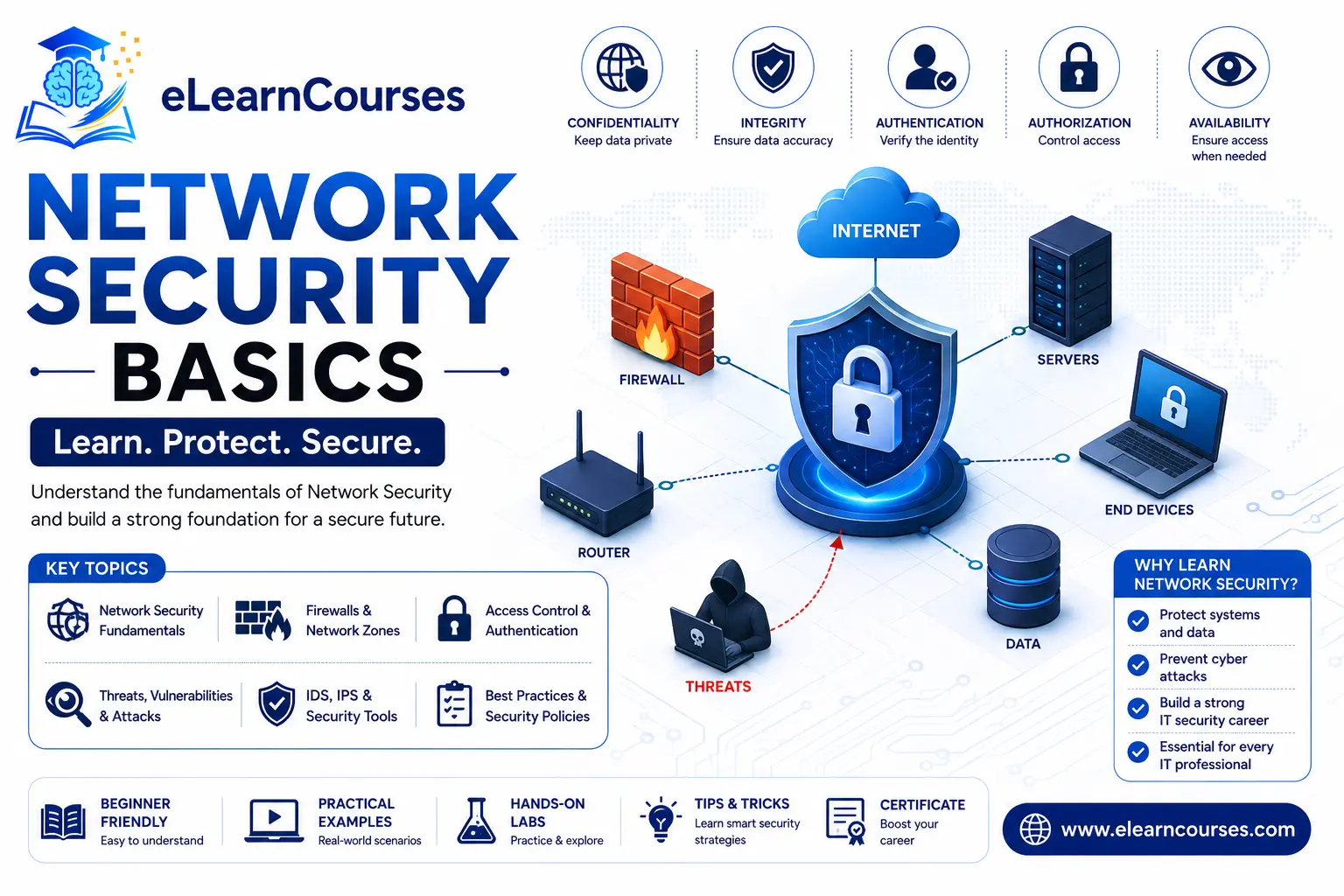
Network Security Basics: A Complete Beginner's Guide (2026)
Every cybersecurity specialty — cloud security, application security, identity and access management, ethical hacking — eventually traces back to the same foundation: network security. Before you can understand how attackers move laterally through a compromised system, how a firewall decides what traffic to block, or why Zero Trust has become the dominant security model in 2026, you need a solid grasp of how networks are actually protected in the first place.
This guide covers exactly that. We’ll walk through the core principles of network security, the most common threats you need to defend against, the tools and technologies that make up a modern security stack, and how the field has evolved heading into 2026 — including the shift toward Zero Trust architecture and the growing role of AI on both sides of the attacker-defender equation. No prior security background required.
What Is Network Security?
Network security refers to the policies, practices, and technologies used to protect the integrity, confidentiality, and accessibility of computer networks and the data flowing across them. In practical terms, it’s everything an organization does to prevent unauthorized users from accessing, misusing, modifying, or disrupting a network — and everything it does to detect and respond quickly when something slips through anyway.
It’s worth understanding network security as a layered discipline rather than a single tool or fix. No single firewall, antivirus program, or security policy makes a network “secure” — real-world network security is built from multiple overlapping layers of defense, so that if one layer fails, others are still in place to catch the threat. This layered approach is often called “defense in depth,” and it’s one of the most important mental models to internalize as you learn this field.
The CIA Triad: The Foundation of All Network Security
Nearly every network security concept ultimately serves one of three goals, commonly known as the CIA triad:
Confidentiality ensures that data is only accessible to authorized users. This is achieved through tools like encryption, access controls, and authentication — preventing sensitive information from being read by anyone who shouldn’t see it.
Integrity ensures that data hasn’t been altered or tampered with, whether in storage or in transit across a network. Techniques like checksums, digital signatures, and hashing algorithms let systems verify that data arrived exactly as it was sent.
Availability ensures that authorized users can access the network and its resources when they need to. This is why defenses against Distributed Denial-of-Service (DDoS) attacks, along with redundancy and failover systems, are considered core network security concerns, not just an IT operations afterthought.
Whenever you’re evaluating a new security tool or practice, it’s genuinely useful to ask which piece of the CIA triad it primarily addresses — it’s one of the fastest ways to understand why a given control exists in the first place.
The OSI Model: Where Network Security Controls Actually Apply
Before diving into specific threats and tools, it helps to have a basic mental map of how network communication is structured — the OSI (Open Systems Interconnection) model. It breaks network communication into seven layers, and different security controls operate at different layers, which is a big reason network security can feel scattered until you see how these pieces fit together.
- Layer 3 (Network) is where routing and IP addressing happen, and where firewalls traditionally do much of their basic traffic filtering based on IP addresses and ports.
- Layer 4 (Transport) governs how data is reliably delivered (TCP) or sent without guaranteed delivery (UDP), and is where load balancers and some firewall rules also operate.
- Layer 7 (Application) is where modern Next-Generation Firewalls and Web Application Firewalls (WAFs) do their most sophisticated work — inspecting the actual content and context of traffic (a specific HTTP request, an application command) rather than just its origin and destination.
You don’t need to memorize every layer in detail to get value from this model. The practical takeaway is simpler: a tool that only filters based on IP address and port (a traditional, basic firewall) is operating at a much lower, less context-aware layer than a tool that can inspect and understand the actual content of an HTTPS request or a specific application command. This is exactly why “next-generation” security tools, which understand application-layer context, generally catch threats that older, lower-layer tools miss entirely.
Common Types of Network Threats
Understanding what you’re defending against is just as important as knowing the defensive tools themselves. A few threat categories show up repeatedly across nearly every network security curriculum and real-world incident report.
Malware — malicious software including viruses, worms, trojans, and ransomware — remains one of the most common and damaging categories of network threats, often gaining initial access through phishing emails or compromised downloads before spreading across a network.
Phishing and social engineering attacks manipulate people, rather than technical systems, into granting access or revealing sensitive information. In 2026, AI-generated phishing content and deepfake voice/video impersonation have made these attacks noticeably more convincing and harder for employees to spot on their own, pushing organizations toward stronger technical safeguards rather than relying on user awareness alone.
Man-in-the-Middle (MitM) attacks occur when an attacker intercepts communication between two parties — for example, on an unsecured public Wi-Fi network — potentially reading or altering data in transit without either party realizing it.
Distributed Denial-of-Service (DDoS) attacks flood a network or service with overwhelming traffic, making it unavailable to legitimate users. These attacks target the “availability” leg of the CIA triad directly and remain a persistent threat against public-facing services.
SQL injection and other application-layer attacks exploit poorly secured input fields in web applications to manipulate databases or gain unauthorized access — a reminder that network security and application security are closely intertwined rather than fully separate disciplines.
Insider threats — whether malicious or simply careless — involve authorized users misusing their legitimate access. This category has become an increasingly central focus in 2026 security strategy, since traditional perimeter defenses do nothing to stop someone who already has valid credentials.
Credential-based attacks, including brute-force attempts and credential stuffing (reusing leaked passwords from other breaches), continue to be among the most common initial access methods attackers use, which is a major reason multi-factor authentication has become close to a baseline requirement rather than an optional extra.
Core Network Security Components and Tools
A modern network security stack typically combines several distinct categories of tools, each addressing a different part of the defense-in-depth model.
Firewalls act as a barrier between trusted internal networks and untrusted external networks (like the internet), inspecting traffic and allowing or blocking it based on defined security rules. Modern Next-Generation Firewalls (NGFWs) go well beyond simple port and protocol filtering, incorporating deep packet inspection, intrusion prevention, and application-aware filtering in a single platform.
Intrusion Detection and Prevention Systems (IDS/IPS) monitor network traffic for signs of known attack patterns or suspicious behavior. An IDS alerts security teams when it detects a potential threat, while an IPS goes a step further and can actively block or reject suspicious traffic automatically.
Virtual Private Networks (VPNs) create encrypted tunnels for data traveling across public or untrusted networks, commonly used to secure remote employee connections back to internal company resources. In 2026, many organizations are supplementing or replacing traditional VPNs with Zero Trust Network Access (ZTNA) solutions, which grant access to specific applications based on continuous identity verification rather than putting a remote user fully “inside” the network the way a traditional VPN does.
Antivirus and endpoint protection software defends individual devices (endpoints) against malware, and modern tools increasingly fall under the broader category of Endpoint Detection and Response (EDR), which adds continuous monitoring and automated response capabilities beyond traditional signature-based antivirus scanning.
Security Information and Event Management (SIEM) platforms aggregate and analyze log data from across an organization’s entire network and security tools, helping teams detect patterns and anomalies that would be effectively invisible looking at any single data source in isolation.
Network Access Control (NAC) systems enforce policies about which devices are allowed to connect to a network in the first place, often checking a device’s security posture (patch status, antivirus presence) before granting access — a practical building block for the device-verification piece of a Zero Trust approach.
Data Loss Prevention (DLP) tools monitor and restrict how sensitive data moves across a network, helping prevent confidential information from being accidentally or maliciously exfiltrated — whether through email, file uploads, or removable storage devices. DLP sits squarely at the intersection of technical controls and policy enforcement, since it typically requires an organization to have already classified what data actually counts as sensitive before the tooling can protect it effectively.
Network Segmentation and the Zero Trust Model
Two related concepts have become central to how modern networks are actually architected for security, and both are worth understanding in depth.
Network segmentation divides a network into smaller, isolated sections, limiting how far an attacker can move if they gain access to one part of the network. A well-segmented network might separate guest Wi-Fi from internal corporate systems, isolate sensitive financial systems from general employee networks, and use “microsegmentation” to restrict communication even between individual servers or applications within the same broader network zone.
Zero Trust has become the dominant network security philosophy heading into 2026, built on a simple but genuinely transformative principle: never trust, always verify. Rather than assuming anything inside the traditional network perimeter is automatically safe, Zero Trust requires continuous verification of every user and device, regardless of whether they’re connecting from inside or outside the network.
This shift reflects a hard lesson the industry has learned repeatedly: once an attacker breaches the perimeter of a traditional “trusted internal network” model, they’ve often historically been able to move around with very little additional resistance — Zero Trust is designed specifically to eliminate that free lateral movement.
Practically, implementing Zero Trust involves strong identity verification (often including adaptive multi-factor authentication), device posture checks (confirming a device meets security requirements before granting access), least-privilege access policies (granting users only the specific access they need, nothing more), and continuous monitoring rather than a one-time login check.
Encryption and Secure Protocols
Encryption transforms readable data into an unreadable format that can only be reversed with the correct decryption key, protecting confidentiality both for data in transit (moving across a network) and data at rest (stored on a device or server).
A few protocols and concepts come up constantly in network security fundamentals:
- TLS/SSL encrypts data traveling between web browsers and servers — the “S” in HTTPS specifically indicates that TLS encryption is active for that connection.
- IPsec provides encryption and authentication at the network layer, commonly used to secure VPN connections.
- Symmetric vs. asymmetric encryption — symmetric encryption uses a single shared key for both encrypting and decrypting data (fast, but requires securely sharing that key), while asymmetric encryption uses a mathematically linked public/private key pair, avoiding the need to share a secret key directly.
- Hashing converts data into a fixed-length string used to verify integrity — unlike encryption, hashing is a one-way process not meant to be reversed, which is why it’s commonly used for storing passwords securely.
One emerging 2026 concern worth knowing about even at a beginner level: post-quantum cryptography. As quantum computing continues to advance, today’s most widely used encryption standards (like RSA and ECC) are theoretically at risk of being broken by sufficiently powerful future quantum computers.
This has pushed security researchers and standards bodies to begin developing and rolling out quantum-resistant encryption algorithms well ahead of quantum computing actually reaching that threat threshold — a good example of how network security as a discipline tries to stay ahead of threats rather than purely reacting to them.
Authentication and Access Control
Controlling who gets access to what is one of the most fundamental — and most commonly under-implemented — aspects of network security.
Authentication verifies that someone is who they claim to be, typically through one or more of three factors: something you know (a password), something you have (a security key or authenticator app), or something you are (biometrics like a fingerprint). Multi-factor authentication (MFA), which combines two or more of these factors, has become close to a non-negotiable baseline requirement across the industry, given how effectively it blocks the most common credential-based attacks even when a password itself has been compromised.
Authorization determines what an authenticated user is actually allowed to do — which systems, files, and actions they can access. The principle of least privilege — giving users only the minimum access necessary to do their job, nothing more — is one of the most consistently emphasized best practices across every network security framework and audit standard.
Identity and Access Management (IAM) systems centralize and enforce these authentication and authorization policies at scale across an organization. Specialized tools in this space, like privileged access management platforms, add an extra layer of protection specifically around the most sensitive, high-value accounts — the ones that would cause the most damage if compromised.
Network Security Monitoring: SIEM and SOAR
Prevention alone isn’t enough — modern network security assumes that some threats will get through, which makes detection and response capabilities just as important as the preventive controls covered earlier.
SIEM (Security Information and Event Management) platforms collect and correlate log and event data from across an entire network — firewalls, servers, applications, endpoints — giving security teams a centralized view for detecting suspicious patterns that wouldn’t be visible looking at any single system in isolation.
SOAR (Security Orchestration, Automation, and Response) builds on top of SIEM data by automating common incident response actions, reducing how much manual work a security team needs to do for routine or well-understood threats, and freeing up analyst time for more complex investigations. This automation has become increasingly important in 2026, as security teams continue to face growing alert volumes and a persistent shortage of experienced analysts.
Together, these tools reflect a broader shift in the field: from a purely preventive mindset toward one that assumes breaches will happen and focuses heavily on fast, effective detection and response.
How These Concepts Work Together: A Simple Example
The individual pieces covered so far can feel abstract in isolation, so it helps to walk through how they combine in a realistic scenario.
Imagine an employee working remotely tries to access a company’s internal finance system. In a Zero Trust setup, that request doesn’t automatically succeed just because the employee has valid login credentials. First, authentication confirms their identity, typically requiring MFA rather than a password alone. Next, a device posture check confirms their laptop meets security requirements — updated software, active endpoint protection — before any access is granted.
The connection itself travels through an encrypted tunnel (either a traditional VPN or a ZTNA solution), protecting the data’s confidentiality in transit. Once connected, network segmentation and least-privilege access controls ensure this employee can only reach the specific finance systems their role requires, not the entire internal network. Throughout the session, a SIEM platform logs the activity, and if anything about the access pattern looks unusual — an impossible travel pattern, an attempt to access systems outside their normal role — automated SOAR playbooks or a human analyst can intervene quickly.
Notice that no single tool in this example is doing all the work. Authentication, encryption, segmentation, and monitoring are each addressing a different piece of the puzzle, which is exactly the defense-in-depth principle introduced earlier in practice rather than just in theory.
Network Security Best Practices for 2026
A few practices consistently appear across current industry guidance as the highest-impact steps organizations (and individuals building these skills) should prioritize:
- Implement multi-factor authentication everywhere it’s supported — one of the single highest-impact, lowest-effort security improvements available.
- Adopt Zero Trust principles incrementally — rather than treating it as an all-or-nothing overhaul, most organizations implement Zero Trust in phases, starting with the most critical systems and highest-risk access paths.
- Keep systems and software patched — a large share of real-world breaches exploit known, already-patched vulnerabilities that simply weren’t applied in time.
- Segment networks deliberately — don’t let a flat, unsegmented network allow an attacker who compromises one system to move freely across everything else.
- Monitor continuously, not just at login — device posture, unusual access patterns, and behavioral anomalies matter as much as the initial authentication check.
- Plan for AI-powered threats specifically — 2026 guidance consistently flags AI-generated phishing and deepfake-based social engineering as a growing risk that traditional employee training alone isn’t fully equipped to counter, pushing organizations toward stronger technical controls (like phishing-resistant MFA) rather than user vigilance as the primary defense.
- Extend security requirements to vendors and the software supply chain — increasingly formalized through tools like Software Bills of Materials (SBOMs) that track exactly what components and dependencies make up the software an organization relies on.
Common Network Security Mistakes Beginners Make
A handful of misunderstandings show up repeatedly among people new to this field, and clearing them up early will save real confusion later.
Assuming a firewall alone is “enough.” A firewall is one layer of defense, not a complete security strategy. Defense in depth — combining multiple overlapping controls — is the standard approach precisely because no single tool catches everything.
Treating security as a one-time setup rather than an ongoing process. Threats evolve constantly, which means patching, monitoring, and policy review need to be continuous, not a checklist you complete once and move on from.
Underestimating social engineering. Many beginners focus heavily on technical attack vectors while underestimating how often real breaches start with a convincingly crafted phishing email or a phone call rather than a sophisticated technical exploit.
Confusing encryption with general security. Encryption protects confidentiality specifically — it doesn’t prevent a legitimately authenticated but malicious or careless user from misusing data they’re authorized to access, which is why access control and monitoring remain equally essential.
Ignoring the human and process side of security. Technology alone doesn’t secure a network — clear policies, well-defined incident response plans, and consistent employee training around phishing and credential hygiene are just as much a part of network security as any firewall configuration.
Network Security Certifications and Career Paths
If you’re building toward a network security career, a few widely recognized starting points come up consistently: CompTIA Security+ and Network+ as broad, vendor-neutral foundations; Cisco’s CCNA covering core networking concepts many security roles assume as background knowledge; and vendor-specific certifications like Fortinet’s NSE (Network Security Expert) program, which is particularly valuable given how widely FortiGate firewalls are deployed across enterprise environments.
From there, career paths commonly branch into network security engineering (designing and maintaining an organization’s security infrastructure), SOC analyst roles (monitoring and responding to security events day to day), and more specialized paths like penetration testing or cloud security, both of which build directly on the network security fundamentals covered in this guide.
For those aiming specifically at network security engineering or SOC roles, a reasonable certification sequence looks like this: Network+ or CCNA first, to build solid general networking fundamentals; Security+ next, to layer on broad security concepts across the CIA triad, threats, and access control; and then a vendor-specific track — Fortinet’s NSE program if you’re targeting FortiGate-heavy environments, or equivalents from Palo Alto Networks and Cisco — once you know which specific tools the employers or industries you’re targeting tend to standardize on.
Beyond entry-level certifications, more advanced credentials like CISSP (Certified Information Systems Security Professional) signal broader security leadership and architecture experience, typically after several years of hands-on work rather than as an early starting point.
How to Continue Learning
Network security fundamentals give you the conceptual foundation — the next step is building hands-on familiarity with the specific tools organizations actually deploy in production.
Since FortiGate remains one of the most widely used next-generation firewall platforms in real enterprise environments, our Fortinet tutorial is a practical next step for turning the concepts covered here — firewalls, VPNs, security policies — into hands-on configuration skills, and our Fortinet interview questions guide is useful once you’re ready to start interviewing for network security roles. If you’re mapping out a broader cybersecurity career rather than a network-security-specific path, our cybersecurity career roadmap and cybersecurity interview questions guide are natural companions to this one. For authoritative, continuously updated context on current threat trends, Fortinet’s own cybersecurity trends research is worth reading directly.
FAQs About Network Security
What is the difference between network security and cybersecurity? Cybersecurity is the broader umbrella term covering the protection of all digital systems, data, and devices. Network security is a specific subset focused on protecting the network infrastructure itself — the pathways data travels across — rather than, for example, application code or physical device security specifically.
What are the three main types of network security? While frameworks vary, network security is commonly broken into physical security (protecting physical access to network hardware), technical security (firewalls, encryption, access controls protecting data and systems), and administrative security (policies, procedures, and employee training governing how security is managed).
Is Zero Trust replacing VPNs? Not entirely, but Zero Trust Network Access (ZTNA) is increasingly replacing or supplementing traditional VPNs for remote access specifically, since ZTNA grants access to individual applications based on continuous verification rather than placing a user broadly “inside” the network the way a traditional VPN does.
What’s the easiest way to start learning network security? Understanding core networking fundamentals (IP addressing, routing, the OSI model) first makes everything else in network security click faster, since most security concepts are really about protecting or monitoring these underlying networking mechanisms. From there, hands-on practice with a real firewall platform, like FortiGate, is one of the most effective ways to turn conceptual knowledge into practical skill.
Why has Zero Trust become so widely adopted in 2026 specifically? The rise of remote and hybrid work, cloud-based infrastructure, and increasingly sophisticated credential-based and insider attacks has made the traditional “trusted internal network” assumption far less reliable than it used to be, pushing Zero Trust from a niche best practice into close to an industry standard.
Do small businesses need the same network security measures as large enterprises? The scale differs, but the fundamentals apply broadly. Smaller organizations are, if anything, often more attractive targets precisely because they frequently have fewer security resources in place, making core basics like MFA, patching, and firewalls just as important, even if the overall security program is naturally less elaborate than a large enterprise’s.
What is the OSI model, and do I really need to know it? The OSI model is a conceptual framework describing the seven layers involved in network communication, from physical cabling up through the applications people actually use. You don’t need to memorize every layer’s technical details to get started, but understanding roughly where firewalls, encryption, and application-layer inspection each operate makes the rest of network security noticeably easier to reason about.
What’s the difference between IDS and IPS? An Intrusion Detection System (IDS) monitors traffic and alerts security teams when it identifies a potential threat, but takes no direct action on its own. An Intrusion Prevention System (IPS) goes further, actively blocking or rejecting suspicious traffic in real time rather than just flagging it for a human to review afterward.
Conclusion
Network security can feel like an enormous, fast-moving field — and in many ways, it is. But nearly everything covered in this guide traces back to a small set of durable ideas: protect confidentiality, integrity, and availability; layer your defenses rather than relying on any single control; verify continuously rather than trusting by default; and assume that some threats will get through, so detection and response matter as much as prevention.
The specific tools and terminology will keep evolving — Zero Trust, AI-driven threats, and post-quantum cryptography are all reshaping the field heading into 2026 and beyond — but that underlying framework of thinking is what actually transfers from one specific technology to the next. Master the fundamentals covered here, and the more advanced, tool-specific skills you build on top of them will make a lot more sense.