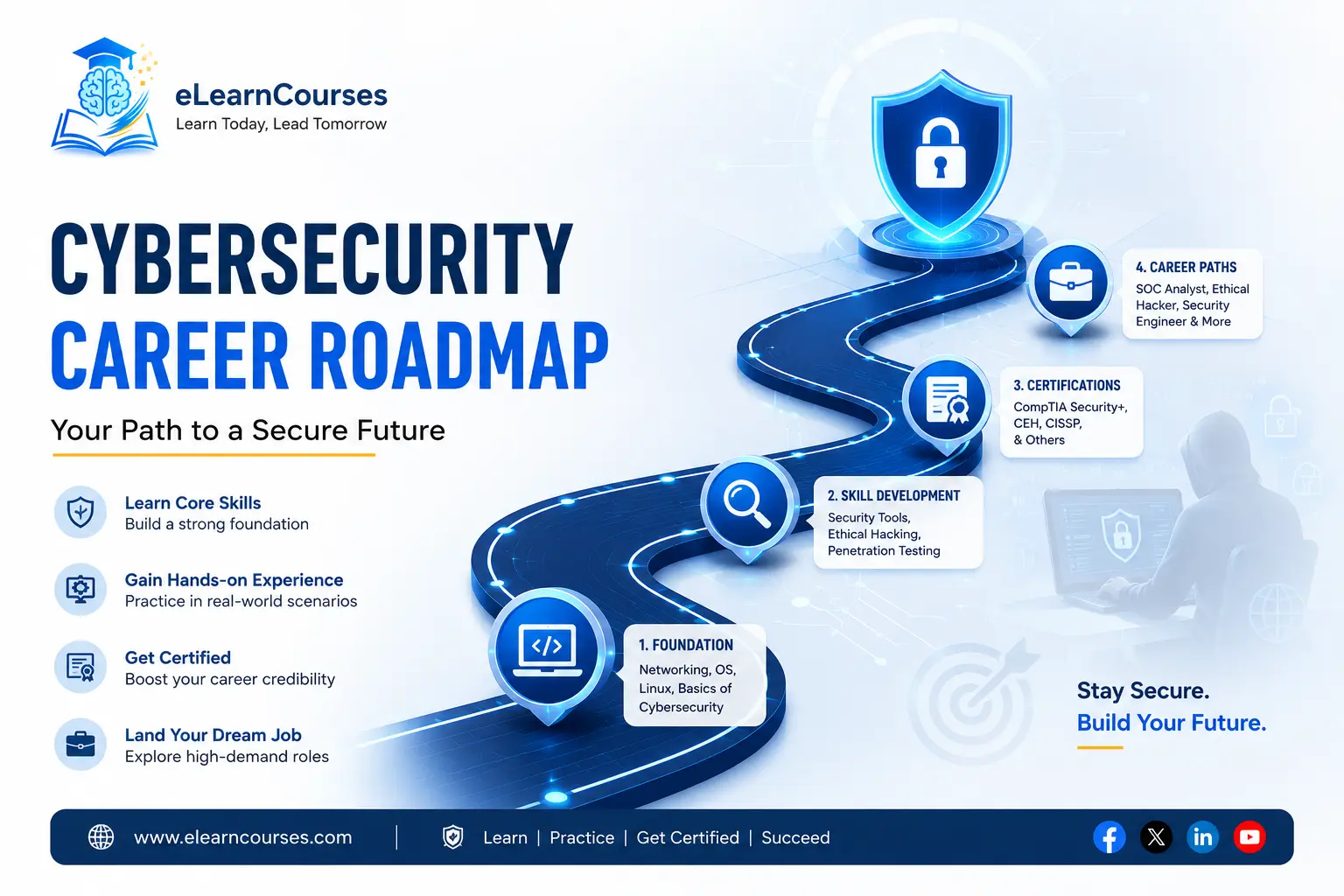
Cybersecurity Career Roadmap: From Beginner to Professional
Cybersecurity has roughly 4.8 million unfilled positions globally, and that number keeps growing rather than shrinking as more of the world’s infrastructure moves online and under attack. That gap creates a genuine opportunity, but it doesn’t mean walking in without a plan. This cybersecurity career roadmap lays out exactly how people actually break into the field, which certifications matter at which stage, and how the major specialization tracks, offensive security, cloud security, governance and compliance, incident response, differ from each other so you can pick a direction that fits how you actually like to work.
The single most important thing to understand before anything else: cybersecurity is a career lattice, not a ladder. Almost nobody starts in a dedicated security role on day one, and the paths in from adjacent fields are wide and well established.
Cybersecurity Is a Lattice, Not a Ladder
Most cybersecurity professionals didn’t start with a “cybersecurity analyst” job title. They came in through feeder roles, help desk support, IT systems administration, network administration, even compliance and audit work in a completely different field, and transitioned into security once they’d built a technical or process-oriented foundation in one of those areas.
This matters because it means there’s no single correct entry point. Someone with a help desk background moves toward SOC analyst roles by building on the troubleshooting and ticketing systems experience they already have. Someone from a compliance or audit background moves toward governance, risk, and compliance (GRC) roles by building on their existing familiarity with frameworks and formal processes. Someone from software development moves toward application security or penetration testing by building on code-level understanding most security generalists don’t have. Recognizing which of these feeder paths matches your current background is often more useful than trying to copy someone else’s exact route into the field.
Foundational Skills Everyone Needs First
Regardless of which specialization you eventually pursue, a handful of fundamentals underpin every serious cybersecurity role.
Networking fundamentals come first: TCP/IP, DNS, firewalls, and VPN technologies. Understanding how data actually moves across a network is what lets you recognize when something’s moving in a way it shouldn’t, which is the core skill behind identifying and responding to most real threats.
Linux proficiency matters heavily, since a large share of servers, security tools, and testing environments run on it. Comfort with the command line isn’t optional at any serious level of the field.
Basic scripting ability, typically Python or Bash, lets you automate repetitive tasks, parse logs at scale, and understand the tools you’re using well enough to adapt them rather than only running them as a black box. Our Python tutorial covers the fundamentals that carry directly into security automation and scripting work.
Operating system internals, how processes, permissions, and memory work at a basic level, matter for understanding both how systems get compromised and how to investigate what happened after they are.
Coding knowledge beyond basic scripting is genuinely helpful but not mandatory for most entry-level and even many mid-level roles, though it becomes considerably more important for penetration testing, application security, and any role involving custom tool development.
Common Tools You’ll Learn Along the Way
Regardless of specialization, a handful of tools show up constantly across the field and are worth getting hands-on with early. SIEM platforms like Splunk and Microsoft Sentinel aggregate and analyze security logs across an organization, and basic proficiency with at least one is expected in nearly every SOC analyst job posting. Wireshark captures and analyzes network traffic at a packet level, essential for understanding what’s actually happening on a network rather than relying only on higher-level summaries.
Nmap scans networks to discover devices, open ports, and running services, a foundational reconnaissance tool used across both defensive and offensive roles. For those leaning toward offensive security specifically, Metasploit provides a framework for testing and validating vulnerabilities in a controlled, authorized environment, and platforms like TryHackMe and HackTheBox build hands-on proficiency with all of these tools through structured, gamified practice environments rather than requiring you to set up a full lab from scratch immediately.
Getting comfortable with two or three of these tools deeply, rather than superficially recognizing all of them, tends to matter more in interviews than being able to list every tool by name without real hands-on time behind any of them.
Entry-Level Roles and How to Get There
The most common true entry point is a Tier 1 SOC (Security Operations Center) Analyst role, monitoring security alerts, triaging suspicious activity, and escalating genuine incidents to more senior analysts. Related entry roles include IT support positions with security responsibilities layered on, endpoint hardening, patch management, basic access control, and junior GRC analyst roles for people coming from compliance, audit, legal, or project management backgrounds rather than a purely technical one.
Entry-level cybersecurity salaries in the US commonly range from roughly $50,000 to $85,000, varying significantly by location, industry, and whether the role sits at a large enterprise or a smaller organization with a leaner security team.
CompTIA Security+ is close to the universal answer for a first certification. It covers foundational security domains broadly, is recognized by essentially every employer in the field, and is required for many US government and defense contractor roles under DoD 8570 compliance requirements. Expect roughly two to three months of study time and a few hundred dollars in exam costs.
What matters just as much as the certification itself: a demonstrable, hands-on portfolio. Employers consistently report wanting people who can actually triage alerts, analyze logs, and troubleshoot real security tools, not just pass a multiple-choice exam. Building a home lab, working through structured hands-on platforms like TryHackMe or HackHouse-style ranked progressions, and writing up your own practice investigations or capture-the-flag (CTF) solutions gives you something concrete to discuss in an interview, and consistently outperforms a certification or even a computer science degree with zero hands-on security work behind it.
The Certification Roadmap: What to Earn and When
Certifications function best as a structured signal of readiness at each career stage, not as an end goal to collect for their own sake.
Entry stage: CompTIA Security+ remains the standard starting point for almost everyone entering the field, alongside options like the Google Cybersecurity Certificate for a more guided, course-based introduction.
Early specialization stage: certifications start splitting by track. CompTIA PenTest+ or the Certified Ethical Hacker (CEH) credential support a move toward offensive security and penetration testing. Cloud provider-specific security certifications, like AWS Certified Security – Specialty or Microsoft’s Azure security certifications, support a move toward cloud security. GRC-focused credentials build on frameworks like NIST and ISO 27001 for governance and compliance-track roles.
Senior and leadership stage: CISSP (Certified Information Systems Security Professional) is widely considered the gold standard credential for senior technical and leadership roles, but it requires five years of relevant professional experience to earn outright, or four years plus a qualifying college degree, which makes it a career-stage certification rather than something to pursue immediately.
The NIST NICE Framework is worth knowing about even if you never formally reference it directly, since it defines the specific competency areas the industry organizes itself around, and many certification paths and job descriptions map back to it whether or not they say so explicitly.
Mid-Level Specialization Tracks
Once you’ve built foundational experience, usually somewhere in your first one to three years, the field splits into genuinely distinct specialization tracks. Mid-level cybersecurity salaries commonly range from around $107,000 to $130,000, though this varies by specialization, location, and how in-demand a given track currently is.
Security Operations and Incident Response
Moving from Tier 1 SOC work into Tier 2 or Tier 3 analysis and incident response involves deeper investigation skills: understanding attacker tactics, techniques, and procedures (TTPs), piecing together attack timelines from fragmented log data, and coordinating remediation across teams during an active incident. This track suits people who enjoy methodical, detail-oriented investigation work, and it often involves irregular hours, since breaches don’t wait for business hours to happen.
Penetration Testing and Offensive Security
Penetration testers are hired to find vulnerabilities before real attackers do, simulating attacks against an organization’s own systems under controlled, authorized conditions. This track demands the deepest technical skill of the common specializations and is rarely a genuine first role straight out of training, though smaller firms sometimes hire junior penetration testers with a strong CTF portfolio and a credential like PenTest+ to show real, demonstrated capability.
Cloud Security
Cloud security engineers secure infrastructure hosted on AWS, Azure, or Google Cloud, focusing on identity and access management, security posture management, and workload protection across increasingly complex, often multi-cloud environments. This track has grown quickly as organizations keep shifting infrastructure to the cloud, and it overlaps significantly with DevOps and platform engineering work. Our Cloud Security Best Practices guide covers the technical foundation this specialization builds directly on, and our DevOps Engineer Roles guide covers the closely adjacent role this track frequently intersects with.
Governance, Risk, and Compliance (GRC)
GRC professionals focus on policy writing, risk assessments, vendor security reviews, and ensuring an organization meets frameworks like NIST, ISO 27001, and SOC 2. This track suits people from legal, finance, audit, or project management backgrounds particularly well, since it leans more on structured process and communication skill than deep hands-on technical work, without being any less critical to an organization’s actual security posture.
Threat Intelligence
Threat intelligence analysts track emerging attacker groups, tactics, and infrastructure, turning raw threat data into actionable guidance for an organization’s broader security strategy. This track suits people who enjoy research, pattern recognition across large datasets, and staying current on a constantly shifting threat landscape.
AI Security (An Emerging Track)
A newer specialization is forming around securing AI systems themselves: protecting machine learning models and pipelines from data poisoning and adversarial manipulation, and helping organizations manage the security risks introduced by rapidly adopting AI tools across their operations. This track doesn’t have the same established certification path as the others yet, but it’s growing quickly as organizations realize their AI adoption has outpaced their security review of it.
Senior and Leadership Roles
Senior specialists, security architects, and eventually leadership roles like a Chief Information Security Officer (CISO), typically command salaries of $150,000 or more, with significant variation based on company size, industry, and region. Getting here generally requires deep expertise in at least one specialization track, demonstrated leadership or mentorship experience, and increasingly, the ability to communicate security risk and strategy clearly to non-technical executives and boards, since a CISO’s role involves as much organizational influence and risk communication as hands-on technical work.
A security architect designs an organization’s overall security strategy and infrastructure decisions, sitting above individual specialization tracks and requiring broad familiarity across several of them rather than deep expertise in just one. This role, and the CISO path beyond it, is where the CISSP certification’s leadership and risk management focus becomes directly relevant, rather than the earlier, more hands-on technical certifications.
Which Industries Are Actually Hiring
Cybersecurity demand has spread well beyond technology companies at this point. Healthcare organizations hire heavily given the sensitivity of patient data and strict regulatory requirements like HIPAA. Financial services remain one of the largest employers of security professionals across nearly every specialization, from GRC to threat intelligence, given the direct financial stakes of a breach. Government and defense contractors offer a substantial share of roles, particularly for candidates who hold or can obtain security clearances, and often specifically require certifications like Security+ under DoD compliance requirements.
Retail and e-commerce hire actively given the volume of payment data they process, and technology companies themselves, both building security products and securing their own infrastructure, remain a major source of roles across every specialization covered above.
This spread matters practically for job hunting: cybersecurity opportunities exist well outside major tech hubs, and a specific industry background, healthcare administration, financial compliance, retail operations, can actually be a meaningful advantage when paired with security skills, since domain knowledge of an industry’s specific risks and regulations is genuinely valuable and relatively scarce.
Soft Skills That Matter More Than People Expect
Technical skill gets most of the attention in how this field is discussed, but communication ability shows up as a genuine differentiator at every stage beyond the most junior roles. Explaining a technical risk clearly to a non-technical executive, writing an incident report that a legal or communications team can actually use, and staying calm and methodical while explaining what’s happening during an active incident are all skills that get tested directly in interviews and rewarded consistently in promotions.
Curiosity and a genuine willingness to keep learning matter just as much, given how quickly the threat landscape and required tooling shift. Professionals who treat their initial certification and training as a finished project, rather than an ongoing practice, tend to plateau noticeably faster than those who keep building skills throughout their career, which is part of why continuous learning shows up so consistently in advice from people already established in the field.
Building a Practical Portfolio
Across every stage of this roadmap, one theme repeats consistently: demonstrated, hands-on experience outweighs certifications and degrees alone in actual hiring decisions.
A home lab, even a modest one built with free virtualization software and a couple of intentionally vulnerable practice machines, lets you practice real investigation and defense skills in an environment where mistakes cost nothing. Platforms like TryHackMe and HackTheBox provide structured, ranked challenges that build a visible track record of practical skill, and many employers specifically look for a demonstrated rank or completed learning path on these platforms as a credible signal alongside formal certifications.
Writing up your own CTF solutions or practice investigations, even informally on a personal blog or GitHub, gives you concrete material to discuss in an interview and shows genuine, self-directed initiative rather than only completing what a course required. For those leaning toward offensive security specifically, contributing to bug bounty programs, even without significant early payouts, builds a real, verifiable track record of finding actual vulnerabilities in live systems.
A Realistic 12-Month Action Plan
For someone starting from genuinely zero cybersecurity background, a reasonable first year looks roughly like this: the first two to three months focus on networking fundamentals, basic Linux proficiency, and beginning study for CompTIA Security+. Months three through six add hands-on practice through a platform like TryHackMe alongside continued certification study, aiming to pass Security+ by month five or six. Months six through nine focus on building a small home lab and starting to specialize, picking one track from the specializations above based on genuine interest rather than only current job market demand, and beginning entry-level applications for SOC analyst or related feeder roles.
The final months of the year focus on interview preparation, building a portfolio of writeups or lab work to discuss concretely, and continuing to apply while refining based on interview feedback.
This timeline assumes consistent, dedicated effort, commonly cited as five to ten hours weekly for ongoing skill development even after landing a first role, since the threat landscape and required skills keep shifting and treating this as a one-time study sprint rather than continuous learning tends to stall a career within a few years.
Advice for Career Changers Specifically
People transitioning from an unrelated field typically need six to eighteen months to become genuinely employable, depending on hours dedicated weekly and how transferable their existing background already is. IT support, systems administration, and network administration backgrounds transfer the most directly, often needing only Security+ and some hands-on lab practice layered on top of existing technical skills. Legal, finance, audit, and project management backgrounds transfer well specifically toward GRC roles, where formal process and communication skills matter as much as deep technical depth. Software development backgrounds transfer well toward application security and, with additional offensive security training, penetration testing.
Formal mentorship through professional organizations like ISC2 or ISACA provides structured guidance and accountability that’s genuinely harder to replicate through informal networking alone, and it’s worth pursuing specifically during a career transition when you’re navigating unfamiliar territory without an established internal network to draw on yet.
Common Mistakes on the Cybersecurity Career Path
Collecting certifications without hands-on practice. A stack of certifications with no demonstrated practical skill behind them reads as memorization to experienced hiring managers, not genuine capability.
Only targeting offensive security roles. Penetration testing gets disproportionate attention in how the field is often portrayed, but defensive roles, SOC analysis, incident response, GRC, cloud security, are far more numerous and often provide a more accessible and sustainable entry point.
Underestimating communication skills. Explaining a risk or an incident clearly to a non-technical stakeholder is a core, frequently tested skill at every level beyond the most junior roles, not a soft add-on to technical expertise.
Treating certification study as a one-time project. The threat landscape and required tooling shift constantly, and professionals who stop learning after their initial certification push tend to plateau noticeably faster than those who budget ongoing time for skill development.
Ignoring the feeder-role path in favor of waiting for a “real” security job. Taking a help desk or IT support role with security-adjacent responsibilities, rather than waiting indefinitely for a dedicated entry-level security opening, is often the faster, more realistic route into the field.
Frequently Asked Questions
Do I need a computer science degree to start a career in cybersecurity? No. A degree can help, particularly for certain government or highly competitive roles, but a demonstrated hands-on portfolio combined with a foundational certification like Security+ is often sufficient for entry-level hiring, and many successful professionals in the field come from non-CS backgrounds entirely, including IT support, the military, and completely unrelated career changes.
What’s the best first certification for someone starting from zero? CompTIA Security+ is the near-universal recommendation. It’s broadly recognized, covers foundational domains across the whole field, and is required for many government and defense contractor roles, making it a safe, versatile starting point regardless of which specialization you eventually pursue.
How long does it realistically take to get a first cybersecurity job? For someone dedicating consistent, serious study time, three to six months for genuine entry-level readiness is a common estimate, though career changers moving from an unrelated field often need six to eighteen months total when accounting for the time to build both certifications and a credible hands-on portfolio.
Is penetration testing a good first cybersecurity job? Rarely, despite how often it’s portrayed as the exciting entry point into the field. It demands deeper technical skill than most other entry-level roles and is more commonly a specialization you move toward after some initial experience, though a small number of firms do hire junior penetration testers with an unusually strong CTF and lab portfolio.
Which cybersecurity specialization has the strongest current demand? Cloud security has shown particularly strong and sustained growth as organizations continue shifting infrastructure to AWS, Azure, and Google Cloud, alongside continued strong demand for SOC analysts and incident responders as the baseline, most numerous roles across nearly every organization with a security team.
Is cybersecurity a good career for remote work? Generally yes. A significant share of cybersecurity roles, particularly in GRC, threat intelligence, and many SOC and cloud security positions, offer substantial remote flexibility, since the work itself is largely tool and data-driven rather than requiring physical presence, though some incident response and highly regulated roles still require on-site or hybrid arrangements.
Do I need to learn to code to work in cybersecurity? Not for most entry-level and GRC-focused roles, though basic scripting in Python or Bash is genuinely useful across nearly every track for automating repetitive tasks and parsing logs at scale. Coding depth becomes considerably more important for penetration testing, application security, and any role involving custom security tool development.
What’s the difference between a cybersecurity certification and a cybersecurity degree? A degree typically provides broader theoretical grounding and can help meet experience requirements for advanced certifications like CISSP faster, while a certification demonstrates specific, current, job-relevant skill more directly. Many successful professionals hold certifications without a directly related degree, and hiring managers in this field generally weigh demonstrated hands-on skill more heavily than either credential alone.
Where to Go From Here
This cybersecurity career roadmap covers a genuine lattice of entry points, feeder roles from IT support, compliance, and development backgrounds, foundational skills every track needs, a certification path that matches each career stage rather than front-loading everything at once, and the major specialization tracks that define mid-career and beyond. The consistent thread across every stage: hands-on, demonstrable skill, built through a home lab, structured practice platforms, and real writeups, matters more to hiring managers than certifications or credentials collected without practical experience behind them.
If cloud security is a track you’re considering, our Cloud Security Best Practices guide covers the technical foundation that specialization is built on, and our Python tutorial is a solid starting point for the scripting skills that support nearly every track in this field. For authoritative, ongoing reference on the competency framework much of the industry organizes around, NIST’s NICE Framework and ISC2’s certification resources are both worth bookmarking as you plan your specific path forward.