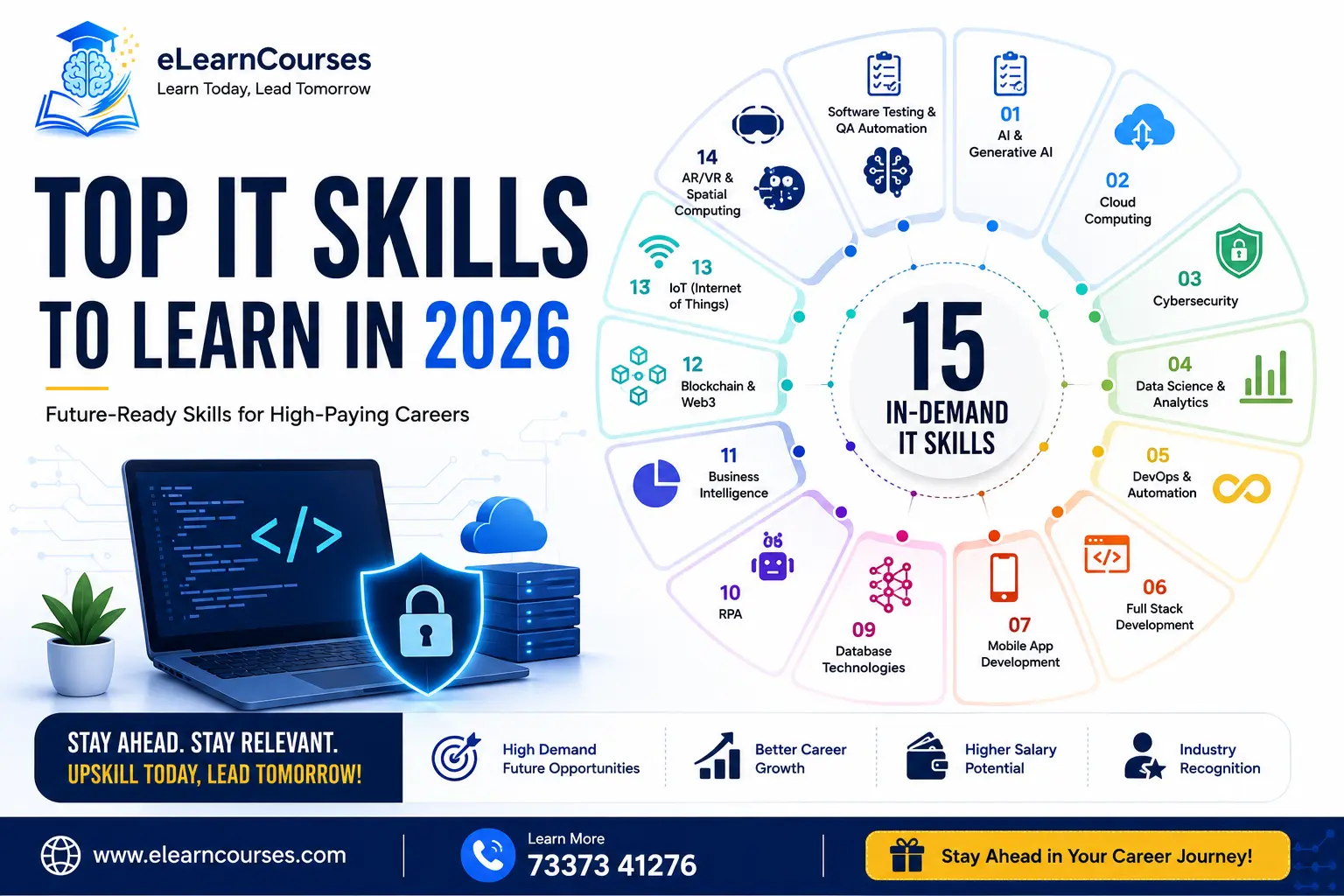
Top IT Skills to Learn in 2026 (Global Career Guide)
The technology job market doesn’t stand still, and 2026 is proving that once again. Artificial intelligence has moved from a buzzword to a baseline expectation, cloud computing is now the default way companies run their infrastructure, and cybersecurity has become a boardroom-level priority rather than a back-office concern. For IT professionals — whether you’re just starting out, switching careers, or trying to move abroad for better opportunities — the real question isn’t whether you need to keep learning. It’s which skills are actually worth your time.
The good news is that despite the noise around layoffs and economic uncertainty in parts of the tech sector, the underlying demand for skilled IT professionals hasn’t slowed down — it’s just become more selective. Companies aren’t hiring generalists who can “do a bit of everything” as readily as they used to. They’re hiring people who can prove depth in at least one or two high-value areas, backed up by real projects, not just certificates sitting in a LinkedIn profile.
This guide breaks down the top IT skills to learn in 2026, why they matter for a global career, which countries are hiring the most tech talent, and how you can start building these skills right now — even without a traditional computer science degree. Whether you’re a fresh graduate trying to land your first role, a mid-career professional planning a shift, or someone eyeing a relocation abroad, the goal here is the same: help you invest your learning time where it will actually move the needle.
Why IT Skills Matter for Your Global Career in 2026
The global tech job market has become genuinely borderless. Remote-first hiring, distributed engineering teams, and streamlined work-visa pathways in countries like Canada, Germany, and Singapore mean that a developer in India, the Philippines, or Nigeria can realistically compete for the same roles as someone based in San Francisco or London. But that also means competition has gone global too — and employers are getting pickier about what “skilled” actually means.
Three forces are shaping hiring decisions in 2026:
- AI adoption inside companies, not just AI products. Businesses of every size are integrating AI into daily workflows, which means IT professionals across nearly every specialty now need at least a working understanding of how AI tools function.
- Cloud-first infrastructure is now the norm, not the exception. Legacy, on-premise systems are shrinking fast, and companies want people who can build, secure, and optimize in the cloud from day one.
- Security and compliance have become non-negotiable. With cyberattacks growing more sophisticated and data regulations tightening across regions, cybersecurity know-how is no longer confined to security teams — it’s expected from developers, cloud engineers, and IT admins alike.
If you’re aiming for an international IT career, the skills below aren’t just “nice to have.” They’re what recruiters in the US, UK, Canada, Germany, Australia, and the Gulf region are actively screening for right now.
Quick-Glance: Top IT Skills at a Glance
| Skill | Best For | Entry Point |
|---|---|---|
| AI & Machine Learning | Developers, data teams, product roles | Python + ML fundamentals |
| Cloud Computing | Infrastructure, backend, ops roles | AWS/Azure/GCP fundamentals cert |
| Cybersecurity | Security-focused or risk-averse career seekers | CompTIA Security+ |
| Data Science & Engineering | Analytical, research-minded professionals | SQL + Python |
| DevOps & Kubernetes | Engineers focused on delivery speed | Docker + Git basics |
| Python & Programming | Almost anyone starting out in tech | Any beginner Python course |
| Blockchain Development | Fintech-focused specialists | Solidity fundamentals |
| UI/UX Design | Creative-technical hybrids | Figma + design fundamentals |
| Prompt Engineering | Non-engineers and engineers alike | Practice with major LLM tools |
| Agile & Project Management | Team leads, coordinators, PMs | Scrum fundamentals course |
This table is a starting map, not a ranking — where you land depends on your existing strengths and how much hands-on time you can commit. Use it to shortlist two or three areas before diving into the details below.
Top 10 IT Skills to Learn in 2026
1. Artificial Intelligence & Machine Learning
AI and machine learning remain the single biggest driver of hiring demand going into 2026. What’s changed is the nature of the skill itself. A few years ago, “AI skills” mostly meant deep technical expertise in building models from scratch. Today, companies need people who can apply AI practically — integrating large language models (LLMs) into products, fine-tuning existing models for specific business use cases, and understanding prompt engineering well enough to get reliable outputs from AI systems.
What to learn: Python, TensorFlow or PyTorch, prompt engineering fundamentals, retrieval-augmented generation (RAG) concepts, and basic statistics for machine learning.
Where it’s used: Healthcare diagnostics, fraud detection in finance, personalized recommendations in e-commerce, customer service automation, and predictive analytics across nearly every industry.
Why it pays well globally: Almost every major economy is short on AI talent, which keeps salaries elevated from Austin to Amsterdam to Bangalore.
One thing worth understanding clearly: you don’t need to become a research scientist to benefit from this trend. Most AI-related job openings in 2026 are for “applied AI” roles — engineers who can plug existing models into products, evaluate their outputs, and fine-tune them for specific business needs. That’s a far more achievable entry point than building a model from scratch, and it’s where the bulk of hiring demand actually sits.
2. Cloud Computing (AWS, Azure, and Google Cloud)
Cloud computing has moved past being a “future skill” — it’s now foundational infrastructure. Companies are shifting workloads to the cloud to cut costs, scale faster, and improve system resilience, and the three major providers (AWS, Microsoft Azure, and Google Cloud) continue to dominate hiring requirements worldwide.
What to learn: Core services on at least one major cloud platform, cloud security fundamentals, cost optimization (often called FinOps), and infrastructure automation.
Certifications worth pursuing: AWS Certified Solutions Architect, Microsoft Azure Fundamentals/Administrator, and Google Cloud Professional Cloud Architect. If cloud data platforms interest you specifically, Snowflake training is one of the fastest-growing niches inside cloud computing right now.
Why it matters for global roles: Cloud certifications are recognized and respected the same way in Berlin as they are in Toronto or Dubai, making them one of the most portable credentials in tech.
Cloud roles also tend to age well. Unlike some trend-driven tech skills, cloud infrastructure knowledge has proven its staying power over more than a decade, and demand keeps climbing as more companies migrate legacy systems and expand into multi-cloud setups. If you’re only going to deeply learn one platform first, AWS still holds the largest market share globally, though Azure has a strong edge in enterprise environments already running Microsoft tools.
3. Cybersecurity
Cybersecurity has quietly become one of the most stable, well-paying tracks in IT. Digital threats keep increasing in scale and sophistication, and organizations everywhere are struggling to find enough qualified people to defend their systems. The 2025 ISC2 Cybersecurity Workforce Study confirms this isn’t just anecdotal — skills shortages, not just headcount gaps, are now the more pressing concern for security teams worldwide, especially around cloud security and AI-related risk.
What to learn: Network security fundamentals, ethical hacking and penetration testing, risk management frameworks, identity and access management (IAM), and incident response.
Entry points: CompTIA Security+, Certified Ethical Hacker (CEH), and hands-on practice through platforms like TryHackMe or Hack The Box. For IAM specifically, CyberArk training and SailPoint training are two of the most requested enterprise security skills right now — and pair well with our cybersecurity career roadmap if you want a structured path in.
Why it matters globally: Data protection regulations (like GDPR in Europe) mean nearly every multinational company needs security-literate staff, regardless of where that company is headquartered.
What makes cybersecurity particularly attractive for a global career is how resistant it is to automation and offshoring. Security work requires context about a specific organization’s systems, threats, and compliance obligations — which means these roles tend to stay local or regional even as other IT functions become more distributed. That translates into steadier demand and less downward salary pressure compared to some other tech fields.
4. Data Science & Data Engineering
Data science remains one of the broadest, most application-heavy skills in tech — used in everything from consumer sentiment analysis to fraud detection to medical diagnostics. What’s shifted in 2026 is a growing emphasis on data engineering: the work of building reliable pipelines that get clean data to the people (and AI models) that need it.
What to learn: SQL, Python, data visualization tools (Tableau, Power BI), data pipeline tools like DBT, and a solid grounding in statistics.
Career paths: Data analyst, data scientist, data engineer, and business intelligence developer.
Why it’s in demand everywhere: As companies generate more data from digital platforms, connected devices, and online transactions, the ability to turn that raw data into decisions is valuable in virtually every country and industry.
5. DevOps & Kubernetes
DevOps continues to be one of the highest-ROI skill investments in IT, combining development and operations to speed up software delivery. Kubernetes, the container orchestration platform, has become close to mandatory for anyone working with modern, scalable applications.
What to learn: Docker and Kubernetes, CI/CD pipelines (Jenkins, GitHub Actions, GitLab CI), Infrastructure as Code (Terraform), and version control with Git.
Why companies want it: DevOps practices directly reduce the time it takes to ship software and fix production issues — a metric every engineering leader is judged on.
Global relevance: DevOps engineers are consistently among the most requested profiles in international tech hiring, particularly for companies scaling across multiple regions.
Kubernetes specifically deserves a callout here. As more companies run containerized applications across multiple cloud providers, Kubernetes expertise has shifted from a “nice differentiator” to something close to a baseline expectation for mid-to-senior infrastructure and platform engineering roles. If you already know the DevOps basics, Kubernetes is one of the highest-leverage additions you can make to your skill set this year.
6. Python & Modern Programming Languages
Python continues to hold its position as one of the most valuable programming languages to know, largely because of its flexibility — it’s used in web development, data science, automation, and AI/ML alike. That said, well-rounded developers in 2026 are also expected to have working knowledge of at least one or two additional languages depending on their specialty.
What to learn: Python as a foundation, plus JavaScript/TypeScript for web development, or Go/Rust if you’re leaning toward backend and systems-level work.
Why it’s still a top pick: Python’s readability and massive ecosystem of libraries make it the common language across AI, automation, and scripting — three of the fastest-growing areas in tech.
7. Blockchain Development
Blockchain’s reputation has shifted well beyond cryptocurrency speculation. In 2026, companies are applying blockchain for secure data management, supply chain traceability, decentralized finance (DeFi), and digital identity verification — areas where tamper-proof record-keeping has real business value.
What to learn: Solidity (for Ethereum-based development), smart contract design, and the fundamentals of decentralized systems.
Where the jobs are: Blockchain developer, smart contract auditor, and crypto/DeFi analyst roles, particularly in fintech hubs across the US, Singapore, and the UAE.
A note of caution: This is a more specialized, higher-risk/higher-reward track than the others on this list — demand is real but narrower than something like cloud or cybersecurity.
8. UI/UX Design
Good technology means nothing if people can’t use it comfortably, which is why UI/UX design continues to be a consistently in-demand skill — especially as companies compete on user experience as much as on features. This one’s slightly less “IT” in the traditional sense, but it’s increasingly bundled into IT and product teams.
What to learn: Figma, Adobe XD, user research methods, and basic accessibility standards (WCAG).
Career paths: Product designer, UX researcher, UI architect.
Industries hiring heavily: Fintech, SaaS, e-commerce, and edtech — all sectors where conversion and retention depend directly on user experience.
9. Prompt Engineering
As large language models have become embedded in everyday business tools, prompt engineering has emerged as its own practical skill — distinct from full machine learning engineering. It’s the ability to communicate with AI systems in a way that consistently produces accurate, useful, and safe outputs.
What to learn: How LLMs process instructions, techniques like few-shot prompting and chain-of-thought reasoning, and how to evaluate and refine AI outputs systematically.
Why it’s valuable even for non-developers: Prompt engineering skills are increasingly expected in roles well outside traditional engineering — marketing, customer support, operations, and content teams are all being asked to work effectively with AI tools.
10. Agile, Scrum & Project Management (The Soft Skill That Isn’t Optional)
Not every valuable IT skill in 2026 is purely technical. Agile methodology and Scrum practices keep development teams organized, adaptable, and able to ship consistently — and hiring managers increasingly expect technical candidates to understand how agile teams operate, even if they’re not managing the process themselves.
What to learn: Scrum fundamentals, sprint planning, backlog management, and tools like Jira or Asana.
Why it matters: Alongside agile know-how, soft skills like clear communication, leadership, and cross-functional collaboration consistently show up as differentiators between candidates with similar technical resumes — especially for roles that involve working across time zones and cultures on distributed global teams.
Bonus Skills Worth Watching in 2026
The ten skills above cover the bulk of hiring demand, but a few emerging areas are worth keeping on your radar — especially if you’re planning a career horizon of five-plus years rather than just your next job.
- Edge computing and IoT — As more devices process data locally instead of sending everything to the cloud, professionals who understand both networking and embedded systems are becoming harder to find.
- AI governance and ethics — With regulations around AI use tightening in the EU and elsewhere, companies are starting to hire specifically for roles that combine technical understanding with compliance and risk awareness.
- Green/sustainable IT — Data centers are under growing pressure to reduce energy consumption, creating a small but growing niche for engineers who understand energy-efficient infrastructure design.
- Quantum computing fundamentals — Still early-stage for most industries, but a small number of specialized roles in finance, pharmaceuticals, and government research are already seeking people with foundational quantum computing knowledge.
None of these need to be your primary focus, but even a working familiarity can set you apart in interviews, particularly for companies that see themselves as forward-looking.
Best Countries Hiring IT Professionals in 2026
If your goal is an international IT career, skills alone aren’t the whole picture — where you aim matters too. A few destinations stand out in 2026 for combining strong tech job demand with realistic visa and settlement pathways:
- United States — Still the largest tech job market globally, with particularly high demand for AI/ML engineers, cloud architects, and cybersecurity specialists. Visa competition (H-1B especially) remains a real hurdle, so a strong portfolio matters.
- Canada — Consistently strong demand in cybersecurity, software development, and data science, paired with clearer permanent residency pathways than many other countries.
- Germany — A major European tech hub with strong demand for cloud, data, and software engineering talent, plus solid work-life balance. English is common in many tech workplaces, though local language skills help long-term.
- United Kingdom — A large, mature IT sector with consistent demand across software development, data, and cybersecurity roles.
- Netherlands — Frequently ranked highly for work-life balance, with a growing tech scene in Amsterdam attracting international talent.
- Singapore — A leading destination for international tech talent in Asia, known for streamlined visa processes and a strong fintech and cloud computing sector.
- Australia — Growing demand for cloud, cybersecurity, and data roles, with skilled migration pathways aimed specifically at tech occupations.
Across nearly all of these markets, the common thread is the same: cloud, AI, cybersecurity, and data skills open the most doors, regardless of the country.
It’s also worth noting that visa and immigration policy shifts fairly often, so if relocation is part of your plan, treat the details above as a starting point rather than a fixed roadmap. Checking each country’s current skilled-migration or work-permit requirements before you commit to a specific destination will save you time and disappointment later.
How to Learn These Skills (Courses & Certifications)
You don’t need a four-year degree to break into most of these tracks — though for some tracks like AI/ML research or blockchain architecture, formal education can still help. Realistic ways to build these skills in 2026 include:
- Structured online courses — Platforms like Coursera, IU International University of Applied Sciences, Udemy, and edX offer both short certificate programs and full degree tracks in cloud computing, AI, cybersecurity, and data science.
- Vendor certifications — AWS, Microsoft, and Google all offer official certification paths that are widely recognized by employers and relatively fast to complete.
- Hands-on practice platforms — Sites like TryHackMe and Hack The Box (cybersecurity), Kaggle (data science/ML), and GitHub (for building a public portfolio) let you demonstrate real skills, not just credentials.
- Bootcamps — Intensive, short-term programs remain a popular route into software development, data analytics, and UX design for career switchers.
- Building real projects — For nearly every skill on this list, a portfolio of 2–3 solid, well-documented projects tends to matter more to employers than certificates alone, especially for candidates without traditional degrees.
The best approach usually combines a bit of all four: one structured course or certification to build fundamentals, ongoing hands-on practice, and a portfolio that proves you can actually do the work. If you’d rather skip the guesswork of piecing this together yourself, browsing structured IT courses covering cloud, data, and security tracks is a faster way to get a guided curriculum instead of a scattered mix of free tutorials.
FAQs About IT Skills in 2026
What IT skills are most in demand in 2026? AI and machine learning, cloud computing, cybersecurity, data science, and DevOps consistently rank as the highest-demand skills across global markets, with prompt engineering emerging as a fast-growing addition.
Which tech skills pay the most in 2026? Cybersecurity, cloud architecture, and AI/ML engineering tend to command the highest salary premiums, particularly for professionals with hands-on experience and relevant certifications rather than theoretical knowledge alone.
What skills do I need for an IT job abroad? Beyond core technical skills, employers hiring internationally tend to prioritize strong communication skills, experience working with distributed or cross-cultural teams, and portable certifications (like AWS or Azure credentials) that are recognized across borders.
Is cybersecurity a good skill to learn in 2026? Yes. Persistent skills shortages, growing regulatory pressure, and the rising sophistication of cyber threats make cybersecurity one of the more stable, long-term career bets in IT. If you’re prepping for interviews already, it’s worth reviewing common cybersecurity interview questions so you know what hiring managers are actually screening for.
Can I switch into a tech career without a technical degree? Yes, particularly in areas like data analytics, UX design, cloud administration, and cybersecurity, where many professionals now transition in through certifications, bootcamps, and self-built project portfolios rather than a traditional CS degree.
Do I need to learn multiple programming languages? Not necessarily all at once. Most professionals build deep expertise in one core language (often Python or JavaScript) and add a second language only when a specific role or specialization calls for it.
How long does it take to learn a new IT skill well enough to get hired? It varies widely by skill and your starting point, but as a general pattern, focused learners often reach a job-ready level in cloud fundamentals or data analytics within 4–8 months, while deeper specialties like AI/ML engineering or advanced cybersecurity typically take closer to a year or more of consistent, hands-on practice.
Will AI replace IT jobs instead of creating them? AI is changing how many IT tasks get done, particularly routine coding and basic troubleshooting, but it’s also creating new categories of work — from prompt engineering to AI system oversight — that didn’t exist a few years ago. The professionals most at risk are those who don’t adapt their skill set at all, not the field as a whole.
Conclusion: Future-Proofing Your IT Career
The IT skills that matter most in 2026 share a common thread: they solve real, ongoing business problems rather than chasing short-lived trends. AI and machine learning, cloud computing, cybersecurity, and data skills aren’t going anywhere — if anything, they’re becoming more embedded into every corner of how businesses operate.
If you’re building a career with global ambitions, the smartest approach is a “T-shaped” one: go deep in one or two specialties — say, cloud security or applied AI — while building broad, working knowledge across the rest. Pair that with strong communication skills and a portfolio that proves what you can do, and you’ll be positioned well for opportunities whether you’re applying down the street or across the world.
The tech industry will keep changing, as it always has. But investing in these ten skill areas gives you a genuinely durable foundation — one that travels well, no matter which country’s job market you’re trying to break into next.