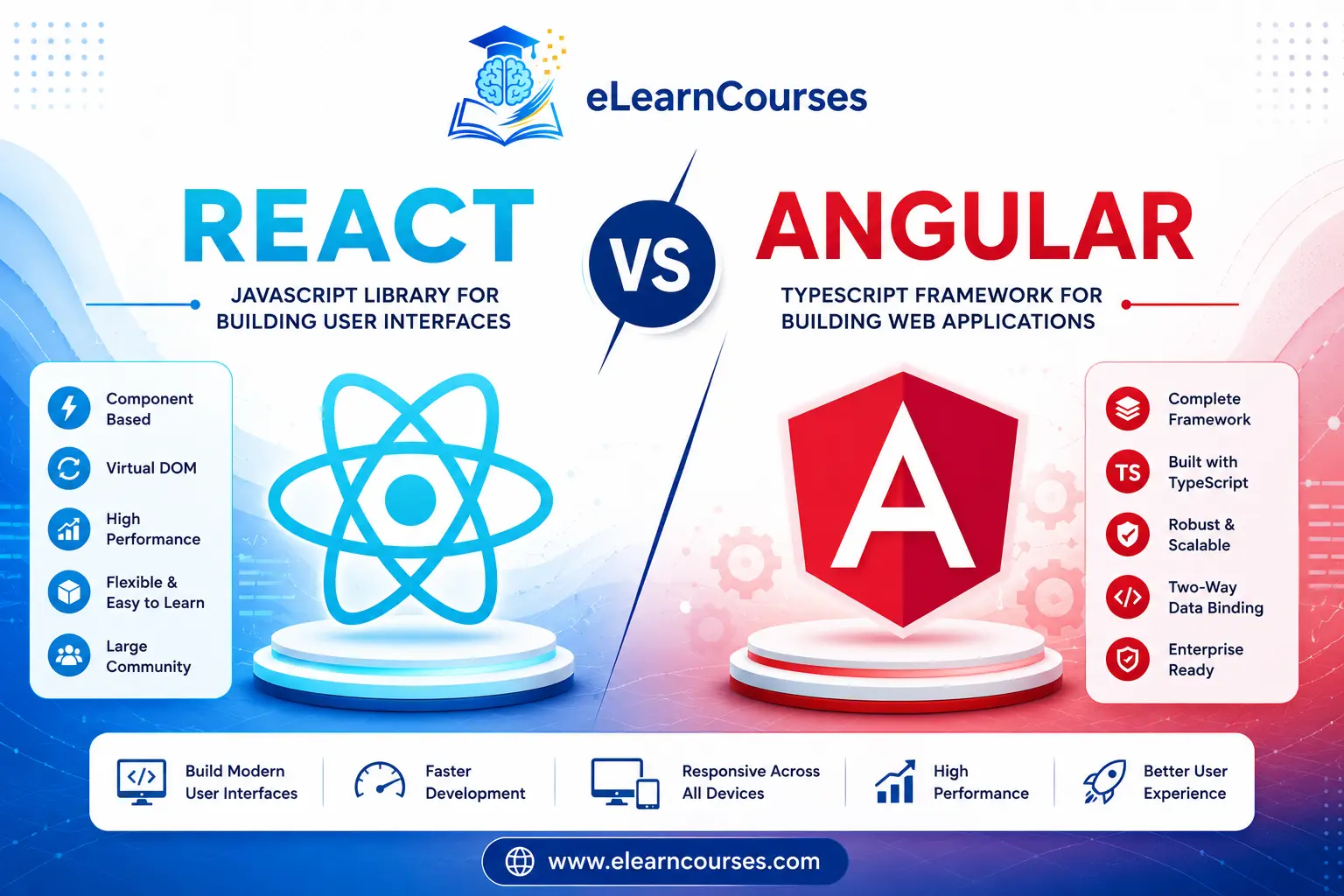
React vs Angular in 2026: Which Framework Should You Choose?
Few debates in web development have stayed as relevant, for as long, as React vs Angular. Both have been core to front-end engineering for over a decade, both are backed by tech giants (Meta for React, Google for Angular), and both have gone through major reinventions to stay competitive heading into 2026. React has doubled down on server-side rendering and compiler-driven performance. Angular has undergone what many developers are calling a genuine renaissance, powered by Signals, zoneless change detection, and a much friendlier developer experience than the Angular of five years ago.
So which one should you actually learn, or choose for your next project? The honest answer is that there’s no universal winner — but there is a right answer for your specific situation. This guide breaks down React and Angular across architecture, performance, learning curve, ecosystem, job market, and salary, so you can make that call with real data instead of guesswork.
React vs Angular at a Glance
| React | Angular | |
|---|---|---|
| Type | UI library | Full framework |
| Backed by | Meta | |
| Language | JavaScript (TypeScript optional) | TypeScript (built-in) |
| Data binding | One-way | Two-way |
| Learning curve | Gentler | Steeper |
| Best for | Startups, fast iteration, flexible stacks | Enterprise, large teams, structured codebases |
| Job market size | Larger, broader | Smaller, more enterprise-concentrated |
| 2026 direction | React Compiler, Server Components, Next.js | Signals, zoneless rendering, standalone components |
Keep this table as a mental map — the sections below unpack exactly why each of these differences matters in practice.
What Is React?
React is a JavaScript library for building user interfaces, originally created by Meta (then Facebook) and first released in 2013. Unlike a full framework, React deliberately focuses on one job: rendering UI components efficiently. Routing, state management, form handling, and API communication are all left to the developer to choose — usually by pairing React with libraries like React Router, Redux or Zustand, and increasingly, meta-frameworks like Next.js that bundle these decisions together.
This “bring your own stack” philosophy is both React’s biggest strength and its biggest source of complaints. Teams get to build exactly the stack they need, but that also means two React codebases at different companies can look almost nothing alike architecturally. In 2026, the React ecosystem has matured enough that this is less chaotic than it used to be — Next.js has become the de facto standard for a large share of new React projects, and the React Compiler (which automatically optimizes re-renders) has removed a lot of the manual performance tuning that used to be required.
What Is Angular?
Angular is a complete, opinionated front-end framework developed and maintained by Google, built entirely on TypeScript. Unlike React, Angular ships with nearly everything a large application needs out of the box: routing, dependency injection, form validation, HTTP client tooling, internationalization, and a full testing setup. This “batteries included” approach is intentional — Angular was designed from the start for large engineering organizations that need consistency across many teams and many years of maintenance.
Angular’s evolution over the past few versions has been significant. The introduction of Signals gives Angular a fine-grained reactivity model similar in spirit to what makes React and Vue feel fast, while standalone components have removed much of the boilerplate that made older Angular projects feel heavy. Zoneless change detection — now available in recent versions — further shrinks bundle size and improves runtime performance by removing Angular’s dependency on Zone.js for tracking changes. The net effect is that modern Angular feels considerably lighter and faster than the framework’s reputation from several years ago.
Architecture & Philosophy
The core difference between React and Angular comes down to one sentence: React is a library, Angular is a framework. Every other comparison point in this guide flows from that distinction.
Because React only handles the view layer, teams have to make architectural decisions — which router, which state management approach, how to structure folders, how to handle side effects. This gives experienced teams enormous flexibility, but it also means two developers coming from different React shops may need real onboarding time to adjust to a new codebase’s conventions.
Angular’s opinionated structure removes most of these decisions. Routing, HTTP calls, forms, and dependency injection all follow patterns defined by the framework itself. For a solo developer or small startup, this can feel restrictive. For a 50-person engineering org building a decade-long enterprise application, it’s often exactly what you want — new hires can move between Angular teams and recognize the architecture almost immediately.
Performance Comparison
Performance conversations between React and Angular used to have a fairly clear conclusion — React’s virtual DOM and reconciliation model generally outperformed older versions of Angular’s change detection, especially on complex, highly interactive UIs. That gap has narrowed substantially in 2026.
React’s advantages now center on React Server Components, which let large portions of an app render on the server and ship less JavaScript to the browser, and the React Compiler, which automatically memoizes components without developers needing to hand-optimize with useMemo and useCallback. For content-heavy applications, this typically translates to faster initial page loads and better Time to Interactive scores.
Angular’s response has been just as significant. Zoneless change detection removes a major source of unnecessary re-renders, and Signals allow for much more granular updates — only the specific piece of UI tied to a changed value re-renders, rather than larger component subtrees. For data-heavy dashboards and enterprise applications with deeply nested component trees, this has closed much of the performance gap that used to favor React.
In practical terms: for most real-world applications in 2026, raw framework performance is no longer the deciding factor it once was. Both frameworks, used well, can deliver fast, responsive applications. The bigger performance differentiator now tends to be how disciplined a team is about following best practices, not which framework they picked.
Learning Curve
This is one of the clearest, most consistent differences between the two frameworks, and it holds up across nearly every source that compares them.
React has a gentler on-ramp, especially for developers who already know JavaScript. You can build a functional React component in an afternoon, and the mental model — components, props, state — is relatively intuitive. The complexity in React tends to show up later, once you need to make architectural decisions about state management, routing, and data fetching patterns that the library itself doesn’t dictate.
Angular asks for more upfront investment. TypeScript is mandatory (a plus for teams that want type safety, a hurdle for developers who haven’t used it before), and concepts like dependency injection, RxJS observables, and Angular’s module/component lifecycle take real time to internalize. Developers moving from React to Angular frequently describe the first few weeks as a steep climb — but also report that the structure pays off once a project grows past a certain size.
A commonly cited pattern across hiring data backs this up: React developers tend to onboard onto new codebases within two to four weeks, while Angular onboarding for developers new to the framework often takes four to eight weeks. That said, once ramped up, Angular’s consistency across projects can actually reduce long-term confusion, particularly on large teams.
Data Binding: One-Way vs Two-Way
React uses one-way (unidirectional) data binding — data flows from parent components down to children via props, and updating the UI means updating the underlying state, which then re-renders the relevant components. This model is predictable and makes it easier to trace where a bug originated, since data only flows in one direction.
Angular supports two-way data binding, most visibly through its [(ngModel)] syntax, which lets changes in the UI automatically update the underlying model and vice versa. This can significantly reduce boilerplate for form-heavy applications — a big reason Angular remains popular for internal enterprise tools and admin dashboards packed with forms. The tradeoff is that two-way binding can make data flow harder to trace in very large applications if it isn’t used carefully.
Neither approach is objectively better; they simply optimize for different things. One-way binding optimizes for predictability and debuggability at scale. Two-way binding optimizes for developer speed on form-heavy, CRUD-style applications.
State Management: React vs Angular
State management is one of the areas where the “library vs framework” divide shows up most clearly in day-to-day development.
React doesn’t ship an official state management solution, which means teams choose based on project size and complexity. Small to mid-sized projects often get by with React’s built-in useState and useContext hooks. Larger applications typically reach for dedicated libraries — Redux Toolkit remains a common choice for complex, enterprise-scale state, while lighter alternatives like Zustand or Jotai have gained significant traction for teams that want less boilerplate. Server state (data fetched from APIs) is increasingly handled separately from UI state, often with a library like TanStack Query, which manages caching, refetching, and loading states without polluting your global store.
Angular takes a more built-in approach. Services combined with dependency injection have traditionally handled shared state, while RxJS Observables manage asynchronous data streams. With the introduction of Signals, Angular now has a lighter-weight, more React-like way to manage reactive state without needing to reach for RxJS for every piece of local component state — a change that many developers say has meaningfully reduced Angular’s historical reputation for boilerplate-heavy state handling.
The practical difference: React developers will likely need to learn and choose a state management library at some point in their careers, while Angular developers are more likely to work within patterns the framework itself provides. Neither is inherently harder — it’s a question of whether you prefer making that choice yourself or having it made for you.
Ecosystem & Tooling
React’s ecosystem is, by a wide margin, the larger of the two. The 2025 Stack Overflow Developer Survey shows Node.js and React leading web framework usage among professional developers, and React’s npm download numbers dwarf Angular’s by a significant multiple. This translates into a much larger pool of third-party libraries, tutorials, Stack Overflow answers, and AI-assistant training data — which matters more than it might seem, since most large language model coding assistants have far more React examples to draw from than Angular ones.
Angular’s ecosystem is smaller but more centralized. Because routing, forms, HTTP, and testing are all part of the official framework rather than community packages, there’s less fragmentation — you’re rarely choosing between five competing libraries for the same job, the way you might be in React. NestJS, a popular Node.js backend framework, borrows heavily from Angular’s architecture, which makes the transition between Angular front-end and NestJS back-end development smoother for full-stack teams already comfortable with Angular’s patterns.
For learning resources and community support, React’s larger community generally means faster answers to common problems. For long-term architectural consistency, Angular’s centralized ecosystem tends to reduce the “dependency hell” that can accumulate in large React codebases over several years.
Tooling is another area worth a quick mention. Angular ships with the Angular CLI, which handles project scaffolding, testing setup, and build configuration in one integrated tool — a big part of why Angular projects tend to look structurally similar to each other. React’s tooling landscape used to be more fragmented (remember manually configuring Webpack?), but that’s largely been resolved by frameworks like Next.js and build tools like Vite, which now handle most of the configuration work that used to be a common pain point for React beginners.
Scalability for Enterprise Projects
Both frameworks are proven at enterprise scale — this isn’t a case of one being “enterprise-ready” and the other not. The difference is in what kind of enterprise use case each tends to fit best.
Angular’s enterprise footprint is substantial. It powers internal tooling at Google itself, parts of Microsoft’s Azure Portal and Office 365 web applications, and is particularly dominant in regulated industries like banking and government, where consistency, auditability, and long-term maintainability outweigh the value of rapid iteration. Angular is also notably strong in the European enterprise market, with especially heavy adoption in Germany.
React’s enterprise adoption has grown substantially too, particularly for products where UI iteration speed and design flexibility matter more than enforced structure — consumer-facing platforms, SaaS products, and e-commerce experiences where the front end changes frequently based on user testing and business needs. Because a much larger share of Fortune 500 companies now build customer-facing products with React (often via Next.js), it has become just as “enterprise-proven,” just for a different category of application.
The practical takeaway: if you’re building a large, long-lived internal system with many contributors over many years, Angular’s enforced structure is often a genuine advantage. If you’re building a customer-facing product where the UI needs to evolve quickly based on user feedback, React’s flexibility tends to serve teams better.
Job Market & Salary Comparison
If you’re choosing a framework partly based on career prospects, the job market data is fairly consistent across sources, even though exact numbers vary depending on which job board or survey you check.
Job volume: React has a significantly larger number of open positions globally — commonly cited job-board data puts React postings at roughly two to two-and-a-half times the volume of Angular postings in markets like the United States. This gap is partly a function of React’s larger overall adoption and partly because bootcamps, universities, and online courses over-index heavily on teaching React, which feeds more developers into the React job pipeline.
Salary: This is where it gets more interesting — the pay gap between the two is much smaller than the job-volume gap would suggest, and in some data sets, Angular developers command a slight premium. This is largely a supply-and-demand dynamic: because fewer developers specialize in Angular, companies that specifically need it (often large enterprises with bigger budgets) sometimes pay a premium to secure that talent. Different salary platforms report different exact figures, but the consistent pattern across most sources is that React and Angular developers land in a broadly similar overall pay band, with regional and seniority differences mattering more than the framework choice itself.
Regional differences: Angular maintains a notably stronger foothold in European enterprise markets, particularly Germany, and in government or defense-adjacent contracting work — sectors that tend to value long-term stability over rapid iteration. React’s job market strength is more geographically even, with particularly deep demand in startup-heavy hubs and consumer tech companies worldwide.
If your priority is maximizing the number of available job opportunities, React currently has the numbers advantage. If you’re comfortable with a narrower but often well-compensated niche — particularly if you’re open to enterprise, government, or European employers — Angular remains a solid, sometimes underrated bet.
Mobile Development: A Secondary Consideration
If mobile app development is part of your longer-term plans, this is worth factoring in. React’s ecosystem extends naturally into mobile through React Native, which lets you reuse a large portion of your React knowledge (and in some cases, actual code) to build native iOS and Android apps. This cross-platform overlap is a significant reason some companies standardize on React across their entire product — the same engineers can move between web and mobile work with a shorter ramp-up period.
Angular doesn’t have an equivalent first-party mobile framework, though Ionic (which can be used with Angular) provides a way to build cross-platform mobile apps using web technologies. It’s a capable option, but it doesn’t have the same native-performance reputation or ecosystem momentum as React Native. If cross-platform mobile development is a priority for your team, this is one area where React’s advantage is more clear-cut than most of the other comparisons in this guide.
React vs Angular in the Age of AI-Assisted Development
This is a genuinely new axis of comparison that barely existed a few years ago, and it’s worth addressing directly given how much AI-assisted coding has changed day-to-day development in 2026.
React currently has an edge here, mostly for ecosystem reasons rather than any technical advantage. Because React has such a larger volume of public code, tutorials, and documentation, AI coding assistants tend to generate more accurate, idiomatic React code with less back-and-forth correction. React’s component-based structure — small, composable, relatively self-contained pieces — also tends to map cleanly onto how AI tools generate and modify code in isolated chunks.
Angular isn’t at a fundamental disadvantage here, but AI-assisted output for Angular projects sometimes needs more correction, particularly around Angular-specific patterns like dependency injection and module structure that are less commonly represented in AI training data compared to React examples. That said, for large-scale systems where consistency matters more than raw iteration speed, some teams report that Angular’s stricter structure actually makes it easier to review and validate AI-generated code, since deviations from the expected pattern are easier to spot.
When to Choose React
React tends to be the stronger choice if:
- You’re building a startup product or MVP where speed of iteration matters more than architectural rigidity
- Your team wants the flexibility to choose its own state management, routing, and styling approach
- You’re building a consumer-facing product where the UI will change frequently based on user feedback
- You want the largest possible pool of candidates when hiring
- You’re planning to use AI coding assistants heavily and want the smoothest possible experience
- You’re interested in cross-platform mobile development via React Native down the line
When to Choose Angular
Angular tends to be the stronger choice if:
- You’re building a large, long-lived enterprise application maintained by many developers over many years
- Your organization values enforced consistency and architectural conventions over creative flexibility
- You’re working in a regulated industry (finance, healthcare, government) where auditability and predictability matter
- Your team is already comfortable with TypeScript and appreciates strong typing throughout the stack
- You’re targeting the European enterprise market, where Angular remains especially strong
- You want fewer third-party dependency decisions and a more centralized, “it just works” toolset
How to Start Learning React or Angular
Whichever framework you choose, the path to genuine proficiency looks similar: strong JavaScript fundamentals first, then framework-specific concepts, then real projects that force you to make architectural decisions rather than just following a tutorial.
If you’re starting from scratch, a structured web development course that covers core JavaScript before introducing a framework will save you a lot of confusion later — most of the difficulty people run into with React or Angular actually traces back to shaky JavaScript fundamentals, not the framework itself. From there, browsing development courses or the JavaScript course category is a good way to find a structured next step rather than piecing together scattered tutorials.
A realistic learning sequence for either framework looks like this:
- Solidify core JavaScript — closures, async/await, array methods, and the DOM.
- Learn TypeScript basics — essential for Angular, increasingly common in professional React codebases too.
- Build 2–3 small projects in your chosen framework — a to-do app is fine as a first step, but push yourself toward something with real data fetching and state complexity.
- Learn the surrounding ecosystem — for React, that means a router and a state management approach (or Next.js); for Angular, that means getting comfortable with RxJS and the Angular CLI.
- Contribute to or review a larger, real-world codebase — this is usually where the architectural lessons that tutorials can’t teach actually click.
FAQs About React vs Angular
Is React or Angular better for beginners? React generally has a gentler learning curve, especially for developers who already know JavaScript, making it a common recommendation for people just entering front-end development.
Which pays more, React or Angular? Overall pay bands are broadly similar between the two. Angular sometimes commands a modest premium in specific enterprise and regulated-industry contexts due to a smaller talent pool, while React offers a much larger volume of job opportunities overall.
Is Angular dying or losing relevance? No. While React holds a larger share of overall usage, Angular remains heavily used in enterprise, government, and European markets, and recent versions with Signals and zoneless rendering represent a significant modernization rather than stagnation.
Can I learn both React and Angular? Yes, and many experienced front-end developers do over the course of their careers. It’s generally more effective to build real proficiency in one framework first before adding the second, since the underlying JavaScript and component-thinking skills transfer between them.
Does React or Angular work better with AI coding tools? React currently has an edge here, mainly because of the much larger volume of React code and documentation that AI models have been trained on, which tends to produce more accurate suggestions with less manual correction.
Is Angular only for large companies? Not exclusively, but Angular’s structure and built-in tooling tend to provide the most value on larger, longer-lived projects. Smaller projects or MVPs often find Angular’s opinionated setup more overhead than they need.
Do I need to know TypeScript for React and Angular? TypeScript is mandatory for Angular but optional for React, though it’s become the de facto standard in most professional React codebases as well. Learning TypeScript alongside either framework is a safe long-term investment either way.
Which framework is easier to hire for? React is generally easier to hire for simply because of the larger talent pool and higher volume of active job seekers with React experience. Angular hiring can take longer, particularly for senior roles, but the smaller candidate pool is often offset by candidates having more consistent, enterprise-relevant experience.
Conclusion: Which Should You Learn in 2026?
There’s a reason this debate hasn’t been settled after a decade — both frameworks are excellent at what they’re designed to do, and the “right” choice depends entirely on context rather than one framework being objectively superior.
If you’re a newer developer optimizing for the broadest job market, the gentlest learning curve, and the smoothest experience working alongside AI coding tools, React is the safer starting point in 2026. If you’re aiming for enterprise, government, or European employers, or you simply prefer a framework that makes more architectural decisions for you, Angular remains a strong, often underrated choice — and its recent evolution with Signals and zoneless rendering means you’re no longer trading away performance to get that structure.
The most future-proof approach, if you have the time, is to get genuinely comfortable with one framework first — ideally by building something real, not just following tutorials — and treat the second framework as a faster, easier pickup once your core JavaScript and component-thinking skills are solid. Framework syntax changes; the underlying engineering judgment about state, structure, and performance is what actually carries your career forward.