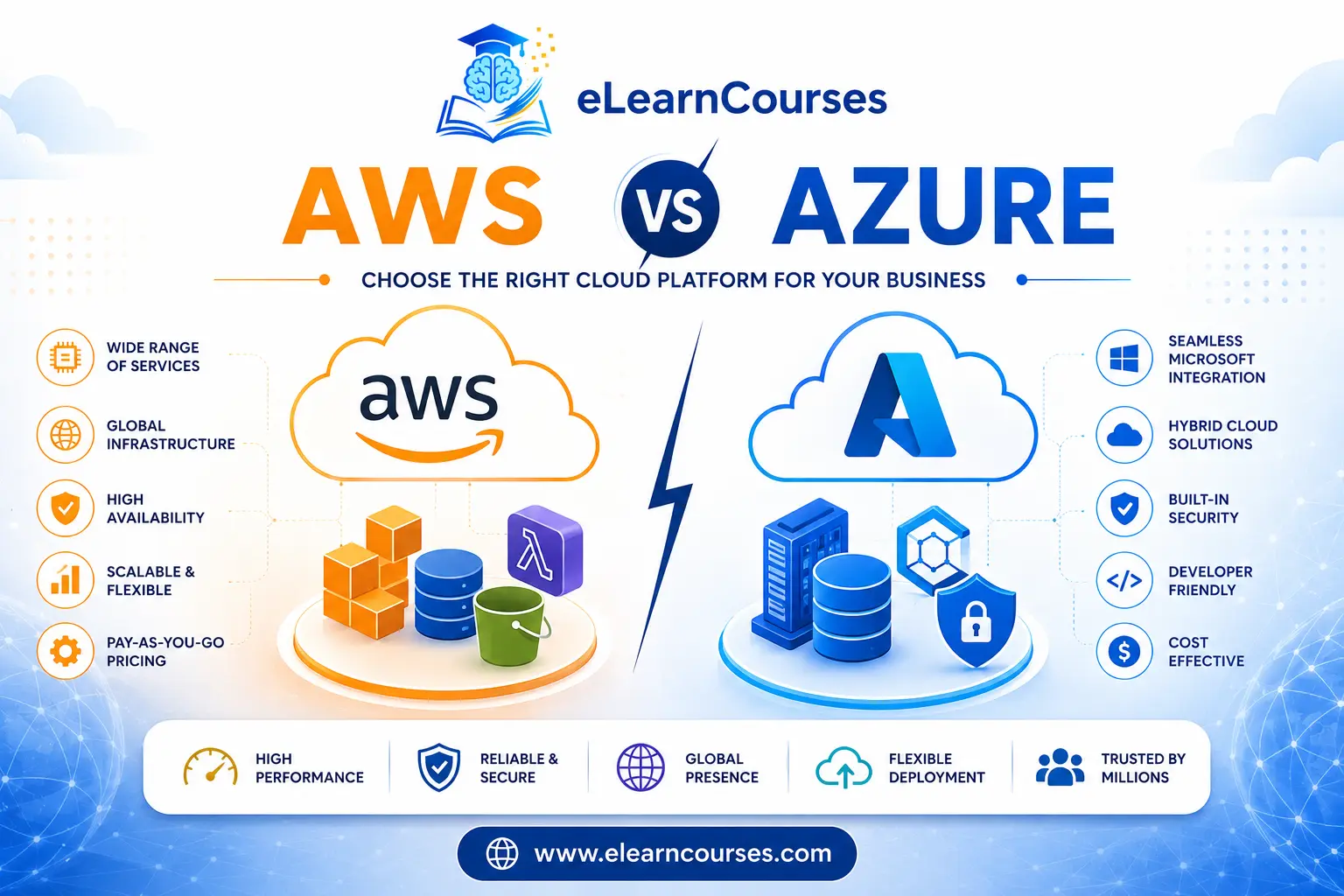
AWS vs Azure 2026: Which Cloud Platform Should You Choose?
Cloud computing decisions used to be simpler: AWS was the default, and everyone else was playing catch-up. That’s no longer the full story. Microsoft Azure has spent the last several years closing the gap, driven by deep enterprise relationships, an exclusive OpenAI partnership, and aggressive growth in AI-related cloud spending. AWS still leads on raw market share and service breadth, but the margin has narrowed to its smallest point in over a decade.
Whether you’re choosing a platform for your career, evaluating cloud providers for a company migration, or just trying to cut through marketing noise, this guide breaks down AWS vs Azure across market share, pricing, core services, AI capabilities, security, certifications, and job market data — using current 2026 figures rather than outdated assumptions.
AWS vs Azure at a Glance
| AWS | Azure | |
|---|---|---|
| Parent company | Amazon | Microsoft |
| Global market share (2026) | ~28–31% | ~21–25% |
| Year-over-year growth | ~18–19% | ~30–40% |
| Best known for | Service breadth, DevOps maturity, startup adoption | Enterprise integration, hybrid cloud, Microsoft 365 tie-in |
| Compute service | EC2 | Virtual Machines |
| Serverless | Lambda | Azure Functions |
| Storage | S3 | Blob Storage |
| Kubernetes | EKS | AKS |
| Government cloud | AWS GovCloud | Azure Government |
| Flagship AI partnership | Anthropic (Claude via Bedrock) | OpenAI (GPT models) |
Keep in mind that market share estimates vary depending on which research firm you check — Synergy Research, Canalys, and Statista don’t always agree on exact percentages — but the general ranking and trend direction are consistent across all of them.
What Is AWS?
Amazon Web Services launched in 2006 and has held the position of market leader ever since, largely because it got there first. AWS now offers more than 200 distinct services covering compute, storage, databases, networking, machine learning, IoT, and more — the broadest catalog of any cloud provider. This breadth is one of AWS’s defining characteristics: if a cloud service exists as a concept, there’s a good chance AWS shipped a version of it before its competitors did.
AWS’s core strengths have remained consistent for years: unmatched global infrastructure footprint, a mature DevOps and automation ecosystem, and the largest partner and third-party integration network in the industry. In 2026, AWS has pushed hard into generative AI with Amazon Bedrock (which offers access to multiple foundation models, including Anthropic’s Claude), continued expanding its sustainability-focused data center initiatives, and launched a European Sovereign Cloud — an EU-only cloud offering built specifically to meet European data residency and compliance requirements.
What Is Microsoft Azure?
Microsoft Azure launched in 2010 and has grown into the fastest-growing of the major hyperscalers in percentage terms, consistently posting year-over-year growth well above AWS’s. Azure’s core advantage has never really been about having more services than AWS — it’s about how deeply Azure integrates with the tools most large enterprises already run: Windows Server, Active Directory, Microsoft 365, and the broader Microsoft enterprise software ecosystem.
That integration story has only gotten stronger in 2026. Microsoft’s exclusive partnership with OpenAI means Azure customers get privileged access to GPT-series models through Azure OpenAI Service, which has become a major selling point for enterprises building AI features into existing Microsoft-centric workflows. Azure has also doubled down on hybrid cloud through Azure Arc, and it holds a notably strong position in regulated sectors — Azure Government maintains FedRAMP High certification across more services than AWS currently offers, making it a common default for U.S. federal and defense-adjacent workloads.
Market Share & Growth: Who’s Winning the Cloud Wars in 2026?
The headline numbers depend on the exact quarter and research firm, but the consistent pattern in 2026 looks like this: AWS holds the largest share of global cloud infrastructure spending, generally cited in the 28–31% range, with Azure close behind at roughly 21–25%. Google Cloud rounds out the “Big Three” at around 11–14%, with the remaining share split across Oracle Cloud, IBM Cloud, Alibaba Cloud, and a long tail of smaller and regional providers.
What makes 2026 different from a few years ago is the growth trend underneath those numbers. AWS’s year-over-year growth has slowed to somewhere in the high-teens percentage range, while Azure has posted growth rates in the 30–40% range for multiple consecutive quarters — driven heavily by AI infrastructure demand and enterprise cloud migrations. If that growth differential holds, the market share gap between the two will likely keep narrowing, even if AWS retains the top spot for the foreseeable future.
It’s worth noting this isn’t really a zero-sum fight. Total global cloud infrastructure spending has grown dramatically — from roughly a tenth of its current size a decade ago to well over $500 billion in annualized run-rate by early 2026 — meaning both providers are growing in absolute revenue even as their relative shares shift.
Compute & Core Services Compared
At the compute level, AWS EC2 and Azure Virtual Machines are functionally similar — both let you provision virtual servers with a wide range of CPU, memory, and GPU configurations. The differences show up more in surrounding tooling and pricing structure than in raw capability.
Serverless computing: AWS Lambda and Azure Functions both let you run code without managing servers, triggered by events like file uploads or API calls. AWS Lambda has the larger ecosystem of integrations and community examples, simply due to AWS’s longer head start and broader adoption. Azure Functions integrates especially well if you’re already using other Azure or Microsoft 365 services in your workflow.
Containers and Kubernetes: AWS offers ECS (a proprietary container orchestration service) and EKS (managed Kubernetes), while Azure’s equivalent is AKS (Azure Kubernetes Service). Both platforms offer solid managed Kubernetes experiences in 2026, though Azure’s free Kubernetes control plane is a genuine cost advantage over AWS’s EKS pricing model for teams running many smaller clusters.
Storage: AWS S3 remains the industry-standard reference point for object storage — so common that many third-party tools and other cloud providers describe their own storage services as “S3-compatible.” Azure’s equivalent, Blob Storage, is fully capable and, notably, priced lower than S3 in most regions, making it an attractive option for storage-heavy workloads.
Networking and content delivery: AWS’s global network backbone and CloudFront CDN have a longer track record and a larger number of edge locations in most rankings, which can translate to marginally better latency for globally distributed audiences. Azure’s networking stack, built around Azure Virtual Network and Azure CDN, has closed much of this gap in recent years, particularly in regions where Microsoft has invested heavily in new data center buildouts. For most applications, the practical latency difference between the two is small enough that other factors — like where your existing infrastructure or team expertise sits — should carry more weight in the decision.
Pricing: Where Each Platform Wins
Pricing comparisons between AWS and Azure resist simple headlines because the “right” answer depends heavily on your specific workload, region, and commitment level. That said, a few consistent patterns show up across cost analyses in 2026:
- General-purpose compute: On-demand pricing for standard Linux virtual machines is broadly comparable between the two platforms, with the actual winner often coming down to specific instance-type promotions or reserved-capacity discounts available at the time.
- Object storage: Azure Blob Storage tends to run somewhat cheaper than AWS S3 for standard tiers, which can add up meaningfully for storage-heavy applications.
- Windows workloads: Azure has a clear structural advantage here through Azure Hybrid Benefit, which lets organizations apply existing on-premises Windows Server and SQL Server licenses toward Azure costs — a discount AWS can’t fully replicate for customers already invested in Microsoft licensing.
- Kubernetes control plane: Azure’s AKS control plane is free, while AWS charges a per-cluster fee for EKS — a small but real advantage for teams running many clusters.
- Commitment discounts: Both platforms offer substantial discounts (often 30–70%) for reserved instances or committed-use pricing versus pure on-demand rates, so real-world enterprise costs often look very different from the sticker-price comparisons you’ll see in most online cost calculators.
The practical takeaway: don’t pick a provider based on a single cost benchmark you saw in an article (including this one). Run pricing calculators against your actual expected workload, and factor in any existing licensing agreements, since those can shift the math significantly in either direction.
AI & Machine Learning Capabilities
AI has become the single biggest battleground between the major cloud providers in 2026, and both AWS and Azure have made it central to their strategy.
AWS’s flagship AI offering is Amazon Bedrock, a managed service that gives developers API access to multiple foundation models from different providers — including Anthropic’s Claude — without needing to manage the underlying infrastructure. This multi-model approach lets AWS customers choose the best model for a given task rather than being locked into a single vendor’s model family. AWS also offers Amazon SageMaker for building, training, and deploying custom machine learning models, plus a range of pre-built AI services for tasks like image recognition (Rekognition) and conversational agents (Lex).
Azure’s core AI advantage is its exclusive partnership with OpenAI, giving Azure customers privileged, enterprise-grade access to GPT-series models through Azure OpenAI Service. For organizations already standardized on Microsoft’s ecosystem, this integration extends naturally into tools like Microsoft 365 Copilot and Power Platform, creating a more unified AI story across both infrastructure and productivity software than AWS currently offers.
Neither approach is objectively superior — it largely comes down to whether your organization wants model flexibility (AWS’s multi-model approach) or the deepest possible integration with an existing Microsoft software investment (Azure’s OpenAI partnership).
Security, Compliance & Government Cloud
Both platforms maintain extensive compliance certifications and take a shared-responsibility approach to security, where the provider secures the underlying infrastructure and customers are responsible for securing their own data, applications, and configurations. In practice, most cloud security incidents trace back to customer-side misconfiguration rather than a flaw in either platform’s core infrastructure.
Where the two diverge more clearly is government and regulated-industry cloud. Azure Government holds FedRAMP High certification across a broader range of services than AWS currently offers, and Microsoft’s long-standing relationships with U.S. federal agencies make Azure the more common procurement choice for defense and intelligence-adjacent workloads. AWS has responded by launching its own European Sovereign Cloud — an EU-only, independently operated cloud region designed to meet strict European data residency and compliance requirements, achieving certifications like SOC 2 and Germany’s C5 standard at launch.
For organizations in heavily regulated industries — banking, healthcare, government contracting — it’s worth evaluating both platforms’ current certification status directly rather than relying on general reputation, since compliance offerings shift fairly often as both providers compete for regulated workloads.
Identity and access management is another area worth understanding before you commit to a platform, since misconfigured permissions are the most common source of real-world cloud breaches on either provider. AWS IAM (Identity and Access Management) and Azure Active Directory (now part of Microsoft Entra ID) both let you define granular, role-based access controls, but Azure’s identity tooling has a natural advantage for organizations already using Microsoft Entra ID for their broader corporate identity management, since it extends the same identity layer across cloud resources, Microsoft 365, and on-premises systems without needing a separate synchronization setup.
Hybrid & Multi-Cloud Support
Hybrid cloud — combining on-premises infrastructure with public cloud resources — is where Azure has built a genuinely strong reputation. Azure Arc extends Azure’s management tools to resources running anywhere, including on-premises servers, other clouds, and edge locations, giving organizations a single control plane even across a mixed environment. Combined with Azure Hybrid Benefit for licensing, this makes Azure a particularly comfortable choice for enterprises with significant existing on-premises Windows infrastructure that aren’t ready for a full cloud migration.
AWS’s equivalent, AWS Outposts, brings AWS infrastructure and services into a customer’s own data center, but it’s generally seen as a less mature hybrid offering than Azure Arc, particularly for organizations with a large existing Windows Server footprint.
Multi-cloud adoption itself has become close to the norm rather than the exception — a large majority of enterprises now report running workloads across more than one cloud provider, whether by deliberate strategy or simply through accumulated technical debt from acquisitions and different teams making independent choices over time. This is one more reason the “AWS vs Azure” framing is often less binary in practice than it appears in comparison articles — many organizations end up using both, for different workloads.
Kubernetes & DevOps Tooling
For teams building containerized applications, both platforms offer mature, production-ready managed Kubernetes services — EKS on AWS and AKS on Azure. AKS’s free control plane gives it a cost edge for smaller clusters, while EKS benefits from AWS’s broader ecosystem of complementary DevOps tools and community tutorials, simply due to AWS’s larger overall market share and longer track record.
On the CI/CD and infrastructure-as-code side, both ecosystems support the major cross-platform tools — Terraform, GitHub Actions, GitLab CI — meaning your choice of cloud provider doesn’t lock you into a particular DevOps toolchain the way it might have a decade ago. AWS’s CodePipeline and CodeBuild, and Azure’s DevOps suite (Azure Pipelines, Azure Repos), remain popular native options for teams that want a single-vendor DevOps stack tightly integrated with their cloud provider.
Certifications & Career Paths
Both AWS and Azure maintain extensive, multi-tier certification programs recognized by employers globally, and both open doors to some of the highest-paying roles in IT.
AWS certification highlights:
- AWS Certified Cloud Practitioner (entry-level)
- AWS Certified Solutions Architect – Associate (the most commonly requested AWS certification in job postings)
- AWS Certified Solutions Architect – Professional
- AWS Certified DevOps Engineer, Security Specialty, and Machine Learning Specialty for more focused career tracks
Azure certification highlights:
- Azure Fundamentals (AZ-900)
- Azure Administrator Associate (AZ-104)
- Azure Solutions Architect Expert (AZ-305) — widely considered Azure’s top career-impact certification
- Azure Security Engineer Associate (AZ-500), increasingly valuable given tightening regulatory requirements in Europe (NIS2, DORA) and elsewhere
A common piece of advice across career guides in 2026: if you’re starting from zero and want the broadest set of job opportunities, AWS certifications currently have a larger job-posting footprint. If you already work inside a Microsoft-centric organization, or you’re targeting enterprise and government employers specifically, starting with Azure certifications often makes more practical sense. Many experienced cloud professionals eventually pursue certifications on both platforms, since multi-cloud skills increasingly command a real salary premium.
Job Market & Salary Comparison
Job volume: AWS consistently shows a larger number of open positions globally, reflecting its larger overall market share and longer head start. Azure job postings have grown quickly, particularly in enterprise-heavy markets, but AWS still leads in total volume in most regions and job boards as of 2026.
Salary: This is genuinely close between the two platforms, and the gap has been shrinking for years. Multiple 2026 salary analyses put AWS-certified professionals slightly ahead on average — commonly cited in the range of 2–10% higher depending on the specific report and role — but the difference has narrowed significantly compared to a few years ago, and Azure professionals in Microsoft-centric enterprise environments sometimes out-earn their AWS counterparts in the same market.
Multi-cloud premium: Across nearly every salary report, one pattern holds consistently: professionals certified in both AWS and Azure earn meaningfully more than single-platform specialists — commonly cited premiums in the range of $15,000–$20,000 or more annually in the U.S. market. If long-term earning potential is your primary goal, becoming genuinely proficient in both platforms tends to pay off more than debating which single platform is “better.”
Regional patterns: AWS tends to dominate among startups and cloud-native tech companies, while Azure holds a stronger position in traditional enterprises, government contracting, and Microsoft-centric organizations. This split shows up clearly in Europe, where Azure has a particularly strong foothold in enterprise environments, partly driven by tightening regional compliance requirements.
Real-World Use Cases: Who Uses AWS vs Azure?
Looking at how each platform is actually used in production tends to clarify the decision better than any feature checklist.
AWS’s customer base skews toward cloud-native companies and consumer tech platforms that scaled up alongside AWS itself — streaming services, e-commerce platforms, and a large share of the startup and scale-up world default to AWS, partly because so much modern DevOps tooling, tutorials, and hiring pipelines are built around it. AWS is also heavily used for data-intensive and AI/ML workloads, given the breadth of managed services like SageMaker and the multi-model flexibility of Bedrock.
Azure’s customer base leans more heavily toward large, established enterprises that were already running Microsoft software before moving to the cloud — organizations in banking, insurance, manufacturing, and government where Windows Server, Active Directory, and Microsoft 365 were already core infrastructure. For these organizations, Azure often represents a natural extension of tools their IT teams already understand deeply, rather than an entirely new platform to learn from scratch. Azure has also become the go-to choice for organizations building AI features specifically on top of OpenAI’s models, given Microsoft’s exclusive partnership.
Neither pattern is a hard rule — plenty of large enterprises run substantial AWS workloads, and plenty of startups choose Azure for specific technical or relationship reasons — but the general skew helps explain why job postings, salary data, and hiring patterns differ the way they do between the two platforms.
When You Might Not Need to Choose At All
Given how common multi-cloud adoption has become, it’s worth stepping back and asking whether “AWS vs Azure” is even the right framing for your specific situation. Many organizations end up running workloads on both platforms — not through a grand unified strategy, but because different teams, acquisitions, or legacy decisions accumulated over time. If you’re an individual developer or IT professional rather than someone making a company-wide infrastructure decision, this actually works in your favor: building competence in one platform doesn’t close the door on the other, and the job market increasingly rewards people comfortable moving between both rather than treating the choice as permanent.
When to Choose AWS
AWS tends to be the stronger choice if:
- You want the broadest possible service catalog and the largest ecosystem of third-party tools and integrations
- You’re building a startup or cloud-native product without significant existing enterprise software investments
- You want maximum job market volume when building your cloud career
- You need flexibility across multiple AI model providers rather than a single vendor’s model family
- Your team already has strong AWS or general cloud-native DevOps expertise
When to Choose Azure
Azure tends to be the stronger choice if:
- Your organization already runs heavily on Microsoft tools — Windows Server, Active Directory, Microsoft 365
- You need deep hybrid cloud capability alongside significant existing on-premises infrastructure
- You’re targeting government, defense, or heavily regulated enterprise employers
- You want the tightest possible integration between cloud infrastructure and OpenAI’s GPT models
- Licensing cost savings through Azure Hybrid Benefit would meaningfully offset your existing Windows Server investment
How to Get Started Learning AWS or Azure
Getting started with either platform follows a similar sequence: understand core cloud concepts first, then get hands-on with the platform’s free tier, then work toward your first certification.
If you’re brand new to cloud computing, a structured AWS tutorial covering core services like EC2, S3, Lambda, and IAM is the most practical starting point before diving into certification study guides. Our broader guide to cloud computing types is also useful groundwork if you’re still deciding between public, private, hybrid, or multi-cloud approaches for a specific project. For data-focused roles specifically, it’s worth exploring how platforms like Snowflake run on top of AWS, Azure, or GCP — a common next step once you’re comfortable with core cloud infrastructure concepts.
A realistic learning path looks like this:
- Learn core cloud concepts — compute, storage, networking, and the shared responsibility model for security.
- Get hands-on with the free tier — both AWS and Azure offer free-tier access to core services, which is the fastest way to build real, practical familiarity.
- Study for an entry-level certification — AWS Certified Cloud Practitioner or Azure Fundamentals (AZ-900) are the standard starting points for either platform.
- Build a small real project — deploy a simple web app, set up a basic CI/CD pipeline, or configure a storage bucket with proper access controls.
- Progress toward an associate-level certification — AWS Solutions Architect Associate or Azure Administrator Associate, depending on your chosen path.
- Consider the second platform once you’re comfortable — the multi-cloud salary premium makes this a worthwhile long-term goal for most cloud career paths.
FAQs About AWS vs Azure
Which is bigger, AWS or Azure? AWS holds the larger global market share, generally cited in the 28–31% range compared to Azure’s 21–25%, though Azure has been growing faster in percentage terms for several consecutive years.
Which pays more, AWS or Azure certification? The gap is small and has been narrowing for years. Most 2026 data shows AWS-certified professionals earning slightly more on average, but Azure professionals in Microsoft-centric enterprises sometimes earn comparably or more in that specific context.
Is Azure cheaper than AWS? It depends on the workload. Azure tends to be cheaper for object storage and offers free Kubernetes control plane pricing, plus significant licensing discounts for organizations with existing Windows Server investments through Azure Hybrid Benefit. AWS pricing is often comparable or better for general-purpose compute and specific reserved-instance commitments.
Should I learn AWS or Azure first? If you’re optimizing for the broadest job market and don’t have existing ties to a Microsoft-centric environment, AWS is generally the safer first choice. If you already work in or are targeting Microsoft-heavy enterprises or government employers, starting with Azure often makes more practical sense.
Do most companies use both AWS and Azure? Multi-cloud adoption has become extremely common — a large majority of enterprises now report using more than one cloud provider, whether by deliberate strategy or accumulated technical decisions across teams and acquisitions over time.
Is it worth getting certified in both AWS and Azure? For long-term earning potential, yes. Multi-cloud certified professionals consistently earn more than single-platform specialists across salary studies, though it’s generally more effective to build solid proficiency in one platform before starting the second.
Which is easier to learn, AWS or Azure? Neither has a dramatically steeper learning curve overall, though many learners find Azure’s exam content and study materials slightly more approachable for absolute beginners, while AWS’s sheer number of overlapping services (like the differences between SQS, SNS, EventBridge, and Kinesis) can feel overwhelming until you’ve worked with a few of them hands-on.
Does AWS or Azure have better customer support? Both offer tiered support plans ranging from free community-based support to enterprise-level plans with guaranteed response times. Anecdotally, Azure’s support tends to feel more approachable for organizations already working with Microsoft account representatives through other software licensing relationships, while AWS’s support quality is generally considered strong across the board once you’re on a paid support tier.
Conclusion: AWS or Azure in 2026?
The honest answer is that AWS vs Azure isn’t really a “which one wins” question anymore — it’s a question of fit. AWS remains the safer default if you want the broadest service catalog, the largest job market, and the most mature general-purpose cloud-native ecosystem. Azure has built a genuinely compelling case for organizations already invested in Microsoft’s software stack, those operating in regulated or government-adjacent industries, or teams that want the deepest possible integration with OpenAI’s models.
If you’re building a career rather than choosing infrastructure for a specific company, the data points toward a fairly clear long-term strategy: get genuinely proficient in one platform first, since trying to learn both at once tends to produce shallow knowledge of each. But treat the second platform as a real goal rather than an afterthought — the multi-cloud salary premium and growing enterprise reality of running mixed environments make it one of the more reliably good investments in cloud computing right now, regardless of which platform you start with.