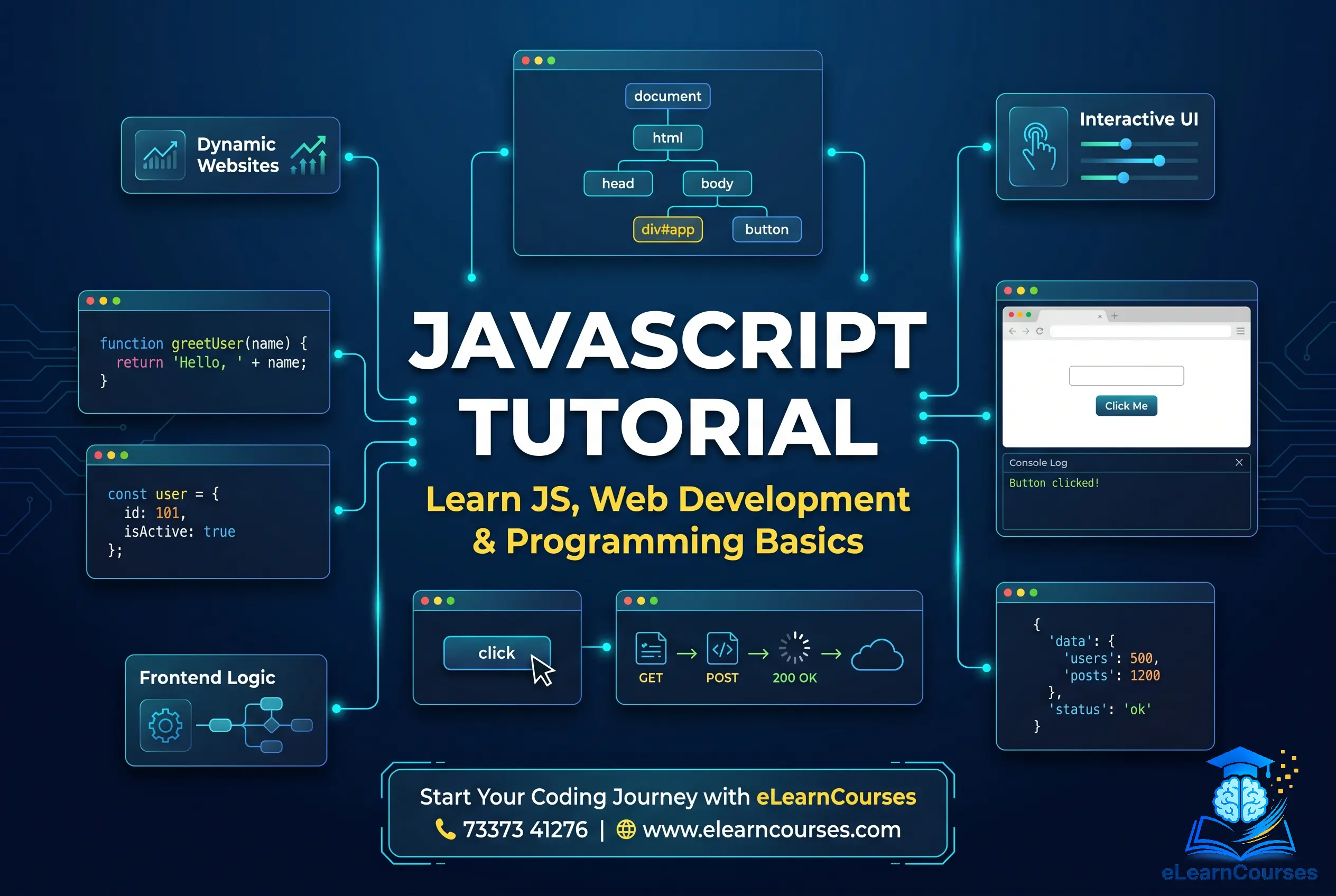
JavaScript Tutorial for Beginners: The Ultimate Proven Guide to Master JavaScript in 2026
If there is one programming language that is truly everywhere — powering the buttons you click, the animations you see, the forms you fill out, and the real-time updates on your screen — it is JavaScript. More than any other language in the world, JavaScript is the language of the web. It runs in every browser, on every device, and increasingly on servers, mobile applications, and even desktop software.
This ultimate JavaScript tutorial is your complete, practical, and beginner-friendly roadmap to mastering JavaScript — one of the most in-demand and versatile programming languages of 2025. Whether you have zero programming experience or are switching from another language, this guide will take you from your first console.log() to building real applications with confidence.
In this JavaScript tutorial, you’ll learn everything: the history and fundamentals of JavaScript, variables and data types, functions and scope, the DOM (Document Object Model), events, ES6+ modern features, object-oriented programming, asynchronous programming with Promises and async/await, error handling, modules, popular frameworks and their use cases, real-world projects, best practices, and a clear career roadmap for 2025.
The JavaScript tutorial you’re about to read is not just theory — every concept is reinforced with real, working code examples you can run immediately in your browser console or code editor.
Let’s write your first line of JavaScript.
What is JavaScript? — The Foundation
JavaScript is a high-level, interpreted, dynamically typed, multi-paradigm programming language originally created by Brendan Eich in just 10 days in May 1995 while working at Netscape Communications. Its original purpose was simple: add interactivity to web pages.
Three decades later, JavaScript has grown into one of the most powerful and ubiquitous programming languages ever created — used for:
- Frontend web development — User interfaces, animations, form validation
- Backend development — Server-side applications via Node.js
- Mobile apps — React Native, Ionic, NativeScript
- Desktop apps — Electron (VS Code, Slack, Discord are built with it)
- Game development — Browser-based games with Canvas and WebGL
- Machine learning — TensorFlow.js, brain.js
- IoT and embedded systems — Johnny-Five framework
JavaScript and Java are completely different languages. They share only the first four letters of their names — a marketing decision made in 1995 to capitalize on Java’s popularity at the time. JavaScript is dynamically typed and runs in browsers; Java is statically typed and runs on the JVM. They have different syntax, different paradigms, and entirely different ecosystems.
The JavaScript EngineJavaScript code doesn’t compile to machine code in advance — it runs in a JavaScript engine that interprets and executes it at runtime:
- V8 — Google’s engine (Chrome, Node.js, Edge)
- SpiderMonkey — Mozilla’s engine (Firefox)
- JavaScriptCore (Nitro) — Apple’s engine (Safari)
Modern engines use Just-In-Time (JIT) compilation to compile JavaScript to optimized machine code at runtime — making JavaScript execution remarkably fast.
ECMAScript — The JavaScript StandardJavaScript follows the ECMAScript (ES) specification maintained by ECMA International. Key versions:
- ES5 (2009) — The baseline;
"use strict", JSON methods - ES6/ES2015 — The game-changer:
let,const, arrow functions, classes, Promises, modules - ES2017 —
async/await - ES2020–2024 — Optional chaining (
?.), nullish coalescing (??), top-level await, and more
This tutorial covers modern JavaScript (ES6+).
Setting Up Your JavaScript Environment
JavaScript requires zero installation to start — every web browser includes a JavaScript engine.
Option 1: Browser Console (Instant Start)- Open any browser (Chrome recommended)
- Press
F12orCtrl+Shift+I(Windows) /Cmd+Option+I(Mac) - Click the Console tab
- Type JavaScript code and press Enter
// Try this in your browser console right now:
console.log("Hello, JavaScript!");
console.log(2 + 2);
console.log(typeof "hello");- Download Visual Studio Code — https://code.visualstudio.com
- Install Node.js — https://nodejs.org (choose LTS version)
- Create a file
app.js - Run with:
node app.js
- CodePen — https://codepen.io (great for HTML/CSS/JS together)
- JSFiddle — https://jsfiddle.net
- Replit — https://replit.com
- StackBlitz — https://stackblitz.com
Variables — Storing Data
Variables are named containers for storing data values. JavaScript has three ways to declare variables:
// ── var (OLD — avoid in modern JavaScript) ─────────────────
var oldVariable = "I'm function-scoped and hoisted";

// ── let (MODERN — use for variables that change) ────────────
let userName = "Alice";
let age = 25;
let isLoggedIn = false;

// You can reassign let variables
userName = "Bob";
age = 26;

// ── const (MODERN — use for values that don't change) ───────
const PI = 3.14159;
const WEBSITE_NAME = "elearncourses.com";
const MAX_STUDENTS = 50;

// const variables cannot be reassigned
// PI = 3; // ❌ TypeError: Assignment to constant variable

// However, const objects and arrays CAN be mutated
const student = { name: "Alice", age: 25 };
student.age = 26;  // ✅ This works — we're mutating, not reassigning
student.city = "Mumbai";  // ✅ Adding new property works too
// student = {};  // ❌ This would fail — can't reassign const

console.log(student); // { name: "Alice", age: 26, city: "Mumbai" }

// ── Best Practice: Prefer const by default ─────────────────
// Use const unless you KNOW the variable will be reassigned
// Use let when you need to reassign
// Never use var in modern JavaScriptJavaScript has 8 data types, divided into Primitive and Reference types:
// ── PRIMITIVE TYPES (stored by value) ──────────────────────

// 1. String — text data
const firstName = "Alice";
const greeting = 'Hello, World!';
const template = `Welcome, ${firstName}!`;  // Template literal (ES6)
const multiLine = `
    Line 1
    Line 2
    Line 3
`;

console.log(firstName.length);        // 5
console.log(firstName.toUpperCase()); // "ALICE"
console.log(firstName.includes("li")); // true
console.log(firstName.slice(1, 3));   // "li"
console.log("  hello  ".trim());      // "hello"
console.log("hello world".split(" ")); // ["hello", "world"]

// 2. Number — integers and floats (JavaScript has ONE number type)
const integer = 42;
const float = 3.14;
const negative = -100;
const scientific = 2.5e6;  // 2,500,000

console.log(10 + 3);   // 13 (addition)
console.log(10 - 3);   // 7  (subtraction)
console.log(10 * 3);   // 30 (multiplication)
console.log(10 / 3);   // 3.333...
console.log(10 % 3);   // 1  (modulus — remainder)
console.log(2 ** 10);  // 1024 (exponentiation ES7)
console.log(Math.floor(3.7));   // 3
console.log(Math.ceil(3.2));    // 4
console.log(Math.round(3.5));   // 4
console.log(Math.abs(-5));      // 5
console.log(Math.max(1,5,3,2)); // 5
console.log(Math.random());     // 0 to 1 (exclusive)

// Special number values
console.log(Infinity);         // Infinity
console.log(-Infinity);        // -Infinity
console.log(NaN);              // Not a Number
console.log(isNaN("hello"));   // true
console.log(Number.isInteger(4.0)); // true

// 3. Boolean — true or false
const isActive = true;
const hasPermission = false;

// Truthy and Falsy values (important JavaScript concept!)
// FALSY values (evaluate to false in boolean context):
// false, 0, "", '', ``, null, undefined, NaN
// EVERYTHING ELSE is TRUTHY

console.log(Boolean(0));          // false
console.log(Boolean(""));         // false
console.log(Boolean(null));       // false
console.log(Boolean(undefined));  // false
console.log(Boolean(1));          // true
console.log(Boolean("hello"));    // true
console.log(Boolean([]));         // true (empty array is truthy!)
console.log(Boolean({}));         // true (empty object is truthy!)

// 4. undefined — variable declared but not assigned
let myVariable;
console.log(myVariable);           // undefined
console.log(typeof myVariable);    // "undefined"

// 5. null — intentional absence of value
let currentUser = null;
console.log(typeof null);  // "object" (JavaScript bug — kept for compatibility)

// 6. Symbol — unique identifier (ES6)
const id1 = Symbol("id");
const id2 = Symbol("id");
console.log(id1 === id2);  // false (every Symbol is unique)

// 7. BigInt — very large integers (ES2020)
const bigNumber = 9007199254740991n;
const anotherBig = BigInt("12345678901234567890");

// ── REFERENCE TYPES (stored by reference) ──────────────────

// 8. Object — collection of key-value pairs
const person = {
    firstName: "Alice",
    lastName: "Johnson",
    age: 28,
    isStudent: true,
    address: {            // Nested object
        city: "Mumbai",
        country: "India"
    },
    greet: function() {   // Method
        return `Hi, I'm ${this.firstName}`;
    }
};

console.log(person.firstName);        // "Alice" (dot notation)
console.log(person["lastName"]);      // "Johnson" (bracket notation)
console.log(person.address.city);     // "Mumbai" (nested access)
console.log(person.greet());          // "Hi, I'm Alice"

// Type checking
console.log(typeof "hello");   // "string"
console.log(typeof 42);        // "number"
console.log(typeof true);      // "boolean"
console.log(typeof undefined); // "undefined"
console.log(typeof null);      // "object" (historical quirk)
console.log(typeof {});        // "object"
console.log(typeof []);        // "object" (arrays are objects)
console.log(typeof function(){}); // "function"
console.log(Array.isArray([])); // true (proper array check)// ── Comparison Operators ────────────────────────────────────
// ALWAYS use === (strict equality) — checks value AND type
console.log(5 === 5); // true
console.log(5 === "5"); // false (different types!)
console.log(5 == "5"); // true (loose equality — AVOID!)
console.log(5 !== 3); // true
console.log(5 > 3); // true
console.log(5 >= 5); // true
console.log(3 < 5); // true
// ── Logical Operators ───────────────────────────────────────
console.log(true && true); // true (AND)
console.log(true && false); // false
console.log(false || true); // true (OR)
console.log(!true); // false (NOT)
// Short-circuit evaluation
const name = null;
const displayName = name || "Guest"; // "Guest" (name is falsy)
console.log(displayName);
const user = { name: "Alice" };
const userName2 = user && user.name; // "Alice"
console.log(userName2);
// ── Nullish Coalescing Operator ?? (ES2020) ─────────────────
// Returns right side ONLY if left side is null or undefined
// Unlike ||, does NOT trigger for 0, "", false
const score = 0;
console.log(score || 100); // 100 (wrong! 0 is falsy)
console.log(score ?? 100); // 0 (correct! only null/undefined triggers)
// ── Optional Chaining ?. (ES2020) ──────────────────────────
const userProfile = null;
// Without optional chaining: TypeError!
// console.log(userProfile.name);
// With optional chaining: returns undefined safely
console.log(userProfile?.name); // undefined
console.log(userProfile?.address?.city); // undefined
// ── Spread Operator ... (ES6) ───────────────────────────────
const arr1 = [1, 2, 3];
const arr2 = [4, 5, 6];
const combined = [...arr1, ...arr2];
console.log(combined); // [1, 2, 3, 4, 5, 6]
const obj1 = { a: 1, b: 2 };
const obj2 = { c: 3, d: 4 };
const merged = { ...obj1, ...obj2, e: 5 };
console.log(merged); // { a: 1, b: 2, c: 3, d: 4, e: 5 }
// ── Destructuring (ES6) ─────────────────────────────────────
// Array destructuring
const [first, second, ...rest] = [10, 20, 30, 40, 50];
console.log(first); // 10
console.log(second); // 20
console.log(rest); // [30, 40, 50]
// Object destructuring
const { firstName: fName, age: userAge = 18, city = "Unknown" } = person;
console.log(fName); // "Alice" (renamed)
console.log(userAge); // 28
console.log(city); // "Unknown" (default value used)// ── if / else if / else ─────────────────────────────────────
const score = 85;
if (score >= 90) {
console.log("Grade: A — Excellent!");
} else if (score >= 80) {
console.log("Grade: B — Good!");
} else if (score >= 70) {
console.log("Grade: C — Satisfactory");
} else if (score >= 60) {
console.log("Grade: D — Needs Improvement");
} else {
console.log("Grade: F — Please retake the course");
}
// ── Ternary Operator — concise conditional ──────────────────
const isAdult = age >= 18 ? "Adult" : "Minor";
console.log(isAdult); // "Adult"
// Nested ternary (use sparingly — readability matters)
const gradeLabel = score >= 90 ? "A" :
score >= 80 ? "B" :
score >= 70 ? "C" : "F";
// ── switch statement ────────────────────────────────────────
const dayOfWeek = "Monday";
switch (dayOfWeek) {
case "Monday":
case "Tuesday":
case "Wednesday":
case "Thursday":
case "Friday":
console.log("Weekday — Time to study!");
break;
case "Saturday":
case "Sunday":
console.log("Weekend — Rest and review!");
break;
default:
console.log("Invalid day");
}// ── for loop ────────────────────────────────────────────────
for (let i = 0; i < 5; i++) {
console.log(`Iteration ${i}`);
}
// Countdown
for (let i = 10; i >= 1; i--) {
process.stdout.write(`${i} `);
}
// 10 9 8 7 6 5 4 3 2 1
// ── while loop ──────────────────────────────────────────────
let count = 0;
while (count < 5) {
console.log(`Count: ${count}`);
count++;
}
// ── do...while (runs at least once) ────────────────────────
let attempts = 0;
do {
console.log(`Attempt ${attempts + 1}`);
attempts++;
} while (attempts < 3);
// ── for...of (iterate over iterables) ──────────────────────
const courses = ["Python", "JavaScript", "DevOps", "Cloud", "Data Science"];
for (const course of courses) {
console.log(`Course: ${course}`);
}
// With index using entries()
for (const [index, course] of courses.entries()) {
console.log(`${index + 1}. ${course}`);
}
// ── for...in (iterate over object keys) ────────────────────
const student = {
name: "Alice",
course: "JavaScript",
grade: "A",
score: 95
};
for (const key in student) {
console.log(`${key}: ${student[key]}`);
}
// ── Loop control ────────────────────────────────────────────
for (let i = 0; i < 10; i++) {
if (i === 3) continue; // Skip 3
if (i === 7) break; // Stop at 7
console.log(i); // 0, 1, 2, 4, 5, 6
}Chapter 3: Functions — The Core Building Block
// ── Function Declaration (hoisted — available before definition) ──
function greetStudent(name, course = "JavaScript") {
    return `Welcome ${name}! You're enrolled in ${course}.`;
}

console.log(greetStudent("Alice"));                    // uses default
console.log(greetStudent("Bob", "Data Science"));

// ── Function Expression (not hoisted) ──────────────────────
const calculateDiscount = function(price, discountPercent) {
    const discount = price * (discountPercent / 100);
    return price - discount;
};

console.log(calculateDiscount(1000, 20));  // 800

// ── Arrow Functions (ES6) — concise syntax ─────────────────
// Full syntax
const multiply = (a, b) => {
    return a * b;
};

// Concise — implicit return (no curly braces)
const square = (n) => n * n;
const double = n => n * 2;  // One parameter: no parentheses needed
const getPI = () => 3.14159;  // No parameters: empty parentheses required

console.log(square(5));   // 25
console.log(double(7));   // 14

// Arrow functions in array methods (very common pattern)
const numbers = [1, 2, 3, 4, 5, 6, 7, 8, 9, 10];

const evens = numbers.filter(n => n % 2 === 0);
const doubled = numbers.map(n => n * 2);
const sum = numbers.reduce((acc, n) => acc + n, 0);
const firstBig = numbers.find(n => n > 5);

console.log(evens);    // [2, 4, 6, 8, 10]
console.log(doubled);  // [2, 4, 6, 8, 10, 12, 14, 16, 18, 20]
console.log(sum);      // 55
console.log(firstBig); // 6

// ── Higher-Order Functions ──────────────────────────────────
// Functions that take/return other functions

function applyOperation(numbers, operation) {
    return numbers.map(operation);
}

const tripled = applyOperation([1, 2, 3, 4], n => n * 3);
const squared = applyOperation([1, 2, 3, 4], n => n ** 2);
console.log(tripled); // [3, 6, 9, 12]
console.log(squared); // [1, 4, 9, 16]

// ── Closures — Functions remembering their outer scope ──────
function createCounter(initialValue = 0) {
    let count = initialValue;  // Private variable in closure

    return {
        increment: () => ++count,
        decrement: () => --count,
        reset: () => { count = initialValue; },
        getValue: () => count
    };
}

const counter = createCounter(10);
console.log(counter.increment());  // 11
console.log(counter.increment());  // 12
console.log(counter.decrement());  // 11
counter.reset();
console.log(counter.getValue());   // 10

// Second counter is completely independent
const counter2 = createCounter(0);
console.log(counter2.getValue());  // 0 (independent closure)

// ── IIFE — Immediately Invoked Function Expression ──────────
const result = (function() {
    const privateData = "This can't be accessed outside";
    return {
        getData: () => privateData
    };
})();

console.log(result.getData());  // "This can't be accessed outside"

// ── Rest Parameters ─────────────────────────────────────────
function sumAll(...numbers) {
    return numbers.reduce((total, n) => total + n, 0);
}

console.log(sumAll(1, 2, 3));        // 6
console.log(sumAll(1, 2, 3, 4, 5)); // 15
Chapter 4: Arrays — Working with Collections
// ── Creating Arrays ─────────────────────────────────────────
const fruits = ["apple", "banana", "mango", "orange", "grape"];
const mixed = [1, "hello", true, null, { name: "Alice" }, [1, 2]];
const empty = [];

// ── Accessing and Modifying ─────────────────────────────────
console.log(fruits[0]);       // "apple" (zero-indexed)
console.log(fruits.at(-1));   // "grape" (last element, ES2022)
fruits[1] = "blueberry";      // Modify element
console.log(fruits.length);   // 5

// ── Essential Array Methods ─────────────────────────────────

// ADD / REMOVE
fruits.push("kiwi");          // Add to end — returns new length
fruits.pop();                  // Remove from end — returns removed element
fruits.unshift("strawberry"); // Add to beginning — returns new length
fruits.shift();                // Remove from beginning — returns removed
const removed = fruits.splice(1, 2);  // Remove 2 items from index 1
fruits.splice(1, 0, "cherry", "plum"); // Insert without removing

// SEARCH
console.log(fruits.indexOf("mango"));    // index or -1
console.log(fruits.includes("apple"));   // true/false
console.log(fruits.find(f => f.length > 5));  // first match
console.log(fruits.findIndex(f => f.startsWith("a"))); // index

// TRANSFORM (these return new arrays — non-mutating)
const upperFruits = fruits.map(f => f.toUpperCase());
const longFruits = fruits.filter(f => f.length > 5);
const totalLength = fruits.reduce((total, f) => total + f.length, 0);
const sortedFruits = [...fruits].sort();  // sort() mutates — use copy!
const reversedFruits = [...fruits].reverse(); // reverse() also mutates

// ITERATE
fruits.forEach((fruit, index) => {
    console.log(`${index}: ${fruit}`);
});

// CHECK
const allShort = fruits.every(f => f.length < 15);   // all must pass
const anyLong = fruits.some(f => f.length > 8);       // at least one passes

// FLATTEN and COMBINE
const nested = [[1, 2], [3, 4], [5, 6]];
const flat = nested.flat();              // [1, 2, 3, 4, 5, 6]
const deepNested = [1, [2, [3, [4]]]];
const deepFlat = deepNested.flat(Infinity); // [1, 2, 3, 4]

const joined = fruits.join(" | ");       // "apple | cherry | ..."
const arr3 = [1, 2].concat([3, 4], [5]); // [1, 2, 3, 4, 5]
const sliced = fruits.slice(1, 3);       // elements 1-2 (new array)

// ADVANCED: flatMap — map then flatten one level
const sentences = ["Hello World", "JavaScript Tutorial"];
const words = sentences.flatMap(s => s.split(" "));
console.log(words); // ["Hello", "World", "JavaScript", "Tutorial"]

// ── Chaining Array Methods (very powerful pattern) ──────────
const students = [
    { name: "Alice", score: 92, course: "JavaScript" },
    { name: "Bob", score: 65, course: "Python" },
    { name: "Charlie", score: 78, course: "JavaScript" },
    { name: "Diana", score: 88, course: "JavaScript" },
    { name: "Eve", score: 45, course: "Python" }
];

// Find JavaScript students who passed, sorted by score, get names
const topJSStudents = students
    .filter(s => s.course === "JavaScript")
    .filter(s => s.score >= 70)
    .sort((a, b) => b.score - a.score)
    .map(s => `${s.name}: ${s.score}`)
    .join(", ");

console.log(topJSStudents); // "Alice: 92, Diana: 88, Charlie: 78"

// Average score of all students
const averageScore = students.reduce((sum, s, _, arr) =>
    sum + s.score / arr.length, 0
);
console.log(`Average: ${averageScore.toFixed(1)}`); // "Average: 73.6"
Chapter 5: Objects — Structuring Data
// ── Object Methods ──────────────────────────────────────────
const course = {
    title: "JavaScript Tutorial",
    instructor: "Dr. Smith",
    students: 1250,
    rating: 4.8,
    topics: ["Variables", "Functions", "DOM", "Async"],
    isPublished: true
};

// Object.keys() — array of keys
console.log(Object.keys(course));
// ["title", "instructor", "students", "rating", "topics", "isPublished"]

// Object.values() — array of values
console.log(Object.values(course));

// Object.entries() — array of [key, value] pairs
for (const [key, value] of Object.entries(course)) {
    console.log(`${key}: ${value}`);
}

// Object.assign() — shallow copy / merge
const courseUpdate = { rating: 4.9, newStudents: 500 };
const updatedCourse = Object.assign({}, course, courseUpdate);

// Spread — same as Object.assign (preferred)
const updatedCourse2 = { ...course, rating: 4.9, updatedAt: new Date() };

// Object.freeze() — prevent any modifications
const config = Object.freeze({
    API_URL: "https://api.elearncourses.com",
    VERSION: "2.0.0"
});
// config.API_URL = "..."; // Silent failure in strict mode, error in strict

// Object.fromEntries() — convert entries back to object
const entries = [["name", "Alice"], ["age", 25], ["city", "Mumbai"]];
const newObj = Object.fromEntries(entries);
console.log(newObj); // { name: "Alice", age: 25, city: "Mumbai" }

// ── Property Shorthand (ES6) ────────────────────────────────
const name = "Alice";
const age = 25;
const city = "Mumbai";

// Old way
const studentOld = { name: name, age: age, city: city };

// ES6 shorthand — same as above when variable name matches key
const student2 = { name, age, city };
console.log(student2); // { name: "Alice", age: 25, city: "Mumbai" }

// ── Computed Property Names (ES6) ───────────────────────────
const fieldName = "score";
const dynamicObj = {
    name: "Alice",
    [fieldName]: 95,          // key is "score"
    [`${fieldName}Percent`]: "95%"  // key is "scorePercent"
};
console.log(dynamicObj); // { name: "Alice", score: 95, scorePercent: "95%" }
Chapter 6: Object-Oriented Programming in JavaScript
// ── ES6 Classes ─────────────────────────────────────────────

class Student {
    // Private fields (ES2022) — truly encapsulated
    #id;
    #enrollmentDate;

    constructor(name, email, course) {
        this.#id = Math.random().toString(36).substr(2, 9).toUpperCase();
        this.name = name;
        this.email = email;
        this.course = course;
        this.#enrollmentDate = new Date();
        this.progress = 0;
        this.completedTopics = [];
    }

    // Getter — access private field
    get id() { return this.#id; }
    get enrollmentDate() {
        return this.#enrollmentDate.toLocaleDateString();
    }

    // Instance methods
    enroll(topic) {
        this.completedTopics.push(topic);
        this.progress = Math.round(
            (this.completedTopics.length / 20) * 100  // Assuming 20 topics
        );
        console.log(`✅ ${this.name} completed: ${topic}`);
        return this;  // Enable method chaining
    }

    getReport() {
        return {
            id: this.#id,
            name: this.name,
            course: this.course,
            progress: `${this.progress}%`,
            completedTopics: this.completedTopics,
            enrolled: this.enrollmentDate
        };
    }

    // Static method — called on the class, not instance
    static validateEmail(email) {
        const emailRegex = /^[^\s@]+@[^\s@]+\.[^\s@]+$/;
        return emailRegex.test(email);
    }

    toString() {
        return `Student[${this.#id}]: ${this.name} — ${this.course}`;
    }
}

// ── Inheritance ─────────────────────────────────────────────
class PremiumStudent extends Student {
    #subscriptionTier;
    #expiryDate;

    constructor(name, email, course, tier = "Gold") {
        super(name, email, course);  // Must call parent constructor
        this.#subscriptionTier = tier;
        this.#expiryDate = new Date(Date.now() + 365 * 24 * 60 * 60 * 1000);
        this.mentorSessions = 0;
    }

    get tier() { return this.#subscriptionTier; }

    bookMentorSession(mentorName, date) {
        this.mentorSessions++;
        console.log(
            `📅 ${this.name} booked mentor session #${this.mentorSessions}` +
            ` with ${mentorName} on ${date}`
        );
        return this;
    }

    // Override parent method
    getReport() {
        return {
            ...super.getReport(),  // Include parent report
            subscriptionTier: this.#subscriptionTier,
            mentorSessions: this.mentorSessions,
            expiryDate: this.#expiryDate.toLocaleDateString()
        };
    }
}

// ── Usage ────────────────────────────────────────────────────
const alice = new Student("Alice", "alice@example.com", "JavaScript Tutorial");
const bob = new PremiumStudent("Bob", "bob@example.com", "DevOps", "Platinum");

// Method chaining
alice.enroll("Variables & Data Types")
     .enroll("Functions")
     .enroll("DOM Manipulation");

console.log(alice.getReport());

// Static method
console.log(Student.validateEmail("test@example.com")); // true
console.log(Student.validateEmail("invalid-email"));     // false

// instanceof
console.log(alice instanceof Student);        // true
console.log(bob instanceof Student);          // true (inheritance!)
console.log(bob instanceof PremiumStudent);   // true
console.log(alice instanceof PremiumStudent); // false
Chapter 7: The DOM — Making Web Pages Dynamic
The Document Object Model (DOM) is the browser’s in-memory representation of an HTML page. JavaScript can read and modify the DOM to make pages interactive.
<!-- index.html — Practice HTML structure -->
<!DOCTYPE html>
<html lang="en">
<head>
    <meta charset="UTF-8">
    <title>eLearn Courses — JavaScript DOM Tutorial</title>
    <style>
        body { font-family: Arial, sans-serif; max-width: 800px; margin: 50px auto; }
        .course-card { border: 1px solid #ddd; padding: 20px; margin: 10px; border-radius: 8px; }
        .highlight { background-color: #fff3cd; }
        .hidden { display: none; }
        #counter { font-size: 48px; font-weight: bold; text-align: center; }
    </style>
</head>
<body>
    <h1 id="main-title">JavaScript DOM Tutorial</h1>
    <p id="description">Learn to manipulate the DOM with JavaScript</p>

    <div id="course-list">
        <div class="course-card" data-course-id="1">
            <h3>Python Tutorial</h3>
            <p class="course-info">Beginner • 40 hours</p>
        </div>
        <div class="course-card" data-course-id="2">
            <h3>JavaScript Tutorial</h3>
            <p class="course-info">Beginner • 35 hours</p>
        </div>
    </div>

    <div id="counter">0</div>
    <button id="increment-btn">+</button>
    <button id="decrement-btn">-</button>
    <button id="reset-btn">Reset</button>

    <input type="text" id="search-input" placeholder="Search courses...">
    <div id="search-results"></div>

    <script src="dom-tutorial.js"></script>
</body>
</html>// dom-tutorial.js — Complete DOM Manipulation Reference
// ── SELECTING ELEMENTS ──────────────────────────────────────
// Single element selectors
const title = document.getElementById("main-title");
const firstCard = document.querySelector(".course-card"); // First match
const searchInput = document.querySelector("#search-input"); // By ID
// Multiple element selectors
const allCards = document.querySelectorAll(".course-card"); // NodeList
const allHeadings = document.getElementsByTagName("h3"); // HTMLCollection
console.log(`Found ${allCards.length} course cards`);
// ── READING AND MODIFYING CONTENT ──────────────────────────
// textContent — plain text (safe, fast)
console.log(title.textContent); // "JavaScript DOM Tutorial"
title.textContent = "eLearn Courses — Learn JS!";
// innerHTML — HTML content (use carefully — XSS risk!)
const courseList = document.getElementById("course-list");
courseList.innerHTML += `
<div class="course-card" data-course-id="3">
<h3>DevOps Tutorial</h3>
<p class="course-info">Intermediate • 50 hours</p>
</div>
`;
// ── MODIFYING STYLES AND CLASSES ────────────────────────────
// Direct style manipulation
title.style.color = "#2563eb";
title.style.fontSize = "2rem";
title.style.fontWeight = "bold";
// CSS classes (preferred over direct styles)
const card = document.querySelector(".course-card");
card.classList.add("highlight");
card.classList.remove("hidden");
card.classList.toggle("selected"); // Add if missing, remove if present
card.classList.replace("highlight", "active");
console.log(card.classList.contains("course-card")); // true
// ── CREATING AND INSERTING ELEMENTS ────────────────────────
function createCourseCard(id, title, level, duration) {
const card = document.createElement("div");
card.className = "course-card";
card.dataset.courseId = id;
const heading = document.createElement("h3");
heading.textContent = title;
const info = document.createElement("p");
info.className = "course-info";
info.textContent = `${level} • ${duration}`;
const enrollBtn = document.createElement("button");
enrollBtn.textContent = "Enroll Now";
enrollBtn.addEventListener("click", () => {
alert(`Enrolling in ${title}!`);
});
card.append(heading, info, enrollBtn);
return card;
}
const newCard = createCourseCard(4, "Cloud Computing", "Intermediate", "45 hours");
document.getElementById("course-list").appendChild(newCard);
// Insertion methods
const list = document.getElementById("course-list");
// list.prepend(element) — first child
// list.append(element) — last child
// list.before(element) — before list
// list.after(element) — after list
// card.replaceWith(newCard) — replace card
// ── EVENT HANDLING ──────────────────────────────────────────
// Counter application
let counterValue = 0;
const counterDisplay = document.getElementById("counter");
function updateCounter() {
counterDisplay.textContent = counterValue;
counterDisplay.style.color = counterValue > 0 ? "#2ecc71" :
counterValue < 0 ? "#e74c3c" : "#333";
}
document.getElementById("increment-btn").addEventListener("click", () => {
counterValue++;
updateCounter();
});
document.getElementById("decrement-btn").addEventListener("click", () => {
counterValue--;
updateCounter();
});
document.getElementById("reset-btn").addEventListener("click", () => {
counterValue = 0;
updateCounter();
});
// Keyboard events
document.addEventListener("keydown", (event) => {
if (event.key === "ArrowUp") { counterValue++; updateCounter(); }
if (event.key === "ArrowDown") { counterValue--; updateCounter(); }
if (event.key === "r") { counterValue = 0; updateCounter(); }
});
// ── EVENT DELEGATION (efficient for dynamic lists) ──────────
// Instead of adding listener to each card, add ONE to the parent
document.getElementById("course-list").addEventListener("click", (event) => {
// Find closest card ancestor
const card = event.target.closest(".course-card");
if (!card) return;
const courseId = card.dataset.courseId;
console.log(`Card clicked! Course ID: ${courseId}`);
// Visual feedback
document.querySelectorAll(".course-card").forEach(c =>
c.classList.remove("selected")
);
card.classList.add("selected");
});
// ── LIVE SEARCH FUNCTIONALITY ───────────────────────────────
const courses = [
{ id: 1, title: "Python Tutorial", level: "Beginner" },
{ id: 2, title: "JavaScript Tutorial", level: "Beginner" },
{ id: 3, title: "DevOps Masterclass", level: "Intermediate" },
{ id: 4, title: "Machine Learning", level: "Advanced" },
{ id: 5, title: "Cloud Computing AWS", level: "Intermediate" },
{ id: 6, title: "Data Science Complete", level: "Intermediate" }
];
const searchInput2 = document.getElementById("search-input");
const searchResults = document.getElementById("search-results");
searchInput2.addEventListener("input", debounce(function(event) {
const query = event.target.value.trim().toLowerCase();
if (query.length < 2) {
searchResults.innerHTML = "";
return;
}
const filtered = courses.filter(c =>
c.title.toLowerCase().includes(query) ||
c.level.toLowerCase().includes(query)
);
searchResults.innerHTML = filtered.length > 0
? filtered.map(c => `
<div class="course-card">
<strong>${highlightMatch(c.title, query)}</strong>
<span> — ${c.level}</span>
</div>
`).join("")
: "<p>No courses found</p>";
}, 300));
// Debounce utility — prevent excessive function calls
function debounce(func, delay) {
let timeoutId;
return function(...args) {
clearTimeout(timeoutId);
timeoutId = setTimeout(() => func.apply(this, args), delay);
};
}
// Highlight search term in results
function highlightMatch(text, query) {
const regex = new RegExp(`(${query})`, "gi");
return text.replace(regex, "<mark>$1</mark>");
}Chapter 8: Asynchronous JavaScript
Asynchronous programming is one of JavaScript’s most powerful and distinctive features. It allows JavaScript (which is single-threaded) to handle time-consuming operations — network requests, file I/O, timers — without blocking execution.
// ── The Evolution of Async JavaScript ──────────────────────

// ── 1. Callbacks (Old Way — leads to "Callback Hell") ──────
function fetchCourseCallback(courseId, onSuccess, onError) {
    setTimeout(() => {
        if (courseId > 0) {
            onSuccess({ id: courseId, title: "JavaScript Tutorial" });
        } else {
            onError(new Error("Invalid course ID"));
        }
    }, 1000);
}

fetchCourseCallback(
    1,
    course => console.log("Got course:", course.title),
    error => console.error("Error:", error.message)
);

// Callback Hell (pyramid of doom) — avoid this:
fetchUserCallback(userId, user => {
    fetchCourseCallback(user.courseId, course => {
        fetchProgressCallback(user.id, course.id, progress => {
            // Deeply nested — hard to read, debug, maintain
            console.log(progress);
        });
    });
});

// ── 2. Promises (Better Way) ────────────────────────────────

function fetchCourse(courseId) {
    return new Promise((resolve, reject) => {
        setTimeout(() => {
            if (courseId > 0) {
                resolve({
                    id: courseId,
                    title: "JavaScript Tutorial",
                    instructor: "Dr. Smith",
                    students: 1250
                });
            } else {
                reject(new Error(`Course ${courseId} not found`));
            }
        }, 1000);
    });
}

function fetchEnrollments(courseId) {
    return new Promise((resolve) => {
        setTimeout(() => {
            resolve([
                { studentId: 1, name: "Alice", progress: 75 },
                { studentId: 2, name: "Bob", progress: 45 },
                { studentId: 3, name: "Charlie", progress: 90 }
            ]);
        }, 800);
    });
}

// Promise chaining
fetchCourse(1)
    .then(course => {
        console.log("Course:", course.title);
        return fetchEnrollments(course.id);  // Return next promise
    })
    .then(enrollments => {
        console.log(`Enrollments: ${enrollments.length}`);
        return enrollments.filter(e => e.progress >= 70);
    })
    .then(topStudents => {
        console.log("Top students:", topStudents.map(s => s.name));
    })
    .catch(error => {
        console.error("Error:", error.message);  // Catches ANY error above
    })
    .finally(() => {
        console.log("Operation complete");  // Always runs
    });

// Promise.all — run multiple promises in PARALLEL, wait for ALL
Promise.all([
    fetchCourse(1),
    fetchCourse(2),
    fetchCourse(3)
]).then(([course1, course2, course3]) => {
    console.log("All courses loaded:", course1.title, course2.title, course3.title);
});

// Promise.allSettled — wait for ALL, regardless of success/failure
Promise.allSettled([
    fetchCourse(1),
    fetchCourse(-1),  // This will reject
    fetchCourse(3)
]).then(results => {
    results.forEach((result, i) => {
        if (result.status === "fulfilled") {
            console.log(`Course ${i + 1}: ${result.value.title}`);
        } else {
            console.log(`Course ${i + 1} failed: ${result.reason.message}`);
        }
    });
});

// Promise.race — resolves/rejects as soon as FIRST settles
// Promise.any — resolves as soon as FIRST fulfills

// ── 3. Async/Await (Modern — Best Way) ─────────────────────

async function loadDashboard(userId) {
    try {
        console.log("Loading dashboard...");

        // Sequential (each waits for previous)
        const user = await fetchUser(userId);
        console.log(`User: ${user.name}`);

        // Parallel with Promise.all (much faster!)
        const [course, enrollments] = await Promise.all([
            fetchCourse(user.activeCourseId),
            fetchEnrollments(user.activeCourseId)
        ]);

        console.log(`Course: ${course.title}`);
        console.log(`Students enrolled: ${enrollments.length}`);

        // Compute dashboard data
        const avgProgress = enrollments.reduce(
            (sum, e) => sum + e.progress, 0
        ) / enrollments.length;

        return {
            user,
            course,
            enrollments,
            avgProgress: avgProgress.toFixed(1)
        };

    } catch (error) {
        console.error("Dashboard load failed:", error.message);
        throw error;  // Re-throw if caller needs to handle
    } finally {
        console.log("Dashboard operation complete");
    }
}

// ── Fetch API — Real HTTP Requests ─────────────────────────
async function fetchRealData(courseId) {
    const response = await fetch(
        `https://jsonplaceholder.typicode.com/posts/${courseId}`
    );

    if (!response.ok) {
        throw new Error(`HTTP Error: ${response.status}`);
    }

    const data = await response.json();
    return data;
}

async function postEnrollment(studentData) {
    const response = await fetch("https://api.elearncourses.com/enrollments", {
        method: "POST",
        headers: {
            "Content-Type": "application/json",
            "Authorization": `Bearer ${getAuthToken()}`
        },
        body: JSON.stringify({
            studentId: studentData.id,
            courseId: studentData.courseId,
            enrolledAt: new Date().toISOString()
        })
    });

    if (!response.ok) {
        const errorData = await response.json();
        throw new Error(errorData.message || "Enrollment failed");
    }

    return response.json();
}

// Using async function
fetchRealData(1)
    .then(data => console.log("Post:", data.title))
.catch(err => console.error(err));// ── Modules (ES6) — Organize code into files ────────────────
// math-utils.js — named exports
export const PI = 3.14159;
export function add(a, b) { return a + b; }
export function multiply(a, b) { return a * b; }
export class Calculator {
constructor() { this.history = []; }
calculate(a, op, b) {
let result;
switch(op) {
case '+': result = a + b; break;
case '-': result = a - b; break;
case '*': result = a * b; break;
case '/': result = b !== 0 ? a / b : "Error: Division by zero"; break;
}
this.history.push(`${a} ${op} ${b} = ${result}`);
return result;
}
}
// Default export (one per file)
export default class MathHelper { /* ... */ }
// main.js — importing
import MathHelper, { PI, add, multiply, Calculator } from "./math-utils.js";
import * as MathUtils from "./math-utils.js"; // Import all as namespace
// ── Generators (Advanced) ────────────────────────────────────
function* idGenerator() {
let id = 1;
while (true) {
yield id++; // Pause and return value
}
}
const generateId = idGenerator();
console.log(generateId.next().value); // 1
console.log(generateId.next().value); // 2
console.log(generateId.next().value); // 3
// ── WeakMap and WeakSet ─────────────────────────────────────
const privateData = new WeakMap();
class BankAccount {
constructor(owner, balance) {
privateData.set(this, { balance, transactions: [] });
this.owner = owner;
}
deposit(amount) {
const data = privateData.get(this);
data.balance += amount;
data.transactions.push({ type: "deposit", amount, date: new Date() });
return this;
}
get balance() {
return privateData.get(this).balance;
}
}
// ── Proxy and Reflect ────────────────────────────────────────
const validatedStudent = new Proxy({}, {
set(target, property, value) {
if (property === "age" && (typeof value !== "number" || value < 0)) {
throw new TypeError("Age must be a positive number");
}
if (property === "name" && typeof value !== "string") {
throw new TypeError("Name must be a string");
}
target[property] = value;
return true;
}
});
validatedStudent.name = "Alice"; // ✅
validatedStudent.age = 25; // ✅
// validatedStudent.age = -1; // ❌ Throws TypeErrorChapter 10: Error Handling
// ── try/catch/finally ───────────────────────────────────────
function divideNumbers(a, b) {
    if (typeof a !== "number" || typeof b !== "number") {
        throw new TypeError("Arguments must be numbers");
    }
    if (b === 0) {
        throw new RangeError("Division by zero is not allowed");
    }
    return a / b;
}

try {
    console.log(divideNumbers(10, 2));   // 5
    console.log(divideNumbers(10, 0));   // Throws RangeError
} catch (error) {
    if (error instanceof TypeError) {
        console.error("Type Error:", error.message);
    } else if (error instanceof RangeError) {
        console.error("Range Error:", error.message);
    } else {
        console.error("Unknown error:", error);
    }
} finally {
    console.log("This always runs");
}

// ── Custom Error Classes ─────────────────────────────────────
class ValidationError extends Error {
    constructor(message, field) {
        super(message);
        this.name = "ValidationError";
        this.field = field;
        this.timestamp = new Date().toISOString();
    }
}

class NetworkError extends Error {
    constructor(message, statusCode) {
        super(message);
        this.name = "NetworkError";
        this.statusCode = statusCode;
    }
}

// ── Global Error Handling ────────────────────────────────────
window.addEventListener("error", (event) => {
    console.error("Uncaught error:", event.error.message);
    // Send to error tracking service (Sentry, etc.)
});

window.addEventListener("unhandledrejection", (event) => {
    console.error("Unhandled promise rejection:", event.reason);
    event.preventDefault();  // Prevent default browser behavior
});After mastering vanilla JavaScript, the next step is frameworks:
Frontend Frameworks| Framework | Creator | Best For | Learning Curve |
|---|---|---|---|
| React | Meta | SPAs, complex UIs, large teams | Medium |
| Vue.js | Evan You | Beginners, progressive adoption | Easy |
| Angular | Enterprise apps, full framework | Steep | |
| Svelte | Rich Harris | Performance, simplicity | Easy |
| Next.js | Vercel | React + SSR, full-stack | Medium |
| Framework | Best For |
|---|---|
| Express.js | Minimal, flexible APIs |
| NestJS | Enterprise, TypeScript, Angular-like |
| Fastify | High-performance APIs |
| Hono | Edge computing, ultra-lightweight |
Also Read : Java interview questions
Real-World JavaScript Projects for Beginners
Project 1: Interactive Quiz Application// quiz-app.js — Complete Quiz Application
const quizData = [
{
question: "What does DOM stand for?",
options: [
"Document Object Model",
"Data Object Management",
"Dynamic Object Method",
"Document Oriented Mode"
],
correct: 0,
explanation: "DOM stands for Document Object Model — the browser's in-memory representation of HTML."
},
{
question: "Which keyword creates a block-scoped variable in modern JavaScript?",
options: ["var", "let", "function", "scope"],
correct: 1,
explanation: "let creates a block-scoped variable. const is also block-scoped."
},
{
question: "What does === check in JavaScript?",
options: [
"Value only",
"Type only",
"Value and type (strict equality)",
"Reference equality"
],
correct: 2,
explanation: "=== is strict equality — checks both value AND type without type coercion."
}
];
class QuizApp {
constructor(questions, containerId) {
this.questions = questions;
this.container = document.getElementById(containerId);
this.currentIndex = 0;
this.score = 0;
this.userAnswers = [];
this.startTime = Date.now();
}
start() {
this.renderQuestion();
}
renderQuestion() {
const q = this.questions[this.currentIndex];
const progress = ((this.currentIndex / this.questions.length) * 100).toFixed(0);
this.container.innerHTML = `
<div class="quiz-header">
<div class="progress-bar">
<div class="progress-fill" style="width: ${progress}%"></div>
</div>
<p>Question ${this.currentIndex + 1} of ${this.questions.length}</p>
<p>Score: ${this.score}/${this.currentIndex}</p>
</div>
<div class="question-card">
<h2>${q.question}</h2>
<div class="options">
${q.options.map((option, i) => `
<button class="option-btn"
data-index="${i}"
onclick="quiz.selectAnswer(${i})">
<span class="option-letter">${String.fromCharCode(65 + i)}</span>
${option}
</button>
`).join("")}
</div>
</div>
`;
}
selectAnswer(selectedIndex) {
const q = this.questions[this.currentIndex];
const isCorrect = selectedIndex === q.correct;
this.userAnswers.push({ questionIndex: this.currentIndex, selectedIndex, isCorrect });
if (isCorrect) {
this.score++;
}
// Show result and explanation
const buttons = this.container.querySelectorAll(".option-btn");
buttons.forEach((btn, i) => {
btn.disabled = true;
if (i === q.correct) btn.classList.add("correct");
if (i === selectedIndex && !isCorrect) btn.classList.add("incorrect");
});
// Show explanation
const explanation = document.createElement("div");
explanation.className = `explanation ${isCorrect ? "correct" : "incorrect"}`;
explanation.innerHTML = `
<strong>${isCorrect ? "✅ Correct!" : "❌ Incorrect!"}</strong>
<p>${q.explanation}</p>
<button onclick="quiz.nextQuestion()">
${this.currentIndex < this.questions.length - 1 ? "Next Question →" : "See Results"}
</button>
`;
this.container.querySelector(".question-card").appendChild(explanation);
}
nextQuestion() {
this.currentIndex++;
if (this.currentIndex < this.questions.length) {
this.renderQuestion();
} else {
this.showResults();
}
}
showResults() {
const timeTaken = Math.round((Date.now() - this.startTime) / 1000);
const percentage = Math.round((this.score / this.questions.length) * 100);
const grade = percentage >= 80 ? "A" : percentage >= 60 ? "B" : "C";
this.container.innerHTML = `
<div class="results">
<h2>Quiz Complete! 🎉</h2>
<div class="score-display">
<div class="score-circle">${percentage}%</div>
<p>Grade: <strong>${grade}</strong></p>
</div>
<div class="stats">
<p>✅ Correct: ${this.score}/${this.questions.length}</p>
<p>⏱️ Time: ${timeTaken} seconds</p>
</div>
<button onclick="quiz.restart()">Try Again</button>
</div>
`;
}
restart() {
this.currentIndex = 0;
this.score = 0;
this.userAnswers = [];
this.startTime = Date.now();
this.renderQuestion();
}
}
const quiz = new QuizApp(quizData, "quiz-container");
quiz.start();JavaScript Career Path and Salary 2025
Career Paths| Role | Primary Skills | India (LPA) | USA (USD/year) |
|---|---|---|---|
| Frontend Developer | HTML, CSS, JS, React/Vue | ₹4–18 LPA | $70K–$130K |
| Full Stack Developer | JS, Node.js, React, DB | ₹8–30 LPA | $95K–$160K |
| React Developer | React, Redux, TypeScript | ₹6–25 LPA | $90K–$150K |
| Node.js Developer | Node.js, Express, APIs | ₹7–28 LPA | $90K–$145K |
| JavaScript Architect | All JS, system design | ₹25–60 LPA | $150K–$230K |
Phase 1 — Fundamentals (Months 1–3): Variables, data types, operators, control flow, functions, arrays, objects, DOM, events
Phase 2 — Intermediate (Months 4–6): ES6+ features, OOP, async/await, Fetch API, error handling, modules, local storage
Phase 3 — Framework (Months 7–10): Choose React (most in demand) or Vue.js — learn components, state, routing, API integration
Phase 4 — Full Stack (Months 11–14): Node.js + Express, databases (MongoDB or PostgreSQL), authentication, deployment
Frequently Asked Questions — JavaScript TutorialQ1: Is JavaScript easy to learn for beginners? Yes — JavaScript is one of the best first languages. It runs instantly in the browser (no setup), provides immediate visual feedback, and has a gentle learning curve for basics. However, mastering async programming and the broader ecosystem takes time. Most beginners can write useful JavaScript within their first 2–3 weeks.
Q2: Should I learn JavaScript or Python first? Both are excellent first languages. JavaScript is better if your goal is web development (you’ll need it regardless). Python is better if your goal is data science, machine learning, or backend development. For web development specifically, JavaScript is non-negotiable.
Q3: What is the difference between let, const, and var? const declares a block-scoped variable that cannot be reassigned (use by default). let declares a block-scoped variable that can be reassigned. var is function-scoped, hoisted, and should be avoided in modern JavaScript. Rule: always prefer const; use let only when you need to reassign.
Q4: What is the DOM in JavaScript? The DOM (Document Object Model) is the browser’s in-memory representation of an HTML page as a tree of objects. JavaScript can read and modify the DOM to change what the user sees — adding elements, changing text, responding to clicks, updating styles — making web pages interactive.
Q5: What is async/await in JavaScript? Async/await is syntax for writing asynchronous code that reads like synchronous code. An async function always returns a Promise. Inside an async function, await pauses execution until a Promise resolves, then returns the resolved value. It’s the cleanest way to handle operations like API calls that take time to complete.
Q6: Which JavaScript framework should I learn first? Learn React first. It has the largest job market, the most learning resources, and the largest community. Once you know React well, learning Vue.js or Angular is much easier. Understanding vanilla JavaScript deeply before learning any framework is strongly recommended.
Q7: How long does it take to learn JavaScript? JavaScript basics: 4–8 weeks of consistent practice. Intermediate JavaScript (ES6+, async, OOP): 3–4 more months. Job-ready as junior frontend developer (with React): 8–12 months total. Mastery is an ongoing journey — JavaScript evolves every year.
Conclusion — Your JavaScript Journey Starts NowThis JavaScript tutorial has taken you through a comprehensive journey — from understanding what JavaScript is and setting up your environment, to variables, data types, control flow, functions, arrays, objects, OOP, the DOM, async programming, and modern ES6+ features.
Here’s what you’ve covered in this complete guide:
- Chapter 1 — Fundamentals: variables, data types, operators (with truthy/falsy, nullish coalescing, optional chaining)
- Chapter 2 — Control flow: conditionals, loops, break/continue
- Chapter 3 — Functions: declarations, expressions, arrow functions, closures, HOF
- Chapter 4 — Arrays: every essential method with chaining patterns
- Chapter 5 — Objects: methods, shorthand, computed properties
- Chapter 6 — OOP: ES6 classes, private fields, inheritance, static methods
- Chapter 7 — DOM: selection, manipulation, events, delegation, live search with debounce
- Chapter 8 — Async: callbacks → Promises → async/await → Fetch API
- Chapter 9 — ES6+: modules, generators, Proxy, WeakMap
- Chapter 10 — Error handling: try/catch, custom error classes, global handlers
- Real Project — Complete interactive quiz application
- Career & Salary — Roadmap and compensation across global markets
JavaScript is not just a language for the web — it is the language of the web. And with Node.js, it has become one of the most versatile languages in the entire software industry. The skills you build learning JavaScript will open doors to frontend, backend, full-stack, mobile, desktop, and even game development.
At elearncourses.com, we offer comprehensive, project-based JavaScript courses — from absolute beginner foundations through advanced React, Node.js, TypeScript, and full-stack development. Our courses combine video lessons, interactive coding exercises, real-world projects, and career support to help you master JavaScript and launch a thriving development career.
Start coding in JavaScript today — the most important programming language in the world is waiting for you.