Cybersecurity Certifications: The Complete 2026 Guide
Cybersecurity certifications have moved well past “nice to have” status. Industry data now puts certifications as a listed requirement in roughly half of all posted cybersecurity roles, and for hiring managers sorting through hundreds of applicants, a recognized credential is often the fastest way to prove baseline competence before a resume even gets a closer look. But with dozens of overlapping options — CompTIA, ISC2, ISACA, EC-Council, Offensive Security, and more — figuring out which certification actually deserves your time and money is genuinely confusing.
This guide cuts through that confusion. We’ll break down the certifications that actually matter in 2026, organized by career stage and specialization, cover real cost and salary data, walk through a major ISC2 policy change that’s reshaping how people plan their CISSP path this year, and help you map out a certification sequence that matches your specific career goals rather than just chasing the most prestigious-sounding acronym.
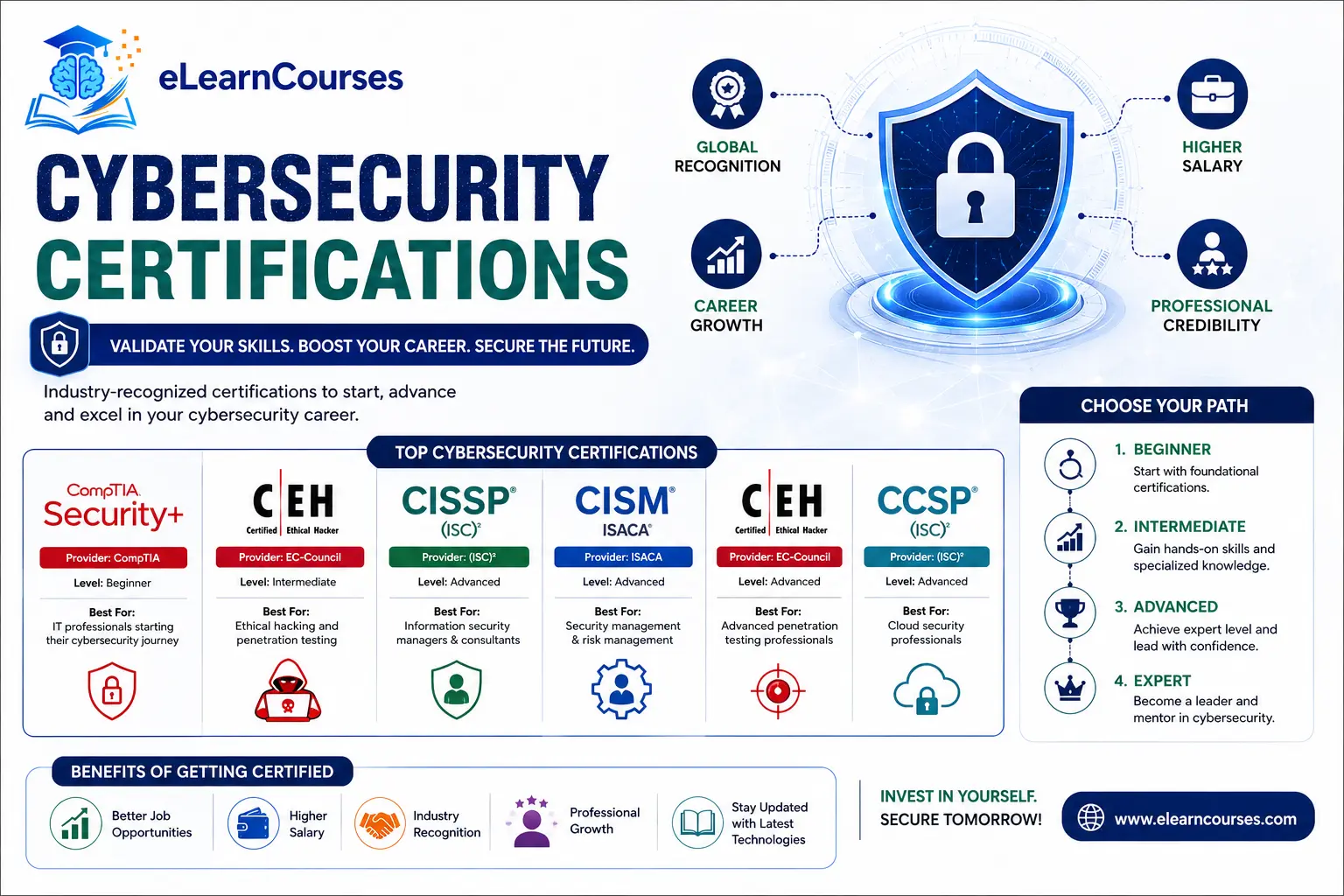
Cybersecurity Certifications at a Glance
| Certification | Level | Exam Cost | Typical Salary Range (US) | Best For |
|---|---|---|---|---|
| CompTIA Security+ | Entry | ~$404 | $75K–$105K | First security role, career changers |
| CompTIA CySA+ | Intermediate | ~$400 | $85K–$115K | Defensive/blue team analysts |
| CompTIA PenTest+ | Intermediate | ~$400 | $90K–$120K | Junior penetration testers |
| CEH (Certified Ethical Hacker) | Intermediate | ~$1,199 | $96K–$125K | Offensive security, DoD-adjacent roles |
| OSCP | Advanced (hands-on) | ~$1,649 | $120K–$160K | Serious penetration testing careers |
| CISSP | Advanced | ~$749 | $120K–$170K+ | Senior/leadership, architecture roles |
| CISM | Advanced (management) | ~$760 | $115K–$170K+ | Security management, governance |
| CISA | Advanced | ~$575 | $110K–$140K | IT audit, compliance |
| CCSP | Advanced | ~$599 | $140K–$168K | Cloud security specialists |
Exact salary figures vary meaningfully across surveys and sources — treat these as directional ranges rather than guaranteed numbers, and note that geography, industry, and years of experience all shift these figures substantially.
Why Certifications Matter More in 2026 Than Ever
A few forces have converged to make certifications a bigger deal in 2026 than they were even a few years ago. Enterprise procurement requirements increasingly specify minimum staff certifications as part of vendor and security review processes. Cyber insurance providers are attaching certification requirements to coverage terms more often, particularly for organizations handling sensitive data. And with cybersecurity job postings continuing to outpace the supply of experienced candidates, certifications give hiring managers a faster, more standardized way to screen candidates than resume review alone.
That said, certifications aren’t a substitute for real skill — they’re a signal of it. The strongest candidates pair certifications with genuine hands-on experience, whether through actual job history, home lab practice, or platforms like TryHackMe and Hack The Box. Treating a certification as the finish line, rather than a milestone alongside practical skill-building, is one of the most common mistakes people make when planning a cybersecurity career.
From an employer’s perspective, certifications also serve a practical filtering function that’s easy to underestimate from a candidate’s side of the table. Hiring managers reviewing dozens or hundreds of applications for a single opening often can’t deeply evaluate every candidate’s actual technical ability before an interview — a recognized certification gives them a reasonably reliable proxy for baseline competence, letting them prioritize interview time for candidates who’ve already cleared that bar. This is precisely why certifications tend to matter more, not less, at larger organizations with high application volumes, while smaller, technically sophisticated teams sometimes weight portfolio work and direct technical screening more heavily instead.
Entry-Level Certifications: Where Most People Should Start
CompTIA Security+ is, by a wide margin, the most commonly recommended starting point for anyone entering cybersecurity. It’s vendor-neutral, requires no prerequisites (though CompTIA recommends some existing IT experience), and covers the broad fundamentals — network security, threats, cryptography, risk management — that nearly every other certification builds on. It also satisfies U.S. Department of Defense 8570 requirements for many government and military-adjacent security roles, making it particularly valuable if that sector interests you. Salary data commonly cited for Security+ holders ranges from $75,000–$105,000, with some sources reporting an 11% salary boost specifically attributable to holding the certification.
Google Cybersecurity Certificate has emerged as a popular, lower-cost alternative or complement for career changers with no prior IT background, often paired with Security+ to build both practical skills and formal credentials simultaneously.
CompTIA Network+ rounds out the entry-level foundation for anyone who wants to strengthen core networking knowledge before or alongside Security+, since a meaningful share of security concepts genuinely just are networking concepts applied through a security lens.
SSCP (Systems Security Certified Practitioner), from ISC2 (the same organization behind CISSP), is a somewhat less commonly discussed entry-level option, but it’s a reasonable choice for candidates specifically eyeing an eventual CISSP path, since it comes from the same certifying body and covers overlapping domain knowledge at an earlier career stage.
Intermediate Certifications: Building Specialized Skills
Once you’ve established a foundation, intermediate certifications let you start specializing in a specific direction — typically either defensive (blue team) or offensive (red team) work.
CompTIA CySA+ (Cybersecurity Analyst) focuses on defensive skills — threat detection, vulnerability management, and incident response — making it a natural next step for anyone heading toward a SOC analyst or security operations career path.
CompTIA PenTest+ covers penetration testing fundamentals and is often positioned as a stepping stone toward more advanced offensive security credentials like OSCP, without requiring the same level of hands-on technical depth right away.
CEH (Certified Ethical Hacker), from EC-Council, remains one of the most widely recognized names in offensive security certification, and it continues to appear frequently in job postings, particularly those with DoD compliance requirements. That said, CEH has drawn consistent criticism from technical hiring managers for leaning more theoretical and multiple-choice-based than genuinely hands-on — a distinction covered in more detail in the next section.
Offensive Security Certifications: CEH vs. OSCP vs. PenTest+
If you’re specifically targeting a penetration testing or red team career, understanding the real differences between these credentials matters more than for almost any other certification decision in this guide.
CEH tests conceptual knowledge of hacking techniques and tools through a primarily multiple-choice format (a separate, optional CEH Practical exam adds hands-on components). It’s valuable for its name recognition and DoD compliance relevance, but many technical hiring managers view it as a starting point rather than proof of genuine offensive capability.
OSCP (Offensive Security Certified Professional) takes a fundamentally different approach: candidates must actually compromise live target machines during a rigorous, timed practical exam, with no multiple-choice component at all. This hands-on format is exactly why OSCP carries substantially more credibility with technical hiring managers and commands a meaningfully higher salary premium — commonly cited in the $20,000–$30,000 range over non-certified peers — despite also being one of the more expensive and demanding certifications to pursue.
PenTest+ sits between the two in both difficulty and hands-on emphasis, offering a useful middle step for candidates who want structured penetration testing knowledge before attempting the considerably more demanding OSCP exam.
A common, well-supported career sequence for this path: Security+ first, then either PenTest+ or CEH (particularly if DoD-adjacent roles are a goal), then OSCP once you’re ready for the field’s most respected hands-on credential.
Leadership and Governance Certifications: CISSP, CISM, CISA, and CRISC
As your career moves toward management, architecture, or governance rather than purely hands-on technical work, a different set of certifications becomes relevant.
CISSP (Certified Information Systems Security Professional), from ISC2, is widely considered the most prestigious and broadly recognized certification in the entire field, and it consistently shows the strongest correlation with six-figure salaries among all cybersecurity credentials. It requires a minimum of five years of cumulative, full-time experience across at least two of its eight security domains, reflecting its position as a credential for experienced professionals rather than an early-career starting point. CISSP is frequently cited as the single most requested certification across U.S. cybersecurity job postings, particularly for senior engineer, architect, and management-track roles.
CISM (Certified Information Security Manager), from ISACA, focuses specifically on the management and governance side of security — information security governance, risk management, and incident management — and is frequently paired with CISSP by professionals targeting the highest end of the security leadership salary band. Some data suggests a CISM plus CISSP combination averages among the highest total compensation packages in the field.
CISA (Certified Information Systems Auditor) and CRISC (Certified in Risk and Control), both also from ISACA, round out the governance, risk, and compliance (GRC) side of cybersecurity — valuable for professionals moving into IT audit, regulatory compliance, or enterprise risk management rather than purely technical security roles.
Cloud Security Certifications: CCSP and Vendor-Specific Options
Cloud security has become one of the fastest-growing certification categories, reflecting how thoroughly cloud infrastructure now underpins enterprise IT.
CCSP (Certified Cloud Security Professional), also from ISC2, has emerged as one of the highest-salary specializations in the field, commonly cited in the $140,000–$168,000 range, and pairs particularly well with an existing cloud platform certification — if you already hold an AWS or Azure credential, CCSP is often described as the single highest-value security specialization to layer on top of it.
Vendor-specific cloud security certifications — like AWS Certified Security – Specialty or Microsoft’s Azure Security Engineer Associate — are worth pursuing if you’re working primarily within one specific cloud ecosystem, since they go deeper into that platform’s specific security tooling and configuration than the more vendor-neutral CCSP.
2026 Update: ISC2 Cuts the CISSP Experience Waiver List
This is genuinely important, current information if CISSP is anywhere in your certification plans, and it’s easy to miss if you’re working from slightly older guidance.
Effective April 1, 2026, ISC2 significantly reduced the list of certifications that qualify for a one-year experience waiver toward CISSP’s five-year experience requirement — cutting the approved list from roughly 50 credentials down to about 25. Notably, CEH, CISA, CRISC, and most GIAC certifications were removed from the waiver list, meaning holding one of these no longer automatically shaves a year off your CISSP experience requirement for applications submitted after that date. Certifications that survived the cut include Security+, CySA+, CASP+, SecurityX, CISM, and ISC2’s own certification family.
According to ISC2, the review applied three criteria: a publicly available exam outline, ANAB ISO/IEC 17024 accreditation or equivalent proctored rigor, and at least 90% content alignment with two or more CISSP domains — credentials missing any of these three came off the list. The cutoff is based on your CISSP application submission date, not your exam date, so if you submitted before April 1, 2026, the previous, broader list still applies to your case.
The practical implication: if you were specifically planning to use a now-removed certification (like CEH or OSCP) to shortcut your CISSP timeline, that path is closed for new applications. Your remaining options are meeting the full five-year experience requirement directly, using a qualifying degree (a bachelor’s or master’s in computer science, IT, or a related field can still substitute for one year), or working toward one of the certifications that remains on the current approved list.
Certification Costs: What You’re Actually Paying For
Certification costs vary widely, and understanding the full picture — not just the headline exam fee — matters for realistic budgeting.
Entry-level exams typically run $300–$404 (CompTIA Security+, Network+, Google Cybersecurity Certificate). Intermediate certifications range from roughly $250–$1,200 (SSCP, CySA+, CEH — with CEH sitting at the higher end of this range given EC-Council’s pricing). Advanced certifications run from about $599–$1,649 (CCSP, CISSP, CISM, OSCP), with OSCP typically the most expensive due to its extended hands-on practical exam format. Beyond the exam fee itself, factor in study materials ($100–$500 is common), and for certifications like GIAC’s GSEC, official training bundles can add $7,000–$8,500 on top of the exam fee alone if you go through formal SANS training rather than self-study.
It’s worth evaluating cost against realistic return rather than assuming the most expensive certification is automatically the best investment. Security+, for example, is consistently cited as offering the strongest return relative to its cost precisely because it unlocks entry into the field at all — a $404 exam that opens the door to a $75,000+ starting salary is a dramatically different value proposition than a $1,649 OSCP exam pursued by someone who isn’t yet ready for the role it targets.
Choosing the Right Certification Path for Your Career Goal
Rather than treating certification choice as a single decision, it’s more useful to think in terms of a full career-stage sequence matched to your specific target role.
Security analyst → senior analyst → manager: Security+ → CySA+ → CISSP → CISM. This is the most common blue-team-to-leadership progression, building from foundational knowledge through defensive specialization and into management-level credentials.
Penetration tester → red team lead: Security+ → CEH or PenTest+ → OSCP → more advanced offensive credentials (like OSCE or GXPN) as your career progresses further.
Cloud security engineer: Security+ → an AWS or Azure security-specific certification → CCSP → eventually cloud security architecture-focused credentials as you move into more senior cloud infrastructure roles.
GRC/compliance specialist: Security+ → CISA → CRISC → CGEIT (Certified in the Governance of Enterprise IT), building specifically toward audit, risk, and enterprise governance responsibility rather than hands-on technical security work.
Security architect → CISO track: Security+ → CISSP → CCSP → CISM, often supplemented with broader enterprise architecture frameworks like TOGAF or SABSA once you’re operating at a genuinely senior architectural level.
A consistent piece of advice across career guidance for all of these paths: don’t rush toward advanced, management-tier certifications like CISSP before you have the practical experience to back them up. The five-year experience requirement exists for a real reason, and attempting the exam (or trying to use it to compensate for thin practical experience) too early tends to produce weaker outcomes than building genuine hands-on skill first and pursuing the credential when your experience actually supports it.
How to Evaluate a Certification Before You Commit
With so many credentials competing for attention, it helps to have a consistent framework for deciding whether a specific certification is actually worth pursuing, rather than choosing based on name recognition or marketing alone.
Check job postings in your target role and location. The most reliable signal for which certification actually matters is what employers are consistently listing as required or preferred in real job postings for the specific role you want — not which certification has the most aggressive marketing or the highest listed average salary in a generic ranking article.
Understand what the exam actually tests. Some certifications, like OSCP, test genuine hands-on capability under exam conditions. Others lean more heavily on memorized, multiple-choice conceptual knowledge. Neither approach is inherently wrong, but knowing which type of exam you’re preparing for should shape how you study and what kind of practical skill you build alongside it.
Factor in the full cost, not just the exam fee. As covered earlier, study materials, official training bundles, and ongoing renewal requirements can meaningfully change a certification’s total cost of ownership over a multi-year career, sometimes by thousands of dollars beyond the headline exam price.
Consider your specific industry, not just the general field. Government and defense-adjacent roles often have specific compliance-driven certification requirements (like DoD 8570 alignment) that don’t necessarily apply to private-sector roles, while highly regulated industries like finance and healthcare sometimes favor different certifications than the broader tech industry does.
Be honest about your current experience level. Pursuing a certification that assumes years of experience you don’t yet have — even if you technically pass the exam — often produces a credential that doesn’t hold up well during technical interviews, where hiring managers frequently probe well past what a certification alone can teach you to memorize.
Do You Actually Need a Certification to Get Hired?
Certifications aren’t strictly mandatory for every cybersecurity role, but their practical importance has grown enough in 2026 that skipping them entirely puts most candidates at a real disadvantage, particularly for anyone without an existing professional network or a strong portfolio of demonstrable hands-on work.
For a small number of highly technical, portfolio-driven roles — especially in penetration testing and security research — genuinely impressive hands-on work (bug bounty findings, CTF rankings, open-source security tool contributions) can sometimes substitute for formal certification, particularly at smaller, technically sophisticated companies. But for the large majority of cybersecurity roles, especially at larger organizations with structured hiring pipelines, certifications remain one of the fastest, most reliable ways to get your resume past initial screening and into an actual interview.
The most effective approach, echoed consistently across hiring guidance, combines both: pursue certifications aligned with your career stage and target role, while building genuine practical skill alongside them through labs, projects, and real-world practice — not one instead of the other.
Certification Renewal and Continuing Education Requirements
An often-overlooked part of certification planning is what happens after you pass the exam. Most cybersecurity certifications aren’t one-and-done credentials — they require ongoing maintenance, and factoring that into your decision matters just as much as the upfront cost and study time.
Most CompTIA and ISC2 certifications require renewal every three years, typically through a combination of Continuing Professional Education (CPE) credits — earned through activities like training, conferences, webinars, and relevant work experience — and an annual maintenance fee, generally in the $0–$125 range depending on the certifying body. CISSP specifically requires 120 CPE credits over its three-year cycle, along with ISC2’s annual maintenance fee, and letting your CPE requirements lapse can result in your certification being suspended or revoked entirely, regardless of how strong your practical skills remain.
OSCP stands out as a notable exception: it doesn’t expire and carries no continuing education requirement, which is one reason it holds a particularly strong reputation among technical hiring managers — once earned, it remains valid proof of the hands-on skill demonstrated during that grueling practical exam, with no ongoing administrative overhead.
Before committing to any certification path, it’s worth budgeting for this ongoing cost — both in dollars and in the time required to accumulate CPE credits — rather than treating the initial exam fee as the full financial picture.
Managing Multiple Certifications Over a Career
As you accumulate multiple certifications over time, a practical question emerges: how do you actually manage a growing portfolio of credentials without letting maintenance requirements become their own part-time job?
Many CPE activities count toward multiple certifications simultaneously — attending a relevant security conference, for example, can often be logged toward CPE requirements for both a CompTIA and an ISC2 credential in the same reporting period, which meaningfully reduces the administrative burden of holding several certifications at once. Structuring your ongoing professional development (conferences, training, relevant projects) with this overlap in mind is a practical way experienced professionals manage certification portfolios that might otherwise feel unsustainable to maintain.
It’s also worth being deliberate about which certifications you actually keep active over time. Not every certification you earn early in your career needs to be maintained indefinitely — letting an entry-level credential lapse once you’ve clearly moved beyond that career stage, in favor of concentrating your CPE effort on the certifications most relevant to your current role, is a completely normal and practical part of long-term certification strategy.
How to Continue Learning
Certifications map out the destinations, but the learning itself is what actually gets you there. If you’re mapping your broader cybersecurity career trajectory, our cybersecurity career roadmap walks through the skills and progression behind many of the certification paths covered here, and our cybersecurity interview questions guide is a practical way to check whether your growing certification knowledge translates into the kind of applied understanding employers actually screen for in interviews.
If your path is leading toward identity and access management specifically — an increasingly certification-relevant specialization in its own right — our CyberArk training and SailPoint training cover two of the most in-demand enterprise IAM tools. And for a broader view of where cybersecurity fits into overall tech hiring trends, our guide to top tech skills in demand for the next decade puts certification-driven career planning into a wider industry context.
FAQs About Cybersecurity Certifications
What is the best cybersecurity certification for beginners? CompTIA Security+ is the most consistently recommended starting point — it’s vendor-neutral, requires no formal prerequisites, and covers the broad fundamentals that nearly every other certification builds on.
Which cybersecurity certification pays the most? CISSP and CISM consistently rank among the highest-paying certifications, with median salaries commonly cited in the $120,000–$170,000+ range, particularly for professionals pairing the credential with genuine leadership or architecture-level experience.
Is CEH or OSCP better for penetration testing? OSCP carries substantially more credibility with technical hiring managers because of its fully hands-on, practical exam format, while CEH remains valuable primarily for its broad name recognition and relevance to DoD-compliance-driven roles. Many penetration testing career paths pursue CEH or PenTest+ first, then OSCP as the more advanced, respected credential.
Do I need five years of experience to get CISSP? Yes, CISSP requires a minimum of five years of cumulative, full-time experience across at least two of its eight domains, though a qualifying bachelor’s or master’s degree can substitute for one year, and a limited number of other certifications on ISC2’s current (post-April 2026) waiver list can substitute for another.
Which certifications were removed from the CISSP experience waiver list in 2026? Effective April 1, 2026, ISC2 removed CEH, CISA, CRISC, and most GIAC certifications from the list of credentials that qualify for a one-year CISSP experience waiver, cutting the approved list from roughly 50 credentials to about 25.
Is it worth getting a cloud security certification like CCSP? Yes, particularly given how central cloud infrastructure has become to most enterprise IT environments. CCSP is commonly cited among the highest-paying cybersecurity specializations, and pairs especially well with an existing AWS or Azure certification for candidates already working in cloud-focused roles.
How long does it take to prepare for a cybersecurity certification? Timelines vary by certification level — commonly cited ranges are one to three months of preparation for Security+, two to four months for intermediate certifications like CySA+ or CEH, and three to six months for advanced certifications like CISSP or OSCP, depending on your existing experience and study pace.
Do cybersecurity certifications expire? Most do, typically requiring renewal every three years through Continuing Professional Education (CPE) credits and an annual maintenance fee. OSCP is a notable exception, remaining valid indefinitely with no continuing education requirement once earned.
Can I get a cybersecurity job with just certifications and no degree? Yes, this is genuinely common in the field. Many entry-level and even mid-career cybersecurity roles prioritize demonstrated skill and relevant certifications over a formal degree, and several advanced certifications (including CISSP) explicitly allow a qualifying degree to substitute for part of their experience requirement — implying the reverse is also true, since the underlying experience requirement itself doesn’t require a degree at all.
Conclusion
The cybersecurity certification landscape can feel genuinely overwhelming, but the underlying logic is simpler than the sheer number of acronyms suggests: start broad and foundational (Security+), specialize based on where your interests and strengths actually point (offensive, defensive, cloud, or governance), and save the most advanced, experience-gated credentials like CISSP for when your practical background genuinely supports them rather than treating them as a shortcut around building real experience.
If there’s one theme worth carrying forward from this entire guide, it’s that certifications and hands-on skill aren’t competing priorities — they’re most valuable together. The strongest cybersecurity careers in 2026 belong to professionals who can back up a well-chosen certification with genuine, demonstrable practical ability, not just a credential sitting alone on a resume.