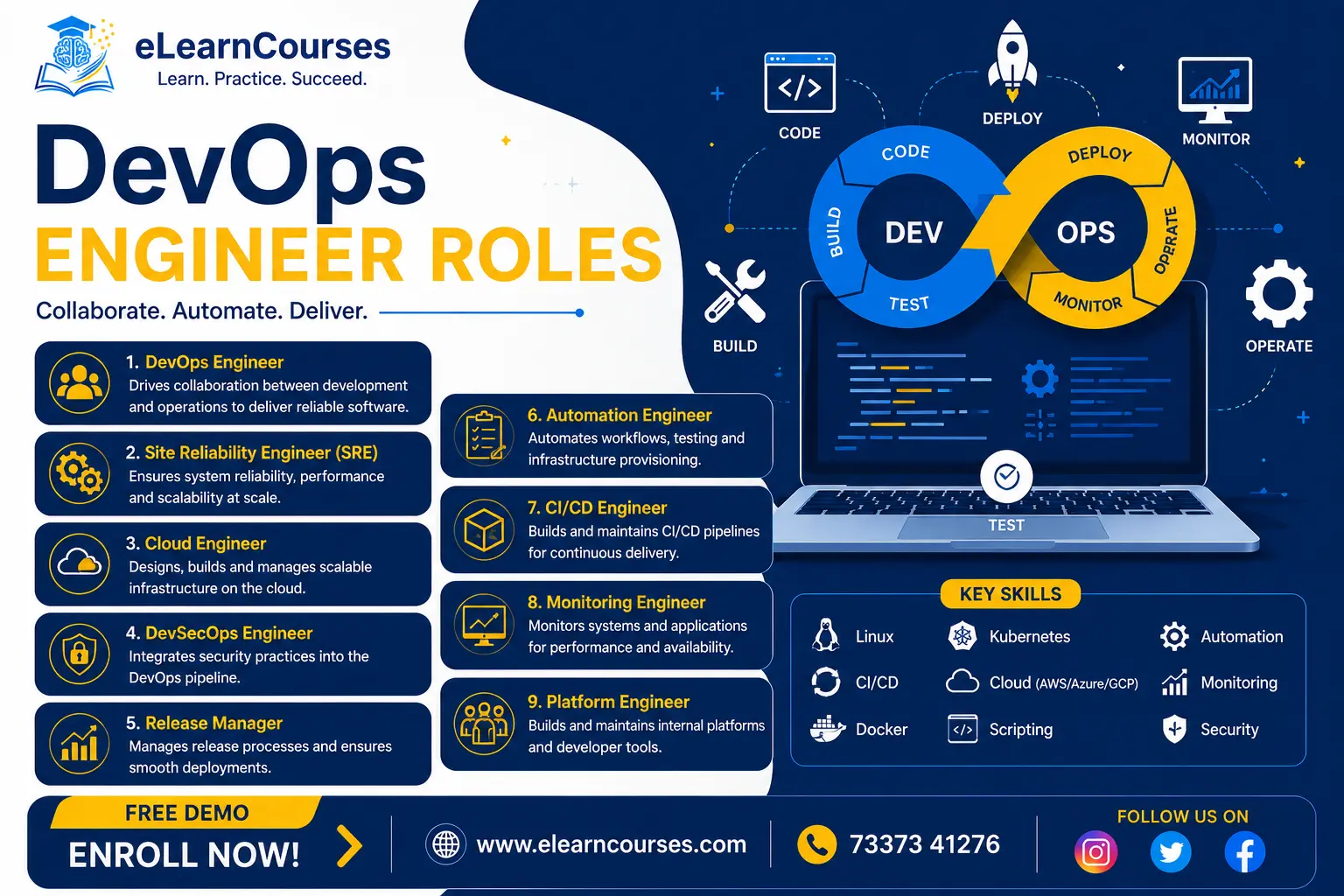
DevOps Engineer Roles and Responsibilities
Ask five different companies what a DevOps engineer actually does, and you’ll get five somewhat different answers. That’s not a sign the role is poorly defined so much as a sign it’s genuinely broad: a DevOps engineer’s job shifts depending on company size, how mature their infrastructure already is, and how much of the “Ops” side has already been automated before that person even joined. This guide breaks down DevOps engineer roles and responsibilities the way they actually show up in real job postings and real day-to-day work, not just the textbook definition.
By the end, you’ll know exactly what the job involves day to day, which tools show up in almost every posting, how the role differs from adjacent titles like SRE and Platform Engineer, and what a realistic path into the field looks like.
What Is a DevOps Engineer?
A DevOps engineer sits at the intersection of software development and IT operations, building and maintaining the automation, infrastructure, and processes that let a company ship software faster without sacrificing stability. The name itself comes from combining “development” and “operations,” reflecting the core idea: instead of developers writing code and throwing it over a wall to a separate operations team to deploy and maintain, DevOps engineers help both sides work from the same pipeline, with automation replacing most of the manual handoffs that used to slow releases down and cause friction between teams.
In practice, that means a DevOps engineer typically writes code (mostly automation scripts and infrastructure configuration rather than application features), manages cloud infrastructure, builds and maintains deployment pipelines, and gets pulled into troubleshooting when something breaks in production.
A Day in the Life of a DevOps Engineer
Job descriptions tend to read as a static list of duties, but the actual daily rhythm looks different depending on what’s happening that week. A fairly typical day might start with checking overnight alerts and dashboards to confirm nothing broke while the team was offline, followed by reviewing a pull request for a Terraform module a teammate wrote to add a new caching layer. Mid-morning might involve debugging why a deployment pipeline started failing at the testing stage after a dependency update, which often turns into an hour of reading logs before finding the actual root cause.
Afternoons often shift toward more forward-looking work: designing how a new microservice should fit into the existing Kubernetes cluster, writing documentation for a runbook so the on-call rotation has clear steps the next time a specific type of incident happens, or sitting in on a planning meeting with a development team to understand infrastructure needs for an upcoming feature before it’s built. Then, without much warning, a production alert can turn the rest of the day into an incident response, tracing a spike in error rates back to a specific deployment and rolling it back before it affects more users.
That mix, planned infrastructure work interrupted by genuinely urgent troubleshooting, is a defining feature of the role rather than an exception to it, and it’s part of why the soft skill of staying calm and methodical under pressure gets mentioned in nearly every job posting for this title.
Core DevOps Engineer Responsibilities
Building and Maintaining CI/CD Pipelines
Continuous integration and continuous delivery (CI/CD) pipelines automate the path from a developer committing code to that code running safely in production. A DevOps engineer designs these pipelines, typically using tools like Jenkins, GitHub Actions, GitLab CI, or AWS CodePipeline, so that every code change is automatically built, tested, and deployed through a consistent, repeatable process rather than a manual release someone has to babysit.
This isn’t a one-time setup. Pipelines need ongoing maintenance as a codebase grows, new services get added, and testing requirements change, and debugging a pipeline that suddenly starts failing at a specific stage is one of the most common day-to-day tasks in the role.
Infrastructure as Code (IaC)
Rather than manually configuring servers through a cloud console, DevOps engineers define infrastructure in code using tools like Terraform, Pulumi, or AWS CloudFormation. This makes infrastructure changes reviewable, version-controlled, and repeatable across environments, so spinning up an identical staging environment to match production is a matter of running the same code rather than manually recreating dozens of settings and hoping nothing gets missed.
resource "aws_instance" "web_server" {
  ami           = "ami-0abcdef1234567890"
  instance_type = "t3.micro"

  tags = {
    Name = "web-server-prod"
  }
}
That’s a small example of Terraform configuration defining a single AWS server. Real infrastructure code manages entire networks, load balancers, databases, and security groups, often across multiple environments, all from version-controlled files instead of manual console clicks.
Containerization and Orchestration
Docker and Kubernetes have become close to standard for packaging and running applications consistently across development, testing, and production environments. A DevOps engineer typically manages containerized workloads: writing Dockerfiles, configuring Kubernetes deployments, and troubleshooting issues like a pod that keeps crashing or a service that isn’t reachable from another part of the cluster. Understanding how containers network with each other and how orchestration handles scaling and failure recovery is core, day-to-day knowledge in most DevOps roles today, not a specialized side skill.
Cloud Infrastructure Management
Most DevOps work today happens on a cloud platform, AWS, Azure, or Google Cloud Platform, and a DevOps engineer is typically responsible for provisioning, securing, and optimizing the resources running there. AWS shows up in the clear majority of cloud-related DevOps job postings, though Azure and GCP dominate in specific industries and regions, so which platform matters most depends heavily on where you’re job hunting.
Monitoring, Logging, and Incident Response
Shipping code faster only matters if the systems running it stay reliable, which is why monitoring and observability are core responsibilities, not an afterthought. DevOps engineers set up tools to track system health (Prometheus, Grafana, Datadog, and similar platforms are common choices), configure alerts for when something goes wrong, and are often part of an on-call rotation to respond when production incidents happen at inconvenient hours. Writing a clear post-incident review after an outage, covering what happened, why, and what’s changing to prevent it from recurring, is a routine part of the job in any team that takes reliability seriously.
Security and Compliance (DevSecOps)
Security has increasingly become part of the DevOps engineer’s core responsibilities rather than a separate team’s problem handled after the fact. This shows up as scanning container images for known vulnerabilities before deployment, managing secrets and credentials securely instead of hardcoding them into scripts, and building security checks directly into CI/CD pipelines so vulnerable code gets flagged before it ever reaches production. This blended approach is often called DevSecOps, and it’s become a standard expectation rather than an optional specialty in most modern DevOps roles.
Cross-Team Collaboration
A DevOps engineer’s technical work only pays off if it actually reduces friction between teams, which means the role involves a genuine amount of communication: working with developers to understand what a new service needs from infrastructure, working with security teams on compliance requirements, and often explaining technical tradeoffs to non-technical stakeholders who just want to know when a feature will ship. Strong communication skills show up in nearly every job posting for this role, right alongside the technical requirements, and for good reason.
Essential Skills for a DevOps Engineer
Scripting and programming: Python, Bash, and PowerShell are the most common languages, used for writing automation scripts, custom tooling, and glue code that connects different systems together.
Linux fundamentals: Most production infrastructure runs on Linux, so comfort with the command line, file permissions, process management, and basic system administration is close to a baseline requirement, not an advanced skill.
Networking basics: Understanding DNS, load balancing, firewalls, and how services communicate across a network is essential for debugging the kind of connectivity issues that show up constantly in distributed, cloud-based systems.
Version control: Git fluency is assumed at this point, not just for application code but for the infrastructure code and pipeline configuration a DevOps engineer manages directly.
Cloud platform expertise: Deep, hands-on familiarity with at least one major cloud provider, with the ability to actually architect and debug solutions rather than just recognize service names, is what separates candidates who get real offers from those who only know the terminology.
Soft skills: Communication, collaboration, and calm problem-solving under pressure matter more in this role than in many other engineering positions, since DevOps engineers work across nearly every team in an organization and are frequently the ones troubleshooting live incidents while stakeholders wait for updates.
Common DevOps Tools by Category
| Category | Common Tools |
|---|---|
| CI/CD | Jenkins, GitHub Actions, GitLab CI, AWS CodePipeline |
| Infrastructure as Code | Terraform, Pulumi, AWS CloudFormation, Ansible |
| Containerization | Docker, Kubernetes, Amazon ECS |
| Configuration Management | Ansible, Puppet, Chef |
| Monitoring & Observability | Prometheus, Grafana, Datadog, New Relic |
| Cloud Platforms | AWS, Microsoft Azure, Google Cloud Platform |
| Version Control | Git, GitHub, GitLab, Bitbucket |
No single DevOps engineer uses every tool in this table on any given day. Most job postings expect deep expertise in a specific subset, usually one cloud platform, one or two CI/CD tools, and Terraform or Ansible for infrastructure, rather than shallow familiarity with everything at once.
DevOps Is a Mindset, Not Just a Tool Stack
It’s easy to reduce DevOps to a specific list of tools, but the underlying philosophy predates most of them and matters just as much as any individual technology. A commonly referenced framework, CALMS, breaks the mindset into five pillars: Culture, breaking down the traditional wall between development and operations teams so they share ownership of outcomes rather than blaming each other when something breaks; Automation, replacing manual, error-prone processes with repeatable, code-driven ones; Lean, delivering software in small, frequent increments rather than large, risky batches; Measurement, tracking real metrics like deployment frequency and recovery time rather than relying on gut feeling; and Sharing, spreading knowledge across teams instead of letting critical infrastructure knowledge live in one person’s head.
This matters practically because a company can adopt every tool in the previous table and still fail at DevOps if the underlying culture stays siloed, with developers and operations still working in isolation and treating deployments as an adversarial handoff rather than a shared responsibility. A genuinely effective DevOps engineer often spends as much energy improving team processes and communication as they do writing infrastructure code, which is part of why the role attracts people who enjoy both the technical and the organizational side of the job.
DevOps Engineer vs. Related Roles
The lines between DevOps-adjacent titles blur constantly, and understanding the general distinctions helps when you’re reading job postings or planning a career path.
DevOps Engineer is generally the broadest title: owns CI/CD pipelines, manages cloud infrastructure, writes infrastructure as code, and keeps deployment processes running smoothly. This is the generalist role most companies are actually hiring for when they post a “DevOps Engineer” opening.
Site Reliability Engineer (SRE), a role that originated at Google, applies software engineering practices specifically to operations problems: defining and tracking service level objectives (SLOs), managing error budgets, and focusing heavily on system reliability metrics rather than general infrastructure work. SRE roles tend to involve more custom software engineering and a narrower, deeper focus on reliability than a generalist DevOps role.
Platform Engineer builds internal tools and self-service platforms that let development teams deploy and manage their own applications without needing to understand the underlying infrastructure in detail. This role has grown quickly as organizations scale, since it reduces how often developers need to go through a DevOps or infrastructure team just to ship a routine change.
Cloud Engineer focuses more narrowly on designing, provisioning, and optimizing cloud infrastructure itself, without necessarily owning the CI/CD and deployment pipeline responsibilities that come with a DevOps title.
DevSecOps Engineer integrates security specifically and deeply into the DevOps pipeline, focusing on vulnerability scanning, secure secrets management, and compliance automation as a primary responsibility rather than a secondary concern layered on top of a broader role.
In smaller companies, one person often covers several of these responsibilities under a single “DevOps Engineer” title. In larger, more mature organizations, these tend to split into genuinely separate, more specialized roles.
DevOps Engineer Career Path and Progression
A typical path starts at an entry-level or junior DevOps engineer role, following existing pipeline patterns, fixing broken builds, and deploying changes under fairly close supervision on architectural decisions.
A mid-level DevOps engineer can design a new pipeline from requirements without heavy oversight, write Terraform modules independently, and make reasonable infrastructure decisions on their own.
A senior DevOps engineer designs multi-environment deployment strategies, evaluates tradeoffs between different tooling options, mentors more junior engineers, and often leads incident response during major outages.
From senior, paths typically branch toward a DevOps Architect role, designing enterprise-wide DevOps strategy and tooling standards across an organization, or toward SRE leadership, focusing specifically on reliability at scale, or toward engineering management, moving away from hands-on technical work toward leading a team of DevOps and infrastructure engineers directly.
DevOps Engineer Salary Expectations
Salary figures for this role vary considerably depending on location, company size, and how the specific title is scoped at a given organization, but a few consistent patterns show up across multiple sources. Entry-level DevOps roles commonly start somewhere in the $55,000 to $95,000 range in the United States, with generalist mid-career roles frequently landing in the $90,000 to $160,000 range.
Senior roles, and adjacent titles like SRE that typically command a premium, often report ranges from $120,000 to $200,000 or higher, particularly at larger technology companies or in high-cost metro areas. These ranges shift substantially outside the US and are worth checking against current, location-specific data before using them to negotiate, since the spread between the low and high end of this role is unusually wide compared to many other engineering titles.
How to Become a DevOps Engineer
Most DevOps engineers come from one of two starting points: a software development background that expanded into infrastructure and operations, or a systems administration background that expanded into automation and coding. Neither path is inherently better, though the skills you’ll need to build first differ depending on which side you’re starting from.
If you’re coming from development, prioritize learning Linux fundamentals, networking basics, and at least one cloud platform in real depth, not just recognizing service names but actually provisioning and debugging real infrastructure. If you’re coming from systems administration, prioritize scripting, since automating what used to be manual, repetitive tasks is the core shift this role represents.
A bachelor’s degree in computer science or a related field is common among DevOps engineers but isn’t strictly required by most employers, especially if you can demonstrate hands-on experience through real projects. Certifications carry real weight in this field specifically: the AWS Certified DevOps Engineer – Professional credential, Kubernetes’ Certified Kubernetes Administrator (CKA), and HashiCorp’s Terraform Associate certification are all commonly recognized by hiring managers as evidence of practical, verified skill rather than just theoretical knowledge.
Beyond certifications, a portfolio showing real infrastructure code, a working CI/CD pipeline you built from scratch, or a documented project deploying a containerized application to a cloud platform, tends to matter more in interviews than credentials alone, since it demonstrates you can actually do the work rather than just describe it. If you’re building up the scripting skills this role depends on, our Python tutorial covers the fundamentals that carry directly into DevOps automation work.
Where DevOps Engineers Work
The role has spread well beyond its original home in fast-moving tech startups. Technology companies scaling their engineering teams remain a major source of openings, but financial services firms modernizing legacy systems, healthcare organizations balancing faster software delivery against strict compliance requirements, e-commerce companies needing to handle unpredictable traffic spikes, and government agencies adopting modern development practices all actively hire for this role now.
Consulting firms have also built out entire practices around helping other companies adopt DevOps tooling and culture, which is its own path into the field for people who enjoy variety across different client environments rather than settling into one company’s specific stack long-term.
This spread matters for anyone job hunting, since it means DevOps opportunities aren’t confined to a handful of major tech hubs the way some other specialized engineering roles historically have been. Combined with how naturally remote-friendly the work tends to be, that opens up a genuinely wider set of options than “move to a big city and hope a startup is hiring.”
Common Misconceptions About the Role
“DevOps is just a new name for sysadmin.” Not accurate. Traditional system administration is largely reactive and manual; DevOps engineering is built around proactive automation, writing code that manages infrastructure rather than manually configuring it server by server.
“DevOps engineers don’t need to know how to code.” They generally do, just not necessarily application-level feature development. Writing automation scripts, infrastructure code, and custom tooling requires genuine programming ability, even if it’s a different flavor of coding than building a user-facing product.
“Any developer can pick up DevOps responsibilities as a side task.” Many developers do handle some DevOps-adjacent work, and that’s increasingly common as the two disciplines blend. But a dedicated DevOps role becomes genuinely valuable once CI/CD complexity, infrastructure scale, or security requirements grow past what a team can handle as a secondary responsibility alongside their main development work.
“DevOps is only relevant at large tech companies.” Financial services, healthcare, e-commerce, and government agencies all actively hire for this role now, and demand has spread well beyond Silicon Valley-style tech companies into essentially every industry that ships and maintains software.
Is DevOps Engineering a Good Career Choice Right Now?
Demand for this role remains strong. Job postings for DevOps-related positions have grown substantially in recent years, and the underlying skill set, automation, cloud infrastructure, and reliability engineering, is exactly what companies need as they scale software delivery and increasingly move workloads to the cloud. Remote work is also unusually common in this field compared to many other technical roles, since the tools and practices DevOps engineers use are built around distributed collaboration by design.
The tradeoff worth being honest about: this is a genuinely broad role that requires ongoing learning, since the specific tools in demand shift over time (Kubernetes and Terraform weren’t the default a decade ago, and something else will likely take a larger share of the conversation a decade from now). People who enjoy that constant learning curve tend to thrive in the role; people looking for a more narrowly defined, stable skill set day to day sometimes find it more demanding than expected.
Frequently Asked Questions
Do I need a computer science degree to become a DevOps engineer? No, though it’s common among people in the role. Many DevOps engineers come from self-taught backgrounds, bootcamps, or a systems administration career path, and practical, demonstrated experience with real infrastructure and pipelines often carries more weight in hiring than a specific degree.
What’s the difference between a DevOps engineer and a software engineer? A software engineer primarily builds application features and business logic. A DevOps engineer primarily builds and maintains the infrastructure, automation, and pipelines that let that application code get built, tested, and deployed reliably. There’s meaningful overlap, particularly around scripting and automation, but the core focus differs.
Is Kubernetes required knowledge for a DevOps engineer? It’s not universal, but it shows up in a large share of job postings, particularly at companies running containerized microservices at any real scale. It’s one of the more valuable specific skills to build if you’re targeting mid-size to large companies, though smaller companies and simpler infrastructure setups sometimes don’t need it at all.
How long does it take to become job-ready as a DevOps engineer? For someone starting with some existing programming or systems administration background, six months to a year of focused, hands-on learning is a reasonable timeline to reach entry-level job readiness. Starting from scratch with no technical background at all typically takes longer, since Linux, networking, and scripting fundamentals need to be solid before infrastructure-specific tools make much sense.
Which cloud platform should I learn first? AWS is the safest default, since it appears in the largest share of DevOps job postings across most industries and regions. That said, if you already know a specific company or industry you want to target, it’s worth checking which platform is more common there first, since Azure dominates in many enterprise and Microsoft-heavy environments, and GCP has a strong presence in certain data-heavy and startup-focused companies.
Can a self-taught person realistically break into DevOps engineering? Yes, and it’s a fairly common path in this field specifically, more so than in some other engineering specialties. Building a real portfolio, a working CI/CD pipeline, infrastructure code deployed to an actual cloud account, a documented incident you diagnosed and fixed, tends to matter more to hiring managers than how you learned the material, as long as you can speak to the decisions behind it in detail during an interview.
What’s the difference between DevOps and Agile? Agile is a project management methodology focused on iterative development and frequent collaboration with stakeholders. DevOps extends that same philosophy of fast, iterative delivery into the technical infrastructure and deployment process itself. They’re complementary rather than competing: a team can run Agile sprints for planning while using DevOps practices to actually ship what gets built in those sprints reliably and quickly.
Where to Go From Here
DevOps engineer roles and responsibilities span CI/CD pipelines, infrastructure as code, containerization, cloud management, monitoring, and security, with the exact mix shifting depending on company size and how mature the existing infrastructure already is. The clearest path into the role is hands-on: build a real pipeline, write real infrastructure code, and deploy something to a real cloud environment, since that practical experience is what hiring managers consistently weigh more heavily than credentials alone.
If you’re building the scripting foundation this role depends on, our Python tutorial is a solid starting point. For deeper technical reference on two of the tools covered throughout this guide, the official Kubernetes documentation and Terraform’s official documentation are both worth bookmarking as you build hands-on experience.