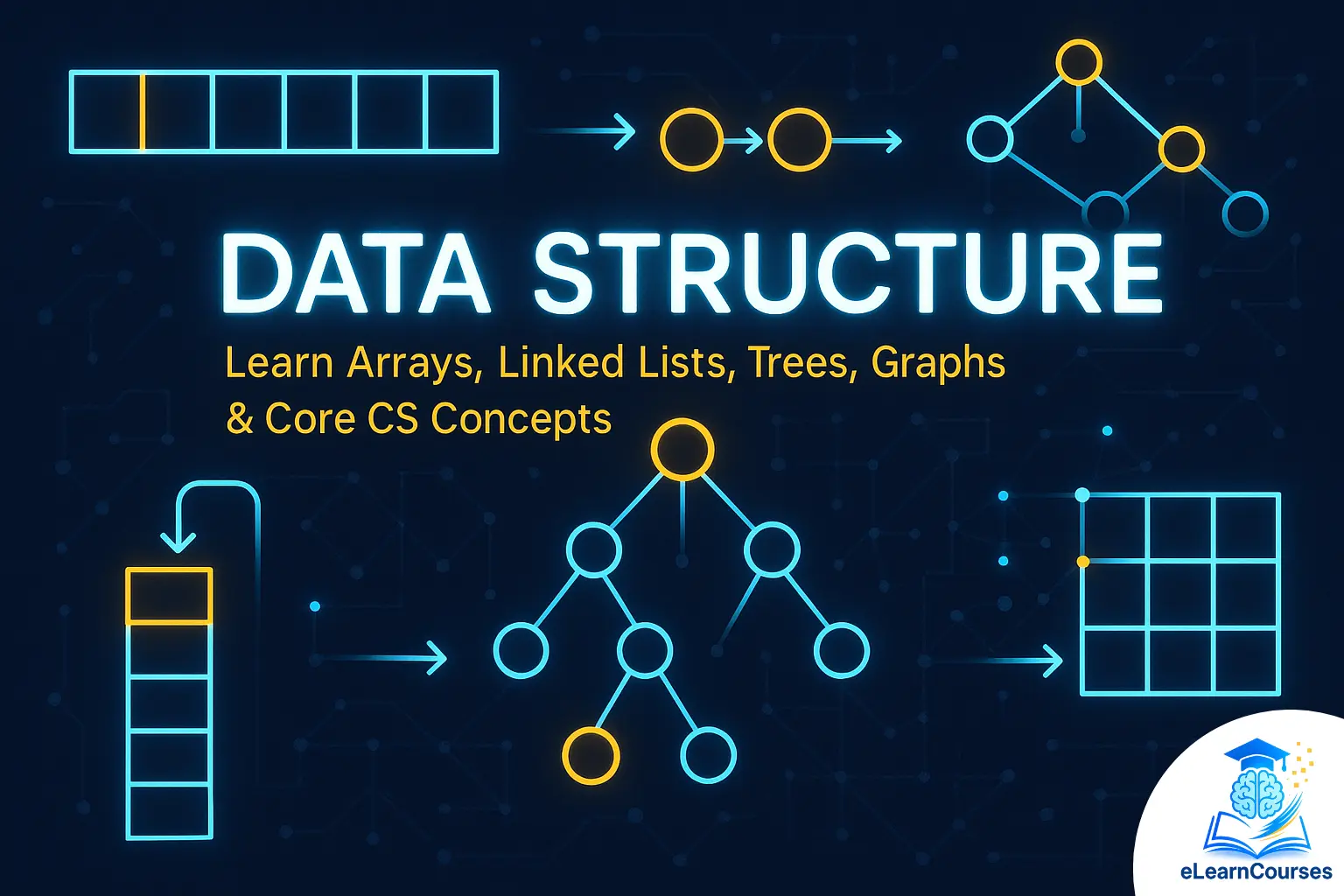
Master Data Structure: Ultimate Guide to Learn Programming Efficiently
Understanding data structure concepts is fundamental to becoming a proficient programmer. Whether you’re preparing for technical interviews, building scalable applications, or optimizing code performance, mastering data structures is essential for software development success.
This comprehensive data structure tutorial covers everything from basic concepts to advanced implementations. You’ll learn how different data structures work, when to use them, and how to implement them efficiently. By mastering data structure principles outlined in this guide, you’ll write faster, more efficient code and solve complex programming challenges with confidence.
In this detailed data structure guide, we’ll explore arrays, linked lists, stacks, queues, trees, graphs, hash tables, and advanced structures. Each data structure comes with practical examples, real-world applications, time complexity analysis, and implementation code that you can use immediately in your projects.
Introduction to Data Structures
What is a Data Structure?
A data structure is a specialized format for organizing, processing, storing, and retrieving data efficiently. Think of data structures as containers that hold data in specific arrangements, enabling various operations like insertion, deletion, searching, and sorting with optimal efficiency.
Every program manipulates data, and the way you organize that data dramatically affects program performance. This data structure tutorial emphasizes that choosing the appropriate structure can mean the difference between an application that runs in milliseconds versus one that takes hours.
Fundamental Concepts
Data Organization: Data structures provide systematic ways to organize information based on relationships and access patterns. Some structures organize data sequentially, while others use hierarchical or networked arrangements.
Operations: Each data structure supports specific operations with varying efficiency levels. Common operations include:
- Insertion: Adding new elements
- Deletion: Removing existing elements
- Searching: Finding specific elements
- Traversal: Accessing each element systematically
- Sorting: Arranging elements in order
- Updating: Modifying existing elements
Memory Management: Understanding how data structures utilize memory helps optimize space usage and access patterns. Some structures use contiguous memory blocks, while others employ dynamic allocation with pointers.
Evolution of Data Structures
Data structures evolved alongside computer science itself. Early computing required efficient memory usage due to hardware limitations. As problems grew more complex, programmers developed sophisticated structures to handle intricate relationships and massive datasets.
The digital age demands processing vast amounts of information quickly. Modern applications—from social networks to search engines, from gaming to artificial intelligence—rely on carefully chosen data structures to deliver seamless user experiences. This data structure knowledge separates average programmers from exceptional software engineers.
Why Learn Data Structures?
Career Advantages
Technical Interviews: Major technology companies like Google, Facebook, Amazon, Microsoft, and Apple heavily emphasize data structure knowledge during technical interviews. Candidates who understand data structures and algorithms consistently perform better and receive superior job offers.
Competitive Programming: Mastering data structures opens doors to competitive programming platforms like Codeforces, TopCoder, and LeetCode. These skills translate directly into problem-solving abilities valued across the software industry.
Higher Salaries: Software engineers with strong data structure knowledge command premium salaries. This expertise demonstrates deep technical competency that employers actively seek and reward financially.
Technical Benefits
Code Efficiency: Proper data structure selection dramatically improves program performance. An algorithm using the right data structure might execute in seconds, while the same algorithm with inappropriate structures could take hours or never complete.
Scalability: As applications grow, poorly chosen data structures create bottlenecks. Understanding data structures ensures your applications scale gracefully from hundreds to millions of users.
Problem-Solving Skills: Learning data structures develops logical thinking and problem decomposition abilities. These cognitive skills transfer to all programming domains, making you a more effective developer overall.
Foundation for Advanced Topics: Data structures form the foundation for databases, operating systems, compilers, network protocols, graphics engines, and machine learning systems. You cannot fully understand these advanced topics without solid data structure knowledge.
Real-World Applications
Search Engines: Google processes billions of searches daily using sophisticated data structures like inverted indexes, tries, and distributed hash tables to deliver results in milliseconds.
Social Networks: Facebook’s friend suggestions, Instagram’s feed algorithms, and Twitter’s trending topics all rely on graph data structures and specialized algorithms for relationship analysis.
Navigation Systems: GPS applications use graph data structures with specialized algorithms like Dijkstra’s or A* to calculate optimal routes through millions of road segments.
Database Systems: Relational and NoSQL databases employ B-trees, hash indexes, and skip lists to provide fast query responses even with terabytes of stored information.
Operating Systems: Your computer’s operating system uses queues for process scheduling, trees for file systems, and hash tables for memory management.
This data structure tutorial will equip you with knowledge that directly applies to building these types of sophisticated systems.
Types of Data Structures
Data structures broadly categorize into two main types, each serving different purposes and offering unique characteristics.
Primitive Data Structures
Primitive data structures represent the most basic data types provided by programming languages:
Integer: Whole numbers like -5, 0, 42, or 1000. Different integer types (byte, short, int, long) accommodate various numeric ranges and memory requirements.
Float/Double: Decimal numbers like 3.14, -0.5, or 2.7e10. Floating-point types balance precision and memory usage for scientific and financial calculations.
Character: Single letters, digits, or symbols like ‘A’, ‘7’, or ‘@’. Characters form the building blocks of text processing.
Boolean: True/false values essential for logical operations and control flow decisions.
These primitive types form the foundation upon which complex data structures are built.
Non-Primitive Data Structures
Non-primitive or derived data structures combine primitive types into more sophisticated organizations. This data structure category divides into two subcategories:
Linear Data Structures
Linear structures organize elements sequentially, where each element connects to its predecessor and successor (except first and last elements):
Arrays: Fixed-size collections with contiguous memory allocation and constant-time index access.
Linked Lists: Dynamic collections where elements (nodes) connect through pointers, enabling efficient insertion and deletion.
Stacks: Last-In-First-Out (LIFO) structures supporting push and pop operations, used in function calls, undo mechanisms, and expression evaluation.
Queues: First-In-First-Out (FIFO) structures supporting enqueue and dequeue operations, used in task scheduling, breadth-first search, and buffering.
Non-Linear Data Structures
Non-linear structures organize elements hierarchically or through complex relationships:
Trees: Hierarchical structures with root nodes and child relationships, including binary trees, binary search trees, AVL trees, and B-trees.
Graphs: Networks of vertices connected by edges, representing relationships like social networks, road maps, or computer networks.
Hash Tables: Associative arrays using hash functions to map keys to values, providing average-case constant-time operations.
Heaps: Complete binary trees satisfying heap properties, used in priority queues and sorting algorithms.
Static vs. Dynamic Data Structures
Static Data Structures: Fixed size determined at compile time or initialization. Arrays exemplify static structures with predetermined capacity. Static structures offer memory efficiency and cache locality but lack flexibility.
Dynamic Data Structures: Size changes during runtime based on program needs. Linked lists, trees, and graphs dynamically allocate memory as elements are added or removed, providing flexibility at the cost of memory overhead.
This data structure classification helps programmers select appropriate structures based on problem requirements, performance needs, and memory constraints.
Array Data Structure
Arrays are the most fundamental data structure in programming, providing contiguous memory storage for elements of the same type with constant-time index access.
Array Fundamentals
Definition: An array is a collection of elements stored at contiguous memory locations, accessed using integer indices starting from zero.
Characteristics:
- Fixed size (in most languages)
- Homogeneous elements (same data type)
- Random access in O(1) time
- Cache-friendly due to contiguous memory
- Simple and memory-efficient
Array Declaration and Initialization
// Declaration
int numbers[5];

// Declaration with initialization
int scores[5] = {85, 90, 78, 92, 88};

// Automatic size determination
int values[] = {1, 2, 3, 4, 5};

// Two-dimensional array
int matrix[3][4] = {
    {1, 2, 3, 4},
    {5, 6, 7, 8},
    {9, 10, 11, 12}
};
Array Operations
Access: Retrieve element at specific index in O(1) time.
int value = scores[2]; // Access third elementUpdate: Modify element at specific index in O(1) time.
scores[2] = 95; // Update third elementTraversal: Visit each array element sequentially.
for (int i = 0; i < 5; i++) {
    printf("%d ", scores[i]);
}
Insertion: Adding elements requires shifting subsequent elements, taking O(n) time in worst case.
void insertElement(int arr[], int *size, int element, int position) {
    for (int i = *size; i > position; i--) {
        arr[i] = arr[i-1];
    }
    arr[position] = element;
    (*size)++;
}
Deletion: Removing elements requires shifting subsequent elements, taking O(n) time.
void deleteElement(int arr[], int *size, int position) {
    for (int i = position; i < *size - 1; i++) {
        arr[i] = arr[i+1];
    }
    (*size)--;
}
Searching: Linear search takes O(n) time, while binary search on sorted arrays takes O(log n).
int linearSearch(int arr[], int size, int target) {
    for (int i = 0; i < size; i++) {
        if (arr[i] == target) return i;
    }
    return -1;  // Not found
}
Array Advantages
Fast Access: O(1) time complexity for accessing any element by index makes arrays ideal when frequent random access is required.
Memory Efficiency: Arrays have minimal memory overhead compared to linked structures requiring pointers.
Cache Performance: Contiguous memory layout provides excellent cache locality, improving performance for sequential access patterns.
Simple Implementation: Arrays are straightforward to understand, implement, and use across all programming languages.
Array Disadvantages
Fixed Size: Traditional arrays cannot grow or shrink dynamically, potentially wasting memory or causing overflow.
Costly Insertion/Deletion: Operations requiring element shifting have O(n) time complexity, making arrays inefficient for frequent modifications.
Homogeneous Elements: Arrays typically store only one data type, limiting flexibility in heterogeneous data storage.
Array Applications
Data Storage: Arrays store collections of similar items like student grades, product prices, or sensor readings.
Lookup Tables: Arrays implement fast lookup mechanisms for mathematical functions, character mappings, or configuration values.
Matrix Operations: Mathematical and scientific computing extensively uses multi-dimensional arrays for matrices, tensors, and image data.
Buffers: Arrays serve as temporary storage buffers in I/O operations, network communication, and multimedia processing.
This data structure excels in scenarios requiring frequent random access with infrequent modifications.
Linked List Data Structure
Linked lists are fundamental dynamic data structure implementations using nodes connected through pointers, enabling efficient insertion and deletion operations.
Linked List Fundamentals
Definition: A linked list is a linear data structure where elements (nodes) are not stored contiguously. Each node contains data and a reference (pointer) to the next node in the sequence.
Node Structure:
struct Node {
    int data;
    struct Node *next;
};
Types of Linked Lists:
Singly Linked List: Each node points to the next node, with the last node pointing to NULL.
Doubly Linked List: Each node has pointers to both next and previous nodes, enabling bidirectional traversal.
Circular Linked List: Last node points back to the first node, creating a circular structure.
Singly Linked List Operations
Insertion at Beginning: O(1) time complexity.
void insertAtBeginning(struct Node **head, int data) {
    struct Node *newNode = (struct Node*)malloc(sizeof(struct Node));
    newNode->data = data;
    newNode->next = *head;
    *head = newNode;
}
Insertion at End: O(n) time complexity without tail pointer, O(1) with tail pointer.
void insertAtEnd(struct Node **head, int data) {
    struct Node *newNode = (struct Node*)malloc(sizeof(struct Node));
    newNode->data = data;
    newNode->next = NULL;

    if (*head == NULL) {
        *head = newNode;
        return;
    }

    struct Node *temp = *head;
    while (temp->next != NULL) {
        temp = temp->next;
    }
    temp->next = newNode;
}
Deletion: O(n) time complexity for finding node, O(1) for actual deletion.
void deleteNode(struct Node **head, int key) {
    struct Node *temp = *head;
    struct Node *prev = NULL;

    if (temp != NULL && temp->data == key) {
        *head = temp->next;
        free(temp);
        return;
    }

    while (temp != NULL && temp->data != key) {
        prev = temp;
        temp = temp->next;
    }

    if (temp == NULL) return;

    prev->next = temp->next;
    free(temp);
}
Traversal: O(n) time complexity.
void printList(struct Node *head) {
    struct Node *temp = head;
    while (temp != NULL) {
        printf("%d -> ", temp->data);
        temp = temp->next;
    }
    printf("NULL\n");
}
Searching: O(n) time complexity.
bool search(struct Node *head, int key) {
    struct Node *temp = head;
    while (temp != NULL) {
        if (temp->data == key) return true;
        temp = temp->next;
    }
    return false;
}
Doubly Linked List
Doubly linked lists maintain both forward and backward pointers:
struct DNode {
    int data;
    struct DNode *prev;
    struct DNode *next;
};
Advantages:
- Bidirectional traversal
- Efficient deletion when node pointer is known
- Easier implementation of certain algorithms
Disadvantages:
- Extra memory for previous pointer
- More complex insertion/deletion operations
Linked List Advantages
Dynamic Size: Grows and shrinks dynamically, allocating memory only when needed.
Efficient Insertion/Deletion: O(1) time when position is known, unlike arrays requiring element shifting.
No Memory Waste: Allocates exactly needed memory without predefined capacity limits.
Easy Implementation of Complex Structures: Foundation for stacks, queues, graphs, and other advanced data structures.
Linked List Disadvantages
No Random Access: Must traverse from head to reach specific positions, taking O(n) time.
Extra Memory: Requires additional memory for storing pointers/references.
Poor Cache Performance: Non-contiguous memory allocation reduces cache locality compared to arrays.
Complexity: More complex to implement and debug than arrays due to pointer manipulation.
Linked List Applications
Dynamic Memory Allocation: Operating systems use linked lists for managing free memory blocks.
Implementation of Other Structures: Linked lists form the foundation for stacks, queues, graphs, and hash table collision resolution.
Polynomial Arithmetic: Represents and manipulates mathematical polynomials efficiently.
Image Viewers: Next/previous image functionality in photo galleries uses circular linked lists.
Music Players: Playlist management with previous/next song navigation employs doubly linked lists.
This data structure excels when frequent insertions and deletions occur, and random access is not critical.
Stack Data Structure
Stacks are essential data structure implementations following Last-In-First-Out (LIFO) principle, where the last element added is the first one removed.
Stack Fundamentals
Definition: A stack is a linear data structure that operates on LIFO principle, supporting two primary operations: push (add element) and pop (remove element).
Real-World Analogy: Think of a stack of plates. You add new plates on top and remove plates from the top—you cannot remove a plate from the middle without removing plates above it.
Key Operations:
- Push: Add element to stack top
- Pop: Remove and return top element
- Peek/Top: View top element without removing
- isEmpty: Check if stack is empty
- isFull: Check if stack is full (array implementation)
Array-Based Stack Implementation
#define MAX_SIZE 100

typedef struct {
    int items[MAX_SIZE];
    int top;
} Stack;

void initialize(Stack *stack) {
    stack->top = -1;
}

bool isEmpty(Stack *stack) {
    return stack->top == -1;
}

bool isFull(Stack *stack) {
    return stack->top == MAX_SIZE - 1;
}

void push(Stack *stack, int item) {
    if (isFull(stack)) {
        printf("Stack Overflow\n");
        return;
    }
    stack->items[++stack->top] = item;
}

int pop(Stack *stack) {
    if (isEmpty(stack)) {
        printf("Stack Underflow\n");
        return -1;
    }
    return stack->items[stack->top--];
}

int peek(Stack *stack) {
    if (isEmpty(stack)) {
        printf("Stack is empty\n");
        return -1;
    }
    return stack->items[stack->top];
}
Linked List-Based Stack Implementation
struct Node {
    int data;
    struct Node *next;
};

typedef struct {
    struct Node *top;
} Stack;

void initialize(Stack *stack) {
    stack->top = NULL;
}

bool isEmpty(Stack *stack) {
    return stack->top == NULL;
}

void push(Stack *stack, int data) {
    struct Node *newNode = (struct Node*)malloc(sizeof(struct Node));
    newNode->data = data;
    newNode->next = stack->top;
    stack->top = newNode;
}

int pop(Stack *stack) {
    if (isEmpty(stack)) {
        printf("Stack Underflow\n");
        return -1;
    }
    struct Node *temp = stack->top;
    int data = temp->data;
    stack->top = temp->next;
    free(temp);
    return data;
}

int peek(Stack *stack) {
    if (isEmpty(stack)) {
        printf("Stack is empty\n");
        return -1;
    }
    return stack->top->data;
}
Time Complexity Analysis
All primary stack operations (push, pop, peek) execute in O(1) constant time regardless of implementation method. This efficiency makes stacks ideal for specific algorithmic patterns.
Stack Applications
Function Call Management: Programming languages use call stacks to manage function calls, local variables, and return addresses. Each function call pushes a new stack frame, and function returns pop frames.
Expression Evaluation: Stacks evaluate mathematical expressions, particularly postfix (Reverse Polish) notation, converting between infix, prefix, and postfix forms.
// Postfix evaluation example: "2 3 + 5 *"
int evaluatePostfix(char *expression) {
    Stack stack;
    initialize(&stack);

    for (int i = 0; expression[i] != '\0'; i++) {
        if (isdigit(expression[i])) {
            push(&stack, expression[i] - '0');
        } else {
            int operand2 = pop(&stack);
            int operand1 = pop(&stack);

            switch (expression[i]) {
                case '+': push(&stack, operand1 + operand2); break;
                case '-': push(&stack, operand1 - operand2); break;
                case '*': push(&stack, operand1 * operand2); break;
                case '/': push(&stack, operand1 / operand2); break;
            }
        }
    }
    return pop(&stack);
}
Parenthesis Matching: Compilers use stacks to verify balanced parentheses, brackets, and braces in source code.
Undo/Redo Functionality: Text editors and graphics applications implement undo operations using stacks storing previous states.
Backtracking Algorithms: Solving mazes, sudoku, and other constraint satisfaction problems uses stacks to track decision points and backtrack when necessary.
Browser History: Web browsers maintain backward/forward navigation using two stacks for previously visited and future pages.
Depth-First Search: Graph traversal algorithms use stacks (explicitly or through recursion) for depth-first exploration.
This fundamental data structure is crucial for understanding program execution, compiler design, and algorithmic problem-solving.
Queue Data Structure
Queues are fundamental data structure implementations following First-In-First-Out (FIFO) principle, where the first element added is the first one removed.
Queue Fundamentals
Definition: A queue is a linear data structure that operates on FIFO principle, supporting two primary operations: enqueue (add element) and dequeue (remove element).
Real-World Analogy: Think of a line at a ticket counter. The first person to join the line is the first to be served—new people join at the back while service occurs at the front.
Key Operations:
- Enqueue: Add element to queue rear
- Dequeue: Remove and return front element
- Front/Peek: View front element without removing
- isEmpty: Check if queue is empty
- isFull: Check if queue is full (array implementation)
Array-Based Queue Implementation (Circular)
#define MAX_SIZE 100

typedef struct {
    int items[MAX_SIZE];
    int front;
    int rear;
    int count;
} Queue;

void initialize(Queue *queue) {
    queue->front = 0;
    queue->rear = -1;
    queue->count = 0;
}

bool isEmpty(Queue *queue) {
    return queue->count == 0;
}

bool isFull(Queue *queue) {
    return queue->count == MAX_SIZE;
}

void enqueue(Queue *queue, int item) {
    if (isFull(queue)) {
        printf("Queue Overflow\n");
        return;
    }
    queue->rear = (queue->rear + 1) % MAX_SIZE;
    queue->items[queue->rear] = item;
    queue->count++;
}

int dequeue(Queue *queue) {
    if (isEmpty(queue)) {
        printf("Queue Underflow\n");
        return -1;
    }
    int item = queue->items[queue->front];
    queue->front = (queue->front + 1) % MAX_SIZE;
    queue->count--;
    return item;
}

int peek(Queue *queue) {
    if (isEmpty(queue)) {
        printf("Queue is empty\n");
        return -1;
    }
    return queue->items[queue->front];
}
Linked List-Based Queue Implementation
struct Node {
    int data;
    struct Node *next;
};

typedef struct {
    struct Node *front;
    struct Node *rear;
} Queue;

void initialize(Queue *queue) {
    queue->front = NULL;
    queue->rear = NULL;
}

bool isEmpty(Queue *queue) {
    return queue->front == NULL;
}

void enqueue(Queue *queue, int data) {
    struct Node *newNode = (struct Node*)malloc(sizeof(struct Node));
    newNode->data = data;
    newNode->next = NULL;

    if (isEmpty(queue)) {
        queue->front = queue->rear = newNode;
    } else {
        queue->rear->next = newNode;
        queue->rear = newNode;
    }
}

int dequeue(Queue *queue) {
    if (isEmpty(queue)) {
        printf("Queue Underflow\n");
        return -1;
    }

    struct Node *temp = queue->front;
    int data = temp->data;
    queue->front = queue->front->next;

    if (queue->front == NULL) {
        queue->rear = NULL;
    }

    free(temp);
    return data;
}

int peek(Queue *queue) {
    if (isEmpty(queue)) {
        printf("Queue is empty\n");
        return -1;
    }
    return queue->front->data;
}
Queue Variants
Priority Queue: Elements have priorities; highest priority element dequeues first regardless of insertion order. Typically implemented using heaps.
Double-Ended Queue (Deque): Supports insertion and deletion at both ends, combining stack and queue functionality.
Circular Queue: Array-based implementation where rear wraps to beginning after reaching array end, efficiently utilizing space.
Time Complexity Analysis
All primary queue operations (enqueue, dequeue, peek) execute in O(1) constant time for both array and linked list implementations.
Queue Applications
Process Scheduling: Operating systems use queues to manage processes waiting for CPU time, implementing various scheduling algorithms like Round Robin.
Breadth-First Search: Graph traversal algorithms use queues to explore nodes level by level, finding shortest paths in unweighted graphs.
Print Spooling: Print servers queue documents, processing them in order of submission.
Call Center Systems: Customer service queues manage incoming calls, ensuring fair first-come-first-served treatment.
Buffering: Streaming services and data transfer protocols use queues as buffers between data producers and consumers handling speed mismatches.
Asynchronous Data Transfer: Queues handle data transfer between processes running at different speeds, like IO buffers or message passing systems.
Request Handling: Web servers queue incoming requests, processing them in order while managing system resources.
This essential data structure is fundamental to understanding concurrent programming, operating systems, and distributed systems.
Also Read : Data Visualization Tools
Tree Data Structure
Trees are hierarchical data structure implementations representing relationships between elements through parent-child connections, enabling efficient searching, sorting, and hierarchical data representation.
Tree Fundamentals
Definition: A tree is a non-linear hierarchical data structure consisting of nodes connected by edges, with one node designated as the root and all other nodes accessible through a unique path from the root.
Tree Terminology:
Root: Topmost node with no parent Parent: Node with children below it Child: Node connected to a parent above Leaf: Node with no children Sibling: Nodes sharing the same parent Subtree: Tree consisting of a node and its descendants Depth: Number of edges from root to node Height: Number of edges on longest path from node to leaf Level: Depth plus one
Binary Tree
A binary tree is a tree where each node has at most two children, referred to as left child and right child.
struct TreeNode {
    int data;
    struct TreeNode *left;
    struct TreeNode *right;
};

struct TreeNode* createNode(int data) {
    struct TreeNode *newNode = (struct TreeNode*)malloc(sizeof(struct TreeNode));
    newNode->data = data;
    newNode->left = NULL;
    newNode->right = NULL;
    return newNode;
}
Binary Tree Traversals
Inorder Traversal (Left-Root-Right):
void inorderTraversal(struct TreeNode *root) {
    if (root != NULL) {
        inorderTraversal(root->left);
        printf("%d ", root->data);
        inorderTraversal(root->right);
    }
}
Preorder Traversal (Root-Left-Right):
void preorderTraversal(struct TreeNode *root) {
    if (root != NULL) {
        printf("%d ", root->data);
        preorderTraversal(root->left);
        preorderTraversal(root->right);
    }
}
Postorder Traversal (Left-Right-Root):
void postorderTraversal(struct TreeNode *root) {
    if (root != NULL) {
        postorderTraversal(root->left);
        postorderTraversal(root->right);
        printf("%d ", root->data);
    }
}
Level Order Traversal:
void levelOrderTraversal(struct TreeNode *root) {
    if (root == NULL) return;

    Queue queue;
    initialize(&queue);
    enqueue(&queue, root);

    while (!isEmpty(&queue)) {
        struct TreeNode *current = dequeue(&queue);
        printf("%d ", current->data);

        if (current->left != NULL)
            enqueue(&queue, current->left);
        if (current->right != NULL)
            enqueue(&queue, current->right);
    }
}
Binary Search Tree (BST)
A Binary Search Tree is a binary tree with the property that for each node:
- All values in left subtree are less than node’s value
- All values in right subtree are greater than node’s value
BST Insertion:
struct TreeNode* insert(struct TreeNode *root, int data) {
    if (root == NULL) {
        return createNode(data);
    }

    if (data < root->data) {
        root->left = insert(root->left, data);
    } else if (data > root->data) {
        root->right = insert(root->right, data);
    }

    return root;
}
BST Search:
bool search(struct TreeNode *root, int key) {
    if (root == NULL) return false;
    if (root->data == key) return true;

    if (key < root->data)
        return search(root->left, key);
    else
        return search(root->right, key);
}
BST Deletion:
struct TreeNode* findMin(struct TreeNode *node) {
    while (node->left != NULL)
        node = node->left;
    return node;
}

struct TreeNode* deleteNode(struct TreeNode *root, int key) {
    if (root == NULL) return root;

    if (key < root->data) {
        root->left = deleteNode(root->left, key);
    } else if (key > root->data) {
        root->right = deleteNode(root->right, key);
    } else {
        // Node with only one child or no child
        if (root->left == NULL) {
            struct TreeNode *temp = root->right;
            free(root);
            return temp;
        } else if (root->right == NULL) {
            struct TreeNode *temp = root->left;
            free(root);
            return temp;
        }

        // Node with two children
        struct TreeNode *temp = findMin(root->right);
        root->data = temp->data;
        root->right = deleteNode(root->right, temp->data);
    }
    return root;
}
AVL Tree
AVL trees are self-balancing binary search trees where heights of left and right subtrees differ by at most one, ensuring O(log n) operations.
Balance Factor: Height of left subtree minus height of right subtree. Must be -1, 0, or 1 for AVL property.
Rotations: AVL trees maintain balance through four rotation types:
- Left Rotation (LL)
- Right Rotation (RR)
- Left-Right Rotation (LR)
- Right-Left Rotation (RL)
Tree Applications
File Systems: Operating systems use tree structures to organize files and directories hierarchically.
Database Indexing: B-trees and B+ trees enable efficient database queries and range searches.
Expression Parsing: Compilers build abstract syntax trees representing program structure.
Autocomplete Features: Tries (prefix trees) implement efficient autocomplete and spell-checking in text editors and search engines.
Decision Making: Decision trees in machine learning and game AI represent decision-making processes.
XML/HTML Parsing: Document Object Model (DOM) uses tree structures to represent markup documents.
This powerful data structure efficiently handles hierarchical relationships and enables logarithmic-time operations for balanced variants.
Graph Data Structure
Graphs are sophisticated data structure implementations representing networks of connections between entities, modeling complex relationships in social networks, transportation systems, and computer networks.
Graph Fundamentals
Definition: A graph is a non-linear data structure consisting of vertices (nodes) connected by edges (links), representing pairwise relationships between objects.
Graph Notation: G = (V, E) where:
- V: Set of vertices
- E: Set of edges
Types of Graphs:
Directed Graph (Digraph): Edges have direction, represented as ordered pairs (u, v) where u is source and v is destination.
Undirected Graph: Edges have no direction; if (u, v) is an edge, then (v, u) is also an edge.
Weighted Graph: Edges have associated weights or costs representing distances, capacities, or other metrics.
Unweighted Graph: All edges are equal without weights.
Connected Graph: Path exists between every pair of vertices.
Disconnected Graph: Some vertices have no path between them.
Cyclic Graph: Contains at least one cycle (path starting and ending at same vertex).
Acyclic Graph: Contains no cycles; directed acyclic graphs (DAGs) are particularly important.
Graph Representation
Adjacency Matrix:
#define MAX_VERTICES 100

typedef struct {
    int vertices;
    int matrix[MAX_VERTICES][MAX_VERTICES];
} Graph;

void initializeGraph(Graph *graph, int vertices) {
    graph->vertices = vertices;
    for (int i = 0; i < vertices; i++) {
        for (int j = 0; j < vertices; j++) {
            graph->matrix[i][j] = 0;
        }
    }
}

void addEdge(Graph *graph, int src, int dest) {
    graph->matrix[src][dest] = 1;
    graph->matrix[dest][src] = 1;  // For undirected graph
}
Adjacency List:
struct Node {
    int vertex;
    struct Node *next;
};

typedef struct {
    int vertices;
    struct Node **adjLists;
} Graph;

Graph* createGraph(int vertices) {
    Graph *graph = (Graph*)malloc(sizeof(Graph));
    graph->vertices = vertices;
    graph->adjLists = (struct Node**)malloc(vertices * sizeof(struct Node*));

    for (int i = 0; i < vertices; i++) {
        graph->adjLists[i] = NULL;
    }

    return graph;
}

void addEdge(Graph *graph, int src, int dest) {
    // Add edge from src to dest
    struct Node *newNode = (struct Node*)malloc(sizeof(struct Node));
    newNode->vertex = dest;
    newNode->next = graph->adjLists[src];
    graph->adjLists[src] = newNode;

    // For undirected graph, add edge from dest to src
    newNode = (struct Node*)malloc(sizeof(struct Node));
    newNode->vertex = src;
    newNode->next = graph->adjLists[dest];
    graph->adjLists[dest] = newNode;
}
Graph Traversal Algorithms
Depth-First Search (DFS):
void DFSUtil(Graph *graph, int vertex, bool visited[]) {
    visited[vertex] = true;
    printf("%d ", vertex);

    struct Node *temp = graph->adjLists[vertex];
    while (temp != NULL) {
        int adjVertex = temp->vertex;
        if (!visited[adjVertex]) {
            DFSUtil(graph, adjVertex, visited);
        }
        temp = temp->next;
    }
}

void DFS(Graph *graph, int startVertex) {
    bool visited[graph->vertices];
    for (int i = 0; i < graph->vertices; i++) {
        visited[i] = false;
    }

    DFSUtil(graph, startVertex, visited);
}
Breadth-First Search (BFS):
void BFS(Graph *graph, int startVertex) {
    bool visited[graph->vertices];
    for (int i = 0; i < graph->vertices; i++) {
        visited[i] = false;
    }

    Queue queue;
    initialize(&queue);

    visited[startVertex] = true;
    enqueue(&queue, startVertex);

    while (!isEmpty(&queue)) {
        int currentVertex = dequeue(&queue);
        printf("%d ", currentVertex);

        struct Node *temp = graph->adjLists[currentVertex];
        while (temp != NULL) {
            int adjVertex = temp->vertex;
            if (!visited[adjVertex]) {
                visited[adjVertex] = true;
                enqueue(&queue, adjVertex);
            }
            temp = temp->next;
        }
    }
}
Common Graph Algorithms
Dijkstra’s Shortest Path: Finds shortest paths from source vertex to all other vertices in weighted graphs with non-negative weights.
Bellman-Ford Algorithm: Computes shortest paths from single source, handling negative weights and detecting negative cycles.
Floyd-Warshall Algorithm: Finds shortest paths between all pairs of vertices using dynamic programming.
Kruskal’s Minimum Spanning Tree: Finds minimum spanning tree by selecting edges with smallest weights without creating cycles.
Prim’s Minimum Spanning Tree: Grows minimum spanning tree from starting vertex by always adding cheapest edge to current tree.
Topological Sorting: Linear ordering of vertices in directed acyclic graph where for every edge (u, v), u appears before v.
Graph Applications
Social Networks: Facebook, LinkedIn, and Twitter model connections between users as graphs, enabling friend suggestions and community detection.
Navigation Systems: GPS and mapping applications use graphs to represent road networks, calculating optimal routes using shortest path algorithms.
Web Page Ranking: Google’s PageRank algorithm uses graph structure of web links to determine page importance.
Network Routing: Internet protocols use graph algorithms to determine optimal data packet routing through networks.
Recommendation Systems: E-commerce and streaming platforms use graphs to model user-item relationships for personalized recommendations.
Dependency Resolution: Package managers and build systems use directed acyclic graphs to resolve dependencies and determine build order.
Circuit Design: Electronic design automation tools use graphs to represent and analyze circuit connections.
This versatile data structure is fundamental to modeling and solving complex real-world network problems.
Hash Table Data Structure
Hash tables are efficient data structure implementations providing average-case constant-time operations for insertion, deletion, and search through key-value mapping.
Hash Table Fundamentals
Definition: A hash table (hash map) is a data structure implementing an associative array, mapping keys to values using a hash function to compute array indices.
Components:
Hash Function: Transforms keys into array indices. Good hash functions distribute keys uniformly across array to minimize collisions.
Array: Stores key-value pairs at computed indices.
Collision Resolution: Handles situations where multiple keys hash to same index.
Hash Functions
Properties of Good Hash Functions:
- Deterministic (same key always produces same hash)
- Uniform distribution across hash table
- Fast computation
- Minimize collisions
Simple Hash Function Example:
unsigned int hash(char *key, int tableSize) {
    unsigned int hashValue = 0;
    while (*key != '\0') {
        hashValue = (hashValue << 5) + *key++;
    }
    return hashValue % tableSize;
}
Collision Resolution Techniques
Separate Chaining:
Uses linked lists at each array position to store multiple key-value pairs hashing to same index.
#define TABLE_SIZE 100

struct Node {
    char *key;
    int value;
    struct Node *next;
};

typedef struct {
    struct Node *buckets[TABLE_SIZE];
} HashTable;

void initialize(HashTable *table) {
    for (int i = 0; i < TABLE_SIZE; i++) {
        table->buckets[i] = NULL;
    }
}

void insert(HashTable *table, char *key, int value) {
    unsigned int index = hash(key, TABLE_SIZE);
    struct Node *newNode = (struct Node*)malloc(sizeof(struct Node));
    newNode->key = strdup(key);
    newNode->value = value;
    newNode->next = table->buckets[index];
    table->buckets[index] = newNode;
}

int search(HashTable *table, char *key) {
    unsigned int index = hash(key, TABLE_SIZE);
    struct Node *current = table->buckets[index];

    while (current != NULL) {
        if (strcmp(current->key, key) == 0) {
            return current->value;
        }
        current = current->next;
    }
    return -1;  // Key not found
}

void delete(HashTable *table, char *key) {
    unsigned int index = hash(key, TABLE_SIZE);
    struct Node *current = table->buckets[index];
    struct Node *prev = NULL;

    while (current != NULL && strcmp(current->key, key) != 0) {
        prev = current;
        current = current->next;
    }

    if (current == NULL) return;  // Key not found

    if (prev == NULL) {
        table->buckets[index] = current->next;
    } else {
        prev->next = current->next;
    }

    free(current->key);
    free(current);
}
Open Addressing:
Stores all entries directly in hash table array. When collision occurs, probes for next available slot.
Linear Probing: Checks next slot sequentially: (h(k) + i) % table_size
Quadratic Probing: Uses quadratic function: (h(k) + i²) % table_size
Double Hashing: Uses second hash function: (h₁(k) + i * h₂(k)) % table_size
Load Factor
Definition: Ratio of number of elements to table size (n/m). Higher load factors increase collision probability.
Rehashing: When load factor exceeds threshold (typically 0.7-0.8), create larger table and rehash all existing entries.
Time Complexity Analysis
Average Case:
- Insertion: O(1)
- Search: O(1)
- Deletion: O(1)
Worst Case (all keys collide):
- Insertion: O(n)
- Search: O(n)
- Deletion: O(n)
With good hash functions and appropriate load factors, average-case performance dominates.
Hash Table Applications
Database Indexing: Databases use hash indexes for fast record retrieval based on key values.
Caching: Hash tables implement caches storing frequently accessed data for quick retrieval (browser caches, CDN systems).
Symbol Tables: Compilers use hash tables to store variable names, function names, and their attributes during compilation.
Password Storage: Systems hash passwords before storage, comparing hashes during authentication.
Duplicate Detection: Hash tables efficiently detect duplicates in datasets.
Associative Arrays: Programming languages implement dictionaries, maps, and objects using hash tables (Python dict, JavaScript objects).
Spell Checkers: Hash tables store dictionaries for fast word lookup and spelling verification.
This fundamental data structure provides unmatched efficiency for key-value storage and retrieval operations.
Heap Data Structure
Heaps are specialized data structure implementations of complete binary trees satisfying heap properties, enabling efficient priority queue operations and sorting algorithms.
Heap Fundamentals
Definition: A heap is a complete binary tree where each node satisfies the heap property relative to its children.
Heap Types:
Max Heap: Parent node value ≥ children node values. Root contains maximum element.
Min Heap: Parent node value ≤ children node values. Root contains minimum element.
Complete Binary Tree: All levels fully filled except possibly the last, which fills from left to right.
Heap Representation
Heaps are typically implemented using arrays due to complete tree property:
// For node at index i:
// Left child: 2*i + 1
// Right child: 2*i + 2
// Parent: (i-1)/2

#define MAX_SIZE 100

typedef struct {
    int data[MAX_SIZE];
    int size;
} Heap;

void initialize(Heap *heap) {
    heap->size = 0;
}
Min Heap Operations
Heapify Up (After Insertion):
void heapifyUp(Heap *heap, int index) {
    int parent = (index - 1) / 2;

    while (index > 0 && heap->data[index] < heap->data[parent]) {
        // Swap with parent
        int temp = heap->data[index];
        heap->data[index] = heap->data[parent];
        heap->data[parent] = temp;

        index = parent;
        parent = (index - 1) / 2;
    }
}
Insertion:
void insert(Heap *heap, int value) {
    if (heap->size >= MAX_SIZE) {
        printf("Heap is full\n");
        return;
    }

    heap->data[heap->size] = value;
    heapifyUp(heap, heap->size);
    heap->size++;
}
Heapify Down (After Extraction):
void heapifyDown(Heap *heap, int index) {
    int smallest = index;
    int left = 2 * index + 1;
    int right = 2 * index + 2;

    if (left < heap->size && heap->data[left] < heap->data[smallest]) {
        smallest = left;
    }

    if (right < heap->size && heap->data[right] < heap->data[smallest]) {
        smallest = right;
    }

    if (smallest != index) {
        int temp = heap->data[index];
        heap->data[index] = heap->data[smallest];
        heap->data[smallest] = temp;

        heapifyDown(heap, smallest);
    }
}
Extract Minimum:
int extractMin(Heap *heap) {
    if (heap->size == 0) {
        printf("Heap is empty\n");
        return -1;
    }

    int min = heap->data[0];
    heap->data[0] = heap->data[heap->size - 1];
    heap->size--;
    heapifyDown(heap, 0);

    return min;
}
Peek:
int peek(Heap *heap) {
    if (heap->size == 0) {
        printf("Heap is empty\n");
        return -1;
    }
    return heap->data[0];
}
Building a Heap
Bottom-Up Heap Construction:
void buildHeap(Heap *heap, int arr[], int n) {
    heap->size = n;
    for (int i = 0; i < n; i++) {
        heap->data[i] = arr[i];
    }

    // Start from last non-leaf node
    for (int i = (n / 2) - 1; i >= 0; i--) {
        heapifyDown(heap, i);
    }
}
Time complexity: O(n) for building heap from array.
Heap Sort
Heap sort uses heap property to sort arrays in O(n log n) time:
void heapSort(int arr[], int n) {
    Heap heap;
    buildHeap(&heap, arr, n);

    for (int i = n - 1; i >= 0; i--) {
        arr[i] = extractMin(&heap);
    }
}
Time Complexity Analysis
Insertion: O(log n) – heapify up through tree height Extract Min/Max: O(log n) – heapify down through tree height Peek: O(1) – root access Build Heap: O(n) – bottom-up construction
Heap Applications
Priority Queues: Heaps efficiently implement priority queues where elements with highest/lowest priority are accessed first.
Heap Sort: In-place sorting algorithm with guaranteed O(n log n) time complexity.
Operating System Scheduling: Process schedulers use priority queues based on heaps for task management.
Graph Algorithms: Dijkstra’s shortest path and Prim’s minimum spanning tree algorithms use min-heaps for efficient vertex selection.
Median Maintenance: Two heaps (max-heap and min-heap) efficiently maintain running median in data streams.
Top K Elements: Finding K largest or smallest elements from large datasets uses heaps efficiently.
Memory Management: Operating systems use heaps for dynamic memory allocation and garbage collection.
This efficient data structure is essential for priority-based operations and optimal sorting.
Advanced Data Structures
Beyond fundamental structures, advanced data structure implementations solve specialized problems with optimal efficiency.
Trie (Prefix Tree)
Definition: A trie is a tree-like data structure storing strings where each node represents a character, enabling efficient prefix-based operations.
#define ALPHABET_SIZE 26

struct TrieNode {
    struct TrieNode *children[ALPHABET_SIZE];
    bool isEndOfWord;
};

struct TrieNode* createNode() {
    struct TrieNode *node = (struct TrieNode*)malloc(sizeof(struct TrieNode));
    node->isEndOfWord = false;
    for (int i = 0; i < ALPHABET_SIZE; i++) {
        node->children[i] = NULL;
    }
    return node;
}

void insert(struct TrieNode *root, char *key) {
    struct TrieNode *current = root;
    for (int i = 0; key[i] != '\0'; i++) {
        int index = key[i] - 'a';
        if (current->children[index] == NULL) {
            current->children[index] = createNode();
        }
        current = current->children[index];
    }
    current->isEndOfWord = true;
}

bool search(struct TrieNode *root, char *key) {
    struct TrieNode *current = root;
    for (int i = 0; key[i] != '\0'; i++) {
        int index = key[i] - 'a';
        if (current->children[index] == NULL) {
            return false;
        }
        current = current->children[index];
    }
    return current != NULL && current->isEndOfWord;
}
Applications: Autocomplete, spell checkers, IP routing tables, genome sequence analysis.
Segment Tree
Definition: A segment tree is a binary tree structure for storing intervals or segments, enabling efficient range queries and updates.
Applications: Range sum queries, range minimum/maximum queries, computational geometry.
Fenwick Tree (Binary Indexed Tree)
Definition: A Fenwick tree efficiently updates elements and calculates prefix sums in logarithmic time.
Applications: Cumulative frequency tables, range sum queries with updates.
Disjoint Set Union (Union-Find)
Definition: A disjoint set (union-find) data structure tracks elements partitioned into disjoint sets with efficient union and find operations.
int parent[MAX_SIZE];
int rank[MAX_SIZE];

void makeSet(int n) {
    for (int i = 0; i < n; i++) {
        parent[i] = i;
        rank[i] = 0;
    }
}

int find(int x) {
    if (parent[x] != x) {
        parent[x] = find(parent[x]);  // Path compression
    }
    return parent[x];
}

void unionSets(int x, int y) {
    int rootX = find(x);
    int rootY = find(y);

    if (rootX == rootY) return;

    // Union by rank
    if (rank[rootX] < rank[rootY]) {
        parent[rootX] = rootY;
    } else if (rank[rootX] > rank[rootY]) {
        parent[rootY] = rootX;
    } else {
        parent[rootY] = rootX;
        rank[rootX]++;
    }
}
Applications: Kruskal’s minimum spanning tree, cycle detection in graphs, dynamic connectivity problems.
Bloom Filter
Definition: A probabilistic data structure testing set membership with possible false positives but no false negatives.
Applications: Spell checkers, database query optimization, network routers, cryptocurrency systems.
Skip List
Definition: A probabilistic alternative to balanced trees using multiple layers of linked lists with express lanes for faster search.
Applications: In-memory databases, concurrent data structures, Redis implementation.
These advanced data structure implementations provide specialized solutions for complex computational problems.
Time and Space Complexity Analysis
Understanding complexity analysis is crucial for choosing appropriate data structure implementations and optimizing algorithm performance.
Big O Notation
Definition: Big O notation describes upper bound of algorithm’s time or space requirements as input size grows.
Common Complexities (Best to Worst):
O(1) – Constant: Operations independent of input size. Examples: array access, hash table lookup (average).
O(log n) – Logarithmic: Operations reducing problem size by constant factor each step. Examples: binary search, balanced tree operations.
O(n) – Linear: Operations proportional to input size. Examples: linear search, array traversal.
O(n log n) – Linearithmic: Efficient sorting algorithms. Examples: merge sort, heap sort, quick sort (average).
O(n²) – Quadratic: Nested iterations over input. Examples: bubble sort, insertion sort, selection sort.
O(2ⁿ) – Exponential: Operations doubling with each input addition. Examples: recursive Fibonacci, subset generation.
O(n!) – Factorial: Extremely slow growth. Examples: permutation generation, traveling salesman brute force.
Data Structure Operation Complexities
Array:
- Access: O(1)
- Search: O(n)
- Insertion: O(n)
- Deletion: O(n)
Linked List:
- Access: O(n)
- Search: O(n)
- Insertion: O(1) at known position
- Deletion: O(1) at known position
Stack/Queue:
- Push/Enqueue: O(1)
- Pop/Dequeue: O(1)
- Peek: O(1)
Binary Search Tree (Balanced):
- Search: O(log n)
- Insertion: O(log n)
- Deletion: O(log n)
Hash Table:
- Search: O(1) average, O(n) worst
- Insertion: O(1) average, O(n) worst
- Deletion: O(1) average, O(n) worst
Heap:
- Insert: O(log n)
- Extract Min/Max: O(log n)
- Peek: O(1)
Space Complexity
Space complexity measures memory usage relative to input size.
Auxiliary Space: Extra space beyond input storage.
Examples:
- In-place algorithms: O(1) auxiliary space
- Recursive algorithms: O(n) for call stack
- Hash tables: O(n) space
- Adjacency matrix: O(V²) for graphs
- Adjacency list: O(V + E) for graphs
Amortized Analysis
Amortized analysis calculates average time per operation over sequence of operations, accounting for occasional expensive operations.
Example: Dynamic array resizing has O(1) amortized insertion cost despite occasional O(n) resize operations.
Understanding complexity analysis guides optimal data structure selection for specific performance requirements.
Choosing the Right Data Structure
Selecting appropriate data structure implementations requires analyzing problem requirements, operation frequencies, and performance constraints.
Decision Factors
Operation Frequency: Identify most common operations (search, insert, delete, access) and optimize for these.
Data Size: Small datasets may work with simpler structures, while large datasets demand efficient algorithms.
Memory Constraints: Limited memory favors compact structures; abundant memory allows trading space for speed.
Access Patterns: Sequential access favors arrays; random access with modifications favors trees or hash tables.
Order Requirements: Maintaining sorted order suggests binary search trees or heaps.
Common Scenarios
Fast Random Access: Use arrays when frequent index-based access is needed with infrequent modifications.
Frequent Insertions/Deletions: Use linked lists or trees when data changes frequently and random access is less critical.
Priority-Based Processing: Use heaps for priority queues requiring efficient minimum/maximum extraction.
Key-Value Mapping: Use hash tables for fast lookups by unique keys without ordering requirements.
Hierarchical Relationships: Use trees for parent-child relationships, file systems, or organizational structures.
Network Relationships: Use graphs for modeling complex connections between entities.
LIFO Operations: Use stacks for undo functionality, expression evaluation, or backtracking algorithms.
FIFO Operations: Use queues for task scheduling, breadth-first search, or buffering.
Performance Trade-offs
Time vs. Space: Hash tables offer fast operations at memory cost; compressed structures save space but increase processing time.
Average vs. Worst Case: Hash tables have excellent average performance but poor worst-case; balanced trees guarantee logarithmic worst-case performance.
Simplicity vs. Efficiency: Simple structures are easier to implement and debug; complex structures offer better asymptotic performance.
Effective data structure selection balances these factors based on application-specific requirements.
Best Practices and Optimization
Professional data structure implementation requires attention to performance, memory management, and code quality.
Implementation Best Practices
Choose Standard Libraries: Use proven implementations (C++ STL, Java Collections) rather than reinventing structures when possible.
Validate Input: Check preconditions and handle edge cases to prevent crashes and undefined behavior.
Memory Management: Free allocated memory promptly, avoid memory leaks, and handle allocation failures gracefully.
Consistent Interfaces: Design intuitive, consistent APIs that follow language conventions and user expectations.
Documentation: Document time/space complexity, usage examples, and edge case behavior for maintainability.
Optimization Techniques
Cache Locality: Organize data to maximize cache hits; arrays offer better cache performance than linked structures.
Memory Pooling: Preallocate memory pools for frequently created/destroyed objects to reduce allocation overhead.
Lazy Evaluation: Defer expensive computations until results are actually needed.
Caching Results: Store frequently accessed or expensive-to-compute values for reuse.
Algorithm Selection: Choose algorithms matching problem characteristics; don’t always default to most complex solution.
Testing and Debugging
Unit Testing: Test individual data structure operations with various inputs, including edge cases.
Stress Testing: Verify performance and correctness with large datasets matching production scale.
Memory Profiling: Use tools like Valgrind to detect memory leaks, invalid accesses, and allocation issues.
Performance Profiling: Identify bottlenecks using profilers; optimize hot paths based on actual measurements, not assumptions.
Mastering these practices ensures data structure implementations are robust, efficient, and maintainable.
Conclusion
This comprehensive data structure tutorial has covered fundamental through advanced concepts, providing knowledge necessary for efficient software development. From basic arrays and linked lists to sophisticated trees, graphs, and hash tables, you now understand when and how to apply various structures effectively.
Data structure mastery is essential for technical interviews, competitive programming, and building scalable applications. The concepts learned here form the foundation for advanced topics including algorithms, databases, operating systems, and distributed systems.
Key Takeaways
Understanding Fundamentals: Solid grasp of basic structures enables learning advanced concepts more easily.
Analyzing Complexity: Time and space complexity analysis guides optimal structure selection for specific scenarios.
Trade-off Awareness: Every data structure involves trade-offs between time, space, and implementation complexity.
Practical Application: Theoretical knowledge gains value through implementation practice and real-world problem solving.
Next Steps
Practice Implementation: Code each data structure from scratch to deeply understand internal workings and operation mechanics.
Solve Problems: Practice data structure problems on platforms like LeetCode, HackerRank, and Codeforces to develop algorithmic thinking.
Study Algorithms: Learn algorithms that leverage these structures: sorting, searching, graph traversal, dynamic programming, and greedy approaches.
Explore Applications: Study how real systems use data structures in databases, operating systems, compilers, and networking.
Continuous Learning: Technology evolves; stay current with new structures, optimization techniques, and best practices.
Resources for Continued Learning
Books:
- “Introduction to Algorithms” by Cormen, Leiserson, Rivest, Stein
- “Data Structures and Algorithms Made Easy” by Narasimha Karumanchi
- “The Algorithm Design Manual” by Steven Skiena
Online Platforms:
- Algorithm visualization tools
- Competitive programming websites
- University course materials
- Technical interview preparation platforms
Communities:
- Stack Overflow for questions and discussions
- GitHub for studying well-implemented structures
- Programming forums and Discord servers
This data structure tutorial provides the foundation for your journey toward programming excellence. Whether you’re preparing for technical interviews, building performant applications, or pursuing computer science education, these concepts prove invaluable.
Remember that mastery comes through consistent practice and application. Start implementing structures, solve increasingly complex problems, and analyze how different approaches affect performance. Every expert programmer once struggled with these concepts but succeeded through persistence and dedication.
Thank you for following this comprehensive guide. Your journey into efficient, elegant programming begins with understanding data structures. Apply this knowledge, build amazing projects, and transform your programming capabilities with the power of well-chosen data structures!