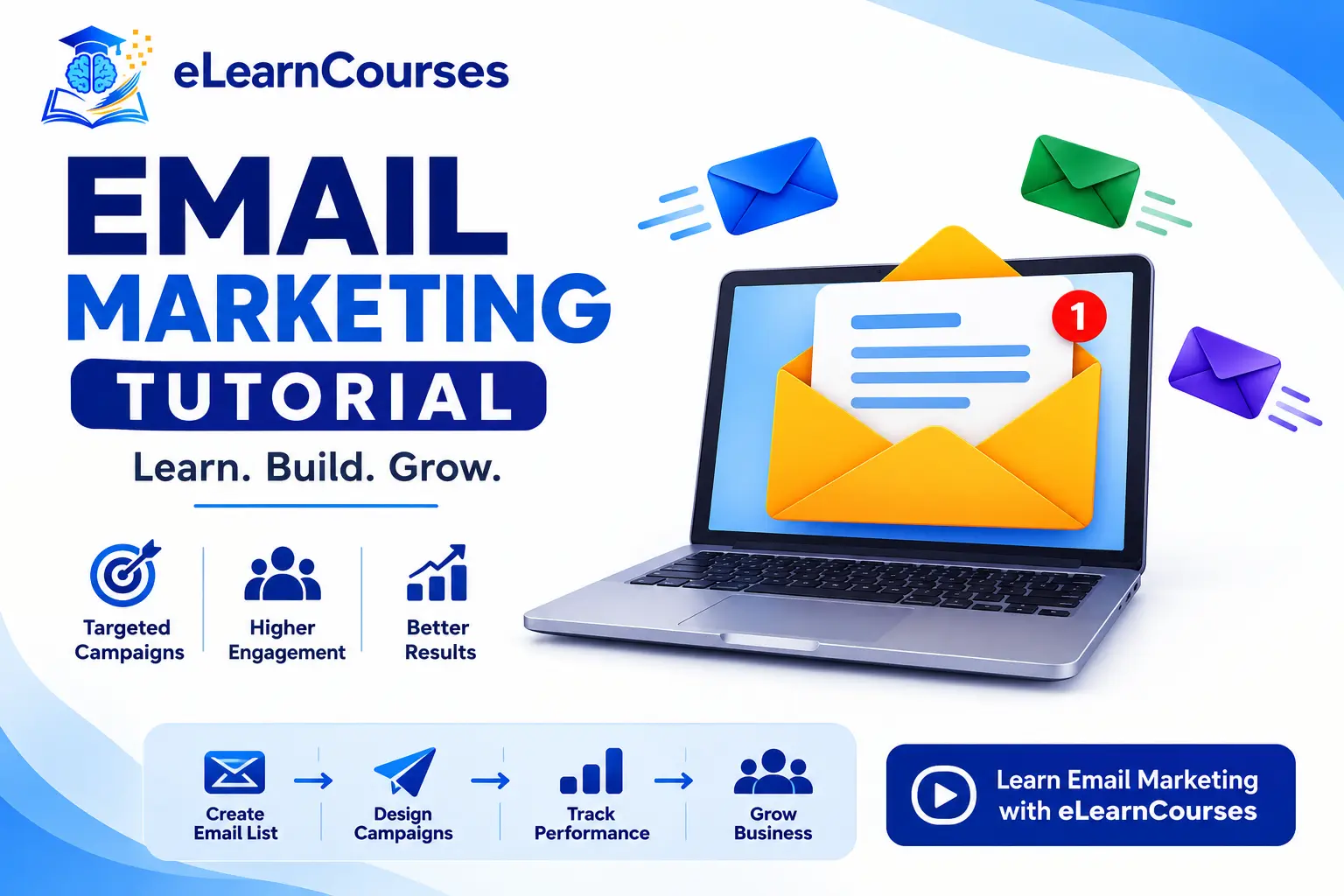
Email Marketing Tutorial for Beginners (2026)
Email is the one marketing channel that keeps getting declared dead and keeps refusing to die. People said social media would kill it. Then they said it would be texting apps. In 2026, email still returns somewhere between $36 and $42 for every dollar spent, according to recent industry benchmarking, and that beats paid search, social ads, and display by a wide margin. The channel works. Most beginners just set it up wrong.
This tutorial covers what you need to build an email program from nothing: list building, choosing a platform, segmentation, the automated flows that do most of the heavy lifting, subject lines, deliverability, and where AI helps versus where it’s just noise in 2026. No prior marketing background required.
What Email Marketing Is
Email marketing is sending messages to people who gave you their email address, with the goal of building a relationship that eventually turns into a sale, a signup, or repeat business. That sounds obvious, but the “gave you their email address” part is the whole game. Every other channel rents attention. Email is one of the few channels where you own the connection outright. Instagram can change its algorithm tomorrow and cut your reach in half. Your email list doesn’t work that way. If someone is on it, you can reach them.
That ownership is why serious ecommerce and content businesses treat their list as one of their most important assets, not a side channel they get to eventually.
Why Email Still Works in 2026
A few numbers explain why email hasn’t gone anywhere. Automated flows, the emails that trigger off a specific action rather than getting blasted to everyone at once, generate dramatically more revenue per send than regular campaigns. Different studies land on different multipliers (some report automated sends earning 20 times more per email, others report figures well into the hundreds), but the direction is the same across every source: automation isn’t a nice extra, it’s where most of the actual money comes from. Klaviyo’s data shows nearly half of all automated flow revenue coming from new buyers alone, with welcome emails, browse abandonment, and cart recovery doing most of that work.
Personalization tells a similar story. Litmus found that 71% of marketers see at least a 20% engagement lift from personalized, dynamic content compared to generic sends. Robly’s 2026 benchmark data puts personalized subject lines at roughly 50% higher open rates than generic ones, and personalized calls to action converting about 42% better.
None of this means email is easy. Inboxes are more crowded than they were five years ago, and Gmail, Yahoo, and Microsoft have all tightened their spam filtering rules. But the programs that treat email as core infrastructure, not an afterthought, are pulling further ahead of the ones still sending the same message to their whole list every Tuesday.
Building Your Email List the Right Way
Buying an email list is tempting when you’re starting from zero. Don’t do it. Purchased lists are full of people who never asked to hear from you, and mass complaints and spam reports from that kind of list will damage your sender reputation fast, which then hurts every future email you send, even to people who want to hear from you.
The better path is slower but it works. Offer something real in exchange for an email address: a discount, a truly useful guide, early access to something, a free tool. The exchange has to feel fair to the person signing up. A vague “subscribe to our newsletter” box converts poorly because it asks for something without offering anything back.
Put your signup form where people already are. A pop-up triggered by exit intent, a form embedded in your best blog posts, a checkout-page opt-in for ecommerce. And once someone signs up, send a confirmation. Double opt-in (where someone has to click a link in a confirmation email before they’re added to your list) adds friction, but it also means everyone on your list actually wants to be there, which pays off later in deliverability and engagement.
Email Service Providers: Picking a Platform
You need software to send these emails at scale, since your regular inbox provider will flag or block you long before you reach even a few hundred recipients. This software is usually called an email service provider, or ESP.
For beginners and small businesses, Mailchimp remains a common starting point because of its free tier and simple drag-and-drop editor. Klaviyo has become the default choice for ecommerce specifically, largely because of how deeply it integrates with Shopify and other store platforms, pulling in purchase history to power segmentation and automated flows without much manual setup. ConvertKit is popular with creators and course sellers who want simpler automation built around content delivery rather than product sales. Brevo (formerly Sendinblue) and ActiveCampaign both sit in the middle, offering more advanced automation than Mailchimp at a lower price than Klaviyo.
Whichever platform you pick, check three things before committing: how their pricing scales as your list grows, whether they support the automated flows you’ll need (covered below), and how good their deliverability reputation really is. Some ESPs have stronger relationships with major inbox providers than others, and that affects whether your emails land in the inbox or the spam folder before you’ve written a single word of copy.
Segmentation: Stop Sending the Same Email to Everyone
A segment is a group of subscribers who share something in common, whether that’s purchase history, engagement level, signup source, or where they sit in your sales funnel. Segmented campaigns consistently outperform broadcast sends because the message matches what the recipient cares about.
Start simple. Split your list into people who’ve purchased and people who haven’t. Split again by engagement: subscribers who’ve opened or clicked in the last 90 days versus people who haven’t touched an email from you in six months. Those two groups need completely different treatment. An active subscriber can handle a promotional email. Someone who’s gone quiet needs a re-engagement message, or they need to be removed from your regular sends entirely so they stop dragging down your open rates.
By 2026, basic demographic segmentation (age, location, gender) has become the floor, not the ceiling. Programs with the strongest ROI lean heavily on behavioral triggers instead: what someone clicked, what they browsed, what they added to a cart and didn’t buy. That kind of layered, behavior-based targeting is sometimes called hyper-segmentation, and it’s a big part of why some programs pull in a 45:1 return while others struggle to break even.
Automated Email Flows You Should Set Up First
If you only build a handful of automated sequences, build these.
Welcome series. Triggered the moment someone joins your list. This is the highest-attention window you’ll ever get with a new subscriber, so use it to introduce your brand, set expectations for what they’ll receive, and make an early offer if that fits your business. Welcome sequences average conversion rates around 2.8%, well above what a typical broadcast email pulls.
Cart abandonment. For ecommerce specifically, this recovers a meaningful slice of otherwise lost revenue, commonly cited around 10% of abandoned carts across studies. A short two- or three-email sequence, starting an hour or two after abandonment, usually outperforms a single reminder.
Browse abandonment. Similar idea, but triggered by someone viewing a product without adding it to a cart at all. Lower intent than cart abandonment, so keep the follow-up lighter and less sales-heavy.
Post-purchase. Confirmation, shipping updates, and then a follow-up asking for a review or suggesting a related product once enough time has passed for the item to arrive and get used.
Win-back. Targeted at subscribers who’ve gone quiet for an extended stretch, often 90 to 180 days without an open or click. Give them a real reason to re-engage. If they still don’t respond after a couple of attempts, remove them from your list. Sending to disengaged addresses hurts your deliverability more than losing a few names helps your vanity list size.
These five flows alone typically account for a large share of total email-driven revenue in a mature program, often well over half, even though they represent a small fraction of total send volume.
Writing Subject Lines People Open
The subject line’s only job is getting the email opened. Everything else you wrote is irrelevant if the subject line fails at that one task.
Specificity beats cleverness almost every time. “20% off your next order” outperforms a vague, mysterious subject line more often than not, because people scan inboxes fast and reward clarity. Personalized subject lines (using a first name, referencing a past purchase, mentioning a browsed category) tend to pull meaningfully higher open rates than generic ones across the benchmark data currently available.
Keep length in mind for mobile, where most email gets read now. Anything past 40 to 50 characters risks getting cut off on a phone screen, so front-load the important part of the message.
AI-assisted subject line generation and testing have become common in 2026, and several platforms report double-digit open rate improvements when marketers use AI tools to generate and test variants rather than writing a single line and shipping it. That doesn’t mean you should hand the job over entirely. It means testing more variants, faster, is now realistic even for a small team, and it’s worth doing.
Email Copy and Design Basics
Good email copy gets to the point. You’re competing with a crowded inbox, not writing a magazine feature. Lead with the value or the offer, not three paragraphs of preamble before you get there.
Write for one reader, not a crowd. “You” works better than “our valued customers.” A single clear call to action beats five competing links fighting for attention, since a confused reader usually clicks nothing at all.
On design, mobile responsiveness isn’t optional anymore. Most email opens happen on a phone, and a design that looks fine on desktop but breaks on mobile will lose a large share of your audience before they even read a word. Keep templates simple: one column, large enough text to read without zooming, buttons big enough to tap accurately with a thumb.
Plain-text-style emails (or HTML emails designed to look plain and personal) have gained ground for certain use cases, particularly one-to-one style messages from a founder or a creator. They read as more human, which matters more than ever now that inboxes are full of AI-generated marketing copy people have started to recognize on sight.
Deliverability: Getting Into the Inbox at All
None of the rest of this matters if your emails land in spam. Deliverability is the unglamorous, unavoidable foundation everything else sits on.
Set up SPF, DKIM, and DMARC. These are authentication records that prove to inbox providers that you’re who you say you are, and that the email wasn’t spoofed. The gap between authenticated and unauthenticated senders shows up clearly in inbox placement rates, with authenticated domains landing dramatically more mail in the inbox rather than spam or promotions purgatory. If you haven’t set these up yet, this is the highest-leverage half hour you can spend on your entire email program.
BIMI (Brand Indicators for Message Identification) is newer and adds your logo directly next to your emails in supporting inboxes once your authentication is solid. Adoption has grown fast through 2026 as more brands chase the trust and recognition it adds at a glance.
Beyond authentication, watch your engagement rate closely. Inbox providers increasingly decide where to route your mail based on how recipients behave: opens, clicks, deletes without reading, and spam complaints all feed into your sender reputation. This is exactly why removing disengaged subscribers matters. A smaller, engaged list delivers better than a large one full of people who never open anything.
Warm up any new sending domain gradually. Start with your most engaged segment and expand slowly rather than blasting your entire list from day one on a brand-new domain. Inbox providers trust sending patterns that build up over time far more than a sudden spike in volume from an unfamiliar sender.
AI in Email Marketing: What’s Useful in 2026
AI has genuinely changed what a small team can do in email, but it’s worth separating what moves results from what’s mostly marketing noise around the word “AI” itself.
Send-time optimization is one of the clearer wins. Instead of picking a single send time for your whole list, AI models learn when each individual subscriber tends to engage and deliver to them at that specific moment. This tends to outperform any single fixed send time, since your list isn’t one person with one schedule.
Content generation is more mixed. AI can draft subject line variants and body copy quickly, and speed has genuinely improved: teams are now producing and sending campaigns in days rather than the two weeks that was common just a couple of years ago. But AI-written copy that isn’t reviewed and edited by an actual person tends to read as generic, and subscribers are getting better at spotting it. The teams seeing the best results treat AI as a fast first draft, not a finished product.
Predictive segmentation and churn prediction are the quieter, less flashy uses, and arguably the most valuable ones. Flagging subscribers likely to disengage before they go quiet, or predicting which segment is most likely to convert on a specific offer, lets a small team focus effort where it pays off instead of guessing.
The honest summary: AI that helps you send more relevant emails to the right person at the right time is worth adopting. AI that just helps you produce more emails, faster, without improving relevance, mostly adds noise to an inbox that already has too much of it.
Metrics That Matter (And the Ones That Don’t Anymore)
Open rate used to be the headline metric everyone tracked. It’s become less reliable since Apple’s Mail Privacy Protection started pre-loading images for a large share of iOS users, which inflates opens regardless of whether someone read the email at all. Open rate still has some directional value, particularly for spotting sudden drops that might signal a deliverability problem, but treating it as your primary success metric in 2026 will mislead you.
Click-through rate is a cleaner signal, since it requires an action rather than a background image load. Conversion rate (the percentage of recipients who complete the action you wanted, whether that’s a purchase or a signup) matters more than either of the above, since opens and clicks are only useful as far as they lead somewhere.
Revenue per email and revenue per recipient give you the clearest read on whether a campaign or flow is working, especially for ecommerce. List growth rate and unsubscribe rate together tell you whether your list is healthy or slowly rotting. A high unsubscribe rate on a specific campaign is a useful signal about what content that segment doesn’t want, not just a number to minimize.
Common Mistakes Beginners Make
Sending the same email to everyone. This is the single biggest gap between a mediocre email program and a strong one. Segmentation isn’t an advanced tactic to get to eventually. It’s foundational.
Skipping authentication setup. SPF, DKIM, and DMARC take an hour to configure and meaningfully change how much of your mail reaches the inbox. Skipping this step and then wondering why open rates are low is one of the most common, most fixable mistakes in the entire field.
Never removing disengaged subscribers. A bigger list feels better, but a list full of people who never open your email actively hurts deliverability for everyone else on it. Prune it.
Writing subject lines as an afterthought. The subject line determines whether anything else you wrote gets read at all. Spend real time on it, and test variants rather than guessing once and moving on.
Treating automation as a one-time setup. Flows need review and updates as your business changes. A welcome sequence built two years ago probably doesn’t reflect your current offers, and a stale automated flow running unattended can quietly underperform for months before anyone notices.
Over-relying on open rate. As covered above, it’s a weaker signal than it used to be. Anchoring decisions to it while ignoring clicks and conversions leads to the wrong conclusions.
A/B Testing Your Campaigns
Testing turns guessing into real knowledge. Start with subject lines, since they have the most direct, easily measured impact on whether an email gets opened at all. Test one variable at a time (subject line, send time, or a single design element) rather than changing five things at once, or you won’t know which change drove the difference.
Give a test enough recipients and enough time before declaring a winner. A test run on 50 people for two hours won’t produce a reliable result. Most ESPs handle statistical significance calculations automatically now, so lean on that rather than eyeballing a small gap in performance and calling it a win.
Once you find something that works reliably (a subject line style, a send-time pattern, a layout choice), turn it into a default rather than re-testing the same thing indefinitely. Testing is most valuable when it’s pointed at genuine open questions, not endlessly re-litigating something you already have solid evidence for.
Staying Compliant: CAN-SPAM, GDPR, and the Basics
Email marketing is regulated, and the rules aren’t optional extras you can skip while you’re small. A few requirements show up across nearly every jurisdiction with meaningful email law.
In the United States, the CAN-SPAM Act requires a working unsubscribe link in every commercial email, honored within 10 business days of a request. It also requires accurate sender information (no misleading “from” names or subject lines) and a real physical postal address somewhere in the email. Violations carry real financial penalties per email, not per campaign, so a mistake that goes out to a large list can get expensive fast.
If you have subscribers in the European Union, GDPR adds stricter consent requirements on top of CAN-SPAM’s baseline. Pre-checked opt-in boxes don’t count as valid consent under GDPR. Someone has to take a clear, affirmative action to join your list, and you need to be able to show when and how they gave that consent if it’s ever questioned. This is part of why double opt-in, covered earlier in this guide, has become standard practice well beyond just the EU: it creates a clean, documented record of consent regardless of which specific law applies to a given subscriber.
Canada’s anti-spam law (CASL) is generally considered even stricter than GDPR in some respects, requiring express consent in most commercial contexts rather than allowing the “implied consent” categories that some other frameworks permit.
The practical takeaway for a beginner: don’t treat compliance as something to figure out later once you’re bigger. Build your list with real opt-in from day one, keep unsubscribe links working and easy to find, and don’t buy or scrape email addresses under the assumption that enforcement only targets large companies. Most ESPs now bake basic compliance features (unsubscribe links, sender verification) into their templates by default, but the underlying practice of earning real consent is still on you, not the software.
How to Keep Learning
Email marketing rarely works in isolation. It performs best as part of a broader strategy where content, search, and social all feed subscribers into your list and reinforce the same messages across channels.
Our digital marketing tutorial covers how email fits alongside SEO, paid search, and social media as part of one connected strategy, and our SEO tutorial for beginners is worth reading if your blog or site content is one of the ways you’re growing your list, since strong content is one of the more sustainable list-building channels available. For ongoing, well-documented benchmark data as the field keeps shifting through 2026, this consolidated email marketing research dataset draws from more than a hundred industry sources and is worth bookmarking directly.
FAQs About Email Marketing
How often should I email my list? There’s no universal number. Weekly is a common starting point for most businesses, though ecommerce brands with frequent promotions sometimes send more, and content-focused newsletters sometimes send less. Watch your engagement and unsubscribe rates as you adjust frequency. A rising unsubscribe rate is a clear signal you’ve pushed too far.
What’s a good open rate in 2026? This varies heavily by industry, and given how unreliable open rate has become since Apple’s Mail Privacy Protection changes, it’s a weaker benchmark than it used to be. Click-through rate and conversion rate are more trustworthy signals of whether a campaign is working.
Do I need a big list to make email marketing worthwhile? No. A smaller, genuinely engaged list of a few hundred people who want to hear from you will outperform a large, disengaged list of tens of thousands almost every time, both in deliverability and in real revenue generated.
Is cold email the same thing as email marketing? Not really. Email marketing, as covered in this guide, is built around people who opted in to hear from you. Cold email, sent to people with no prior relationship or consent, operates under different rules, different deliverability dynamics, and in many regions, different legal requirements entirely.
How long should a marketing email be? Long enough to make your point and no longer. A short, focused email with one clear call to action usually outperforms a long one trying to cover five different offers at once. Save the longer, more detailed content for a dedicated landing page you link to.
Should I use AI to write my emails? AI can speed up drafting, especially for subject line variants and first drafts of routine emails. But copy that goes out unedited tends to read as generic, and subscribers are increasingly good at spotting it. Use AI to move faster, then have an actual person review and adjust before it sends.
Conclusion
Email marketing rewards the parts that feel unglamorous: authentication setup, list hygiene, segmentation, and automated flows that run quietly in the background doing most of the actual revenue work. None of that is complicated once you’ve set it up, and none of it requires a huge budget or a large team.
Start with the fundamentals covered here rather than chasing every new AI feature a platform adds. Get your authentication right, build a welcome and cart abandonment flow, segment your list by engagement, and write subject lines worth opening. Once those pieces are solid, the more advanced tactics (predictive segmentation, AI-driven send-time optimization, deeper personalization) will have a healthy foundation to improve, instead of trying to compensate for a program that’s missing the basics.