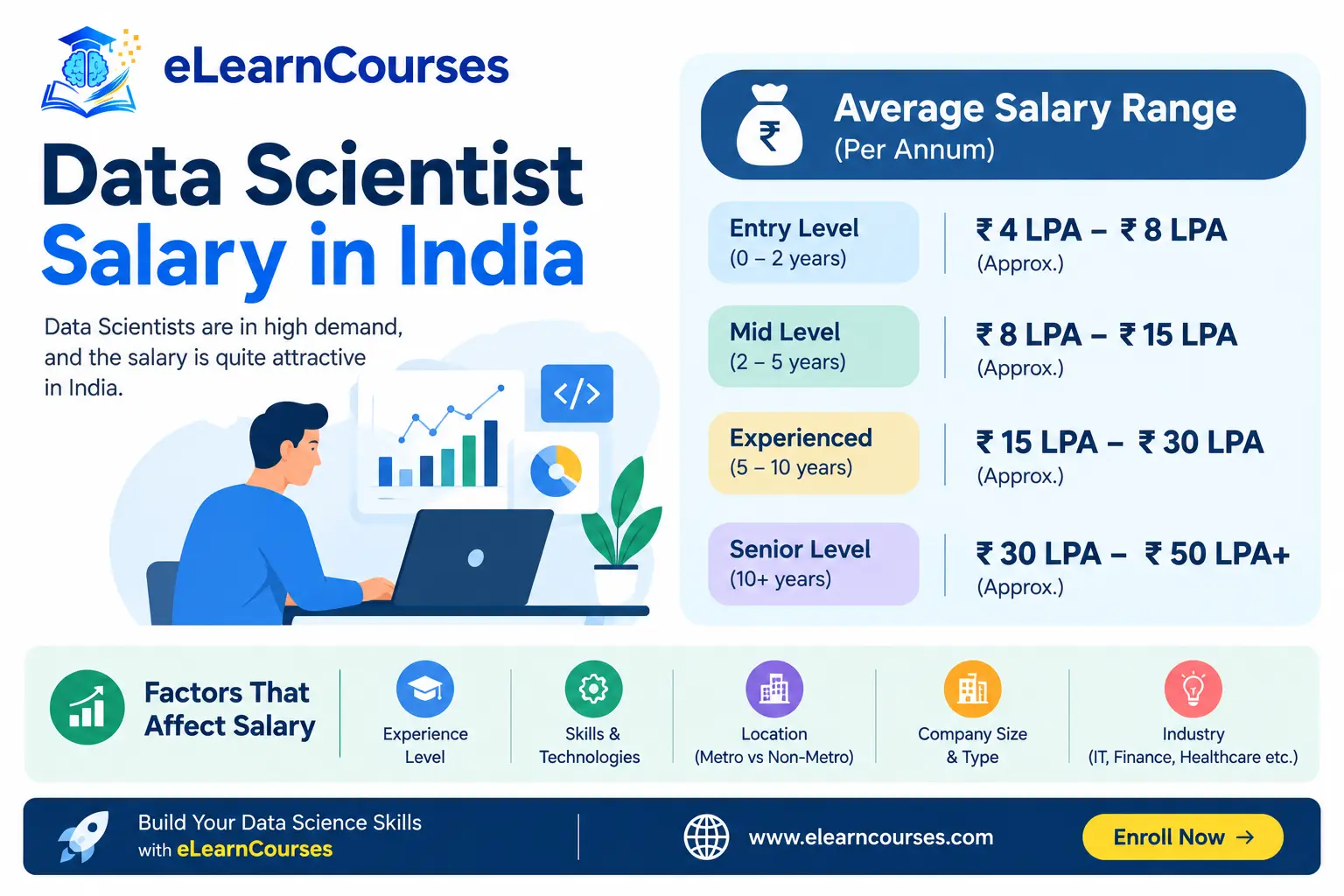
Data Scientist Salary in India (2026): Complete Guide by Experience, City, and Skills
Search “data scientist salary in India” and you’ll land somewhere between ₹5 LPA and ₹80 LPA within the first page of results, sometimes on the same article. Both numbers are real. Neither means much without context. This guide exists to give you that context: what freshers actually start at, how much experience and company type change the picture, which cities pay the most, what the growing GenAI premium actually looks like in real numbers, and what you’d take home each month after the CTC figure gets whittled down by deductions.
Data Scientist Salary in India at a Glance
| Experience Level | Annual CTC (Broad Market) | Annual CTC (Product/AI-First Companies) | Approx. Monthly In-Hand |
|---|---|---|---|
| Fresher (0–1 yr) | ₹5–9 LPA | ₹10–20 LPA | ₹35,000–₹65,000 |
| Mid-level (2–5 yrs) | ₹10–14 LPA | ₹15–30 LPA | ₹70,000–₹1,10,000 |
| Senior (5–10 yrs) | ₹18–25 LPA | ₹30–60 LPA | ₹1,10,000–₹1,80,000 |
| Lead / Principal (10+ yrs) | ₹30–45 LPA | ₹50 LPA–₹1 Cr+ (with ESOPs) | ₹1,80,000+ |
Treat both columns as real, overlapping ranges rather than a strict ladder. A skilled fresher with strong GenAI project experience can land in the product-company column on day one; a data scientist coasting at a services firm for a decade can stay stuck in the broad-market column indefinitely.
Why the ₹5 LPA to ₹80 LPA Range Is So Confusing
Most salary articles quote a single “average” figure, somewhere around ₹11–15 LPA depending on the source, and move on. That number isn’t wrong, but it’s not particularly useful either, because it blends two genuinely different labor markets into one blurry midpoint.
The first market is the broad one: IT services firms, general analytics teams, and companies where “data scientist” sometimes describes work closer to reporting and dashboarding than genuine model building. Salaries here cluster tightly around the ₹5–14 LPA range across experience levels, growing slowly and predictably.
The second market is product companies, GCCs (India-based engineering arms of global tech firms like Google, Microsoft, and Amazon), and funded AI-first startups, where “data scientist” means end-to-end model development, experimentation at scale, and increasingly, GenAI and LLM work tied directly to product outcomes. This market pays 2 to 3 times more for the same title and years of experience, and it’s where the eye-catching ₹40–80 LPA figures actually come from.
Before you anchor to any number in this guide, or any other one, ask which of these two markets it’s describing. That single question resolves most of the apparent contradiction in salary data for this role.
Data Scientist Salary by Experience Level
Freshers (0–1 year): Entry-level data scientists typically earn ₹5–9 LPA in the broad market, and ₹6–14 LPA is a commonly cited overall fresher range once you include stronger candidates and better-paying employers. Graduates from IITs, IIMs, and other top-tier institutes, particularly those with solid machine learning project portfolios, frequently land offers in the ₹12–20 LPA range at product companies, well above the typical fresher band.
Early to mid-career (2–5 years): This band sees the fastest percentage salary growth of any stage in a data science career, commonly moving from roughly ₹8–14 LPA in the broad market up to ₹15–30 LPA at product and AI-first companies. Data scientists who add a genuine specialization, deep learning, cloud ML platforms, or GenAI, during this window tend to separate meaningfully from peers who stay generalist.
Senior (5–10 years): Senior data scientists in the broad market land around ₹18–25 LPA, while product companies, GCCs, and well-funded startups push that range to ₹30–60 LPA. This is also where cross-functional skills, the ability to communicate findings clearly to non-technical stakeholders and tie model work to business outcomes, start meaningfully affecting compensation, not just technical depth alone.
Lead, Principal, and Director-level (10+ years): At the top of the individual-contributor and early-management track, broad-market salaries reach ₹30–45 LPA, while lead and principal roles at FAANG-equivalent companies and successful unicorns can exceed ₹70–90 LPA once bonus and ESOP value are included, occasionally crossing ₹1 crore in total compensation for the most senior, AI-specialized specialists.
Monthly In-Hand Salary: What You Actually Take Home
CTC (Cost to Company) figures get quoted everywhere, but they aren’t what lands in your bank account. Standard deductions, provident fund contributions, professional tax, income tax, and sometimes gratuity accrual, typically consume 15–30% of your annual CTC before you see it, with the exact percentage depending on your tax regime choice and how your specific compensation structure is split between base pay, allowances, and variable components.
| Annual CTC | Approximate Monthly In-Hand |
|---|---|
| ₹6 LPA | ₹42,000–₹46,000 |
| ₹12 LPA | ₹75,000–₹82,000 |
| ₹20 LPA | ₹1,20,000–₹1,30,000 |
| ₹35 LPA | ₹1,90,000–₹2,10,000 |
These figures are approximate and vary by company, city, and how much of your package sits in fixed pay versus bonus or ESOPs, which don’t show up in your monthly paycheck at all. When comparing two offers, always ask for a breakdown of fixed versus variable compensation rather than comparing headline CTC numbers alone, since two ₹20 LPA offers can produce meaningfully different monthly take-home depending on that split.
Data Scientist Salary by City
Bangalore consistently leads, with average figures commonly cited between ₹14–16.4 LPA across experience levels, driven by its dense concentration of product companies and global tech headquarters. Estimates put Bangalore’s premium over other major cities at roughly 15–33%, depending on the specific comparison and data source.
Hyderabad trails closely behind Bangalore, sometimes nearly matching it in specific analyses (figures around ₹12–15.8 LPA show up across different sources), reflecting its position as one of India’s strongest hubs for GCC-based AI and data science hiring, with Microsoft, Google, and Amazon all maintaining substantial Hyderabad operations.
Mumbai and Delhi NCR land in a similar middle tier, generally ₹11–12 LPA on average, with Mumbai’s data science market leaning toward BFSI (banking, financial services, insurance) applications and Delhi NCR skewing toward fintech and consumer internet companies.
Pune sits close behind at roughly ₹10–15 LPA depending on the source, benefiting from a growing product and analytics presence without quite matching the top-tier hubs.
Chennai and Kolkata trail the pack, with Chennai commonly cited around ₹9–9.4 LPA and Kolkata further behind at roughly ₹7–9 LPA, reflecting a smaller concentration of product-company and GCC hiring in these markets relative to the top four hubs.
One caveat worth remembering: higher-paying cities also carry higher costs of living, particularly for housing. Bangalore and Hyderabad’s salary premiums are generally large enough to remain a genuine advantage even after adjusting for cost of living, but it’s worth factoring in when comparing a relocation offer against staying in a lower-cost city.
Data Scientist Salary by Company Type
Company type consistently shows up as one of the single largest salary drivers, often larger than years of experience alone.
IT services companies (large Indian IT consultancies) pay the least for a given experience level, commonly 2 to 3 times lower than product companies for an identically titled role, since the work frequently involves supporting existing analytics systems rather than building new models end to end.
Analytics and consulting firms occupy a middle tier, generally paying better than pure IT services but below dedicated product companies, with compensation often tied closely to specific client engagements and billing structures.
Product companies and unicorns (Flipkart, Swiggy, Razorpay, PhonePe, and similar) pay substantially more, commonly ₹15–40 LPA depending on seniority, with real ownership over models used in production and direct exposure to business impact.
GCCs and global tech companies (Google, Microsoft, Amazon, Meta, Uber, Walmart Global Tech) sit at the top of the market, frequently ₹25–60 LPA or more depending on level, with structured compensation bands, meaningful stock components, and access to genuinely large-scale data and infrastructure.
Top-Paying Companies and Industries
Beyond the broad company-type categories above, a few specific patterns show up consistently in current hiring and compensation data.
Google, Microsoft, Amazon, Meta, Uber, Walmart Global Tech, Razorpay, and PhonePe are commonly cited among the highest-paying employers for data scientists in India, spanning both global tech GCCs and India-headquartered unicorns. The common thread across all of them is scale: each processes enough data, and has enough resources riding on getting models right, that they’re willing to pay a genuine premium to secure strong talent.
Industry also matters beyond company brand recognition alone. Data roles tied directly to revenue, customer behavior, or financial outcomes tend to pay more than roles focused purely on internal reporting or descriptive dashboards, since a model that measurably moves a business metric is easier to justify paying more for than one that simply summarizes existing data. This is part of why fintech and e-commerce data science roles frequently out-earn equivalent-experience roles in more reporting-heavy industries, even at similarly sized companies. A mid-level data scientist in retail or fintech commonly earns ₹24–25 LPA, while a peer with similar experience in a more traditional IT services context might earn ₹13–14 LPA for a nominally similar title.
Freelance and contract data science work has also grown meaningfully in 2026, with platforms reporting a substantial increase in contract engagements from international clients specifically hiring Indian data science talent. This trend particularly benefits experienced professionals with a strong portfolio who want more flexibility than a traditional full-time role offers, though it generally suits established, senior practitioners better than freshers still building foundational experience and references.
The GenAI Premium: Why AI Skills Are Reshaping Data Science Pay
This is the single most consequential shift in data science compensation heading into 2026, and it’s large enough that it deserves to be treated as its own factor, not folded quietly into “skills that help.”
Data scientists with genuine GenAI and LLM experience, fine-tuning, RAG pipeline development, and prompt engineering applied to real production systems, are commonly reported to earn 25–50% more than generalist data scientists at the same experience level, according to multiple 2026 salary analyses drawing on LinkedIn and job-board data. One frequently cited comparison: an LLM engineer role might command ₹20–35 LPA against ₹12–18 LPA for a generalist data scientist with comparable years of experience.
This premium reflects genuine scarcity rather than hype alone. Demand for GenAI-capable data scientists has outpaced the supply of professionals with real, production-level experience in this specific area, and companies are paying accordingly to secure that talent. For anyone actively planning their next 1–2 years of skill development, deliberately building GenAI and LLM experience, not just reading about it, is consistently the highest-leverage single move available in this field right now.
Data Scientist vs. Data Analyst vs. ML Engineer: Salary and Role Differences
These three titles overlap substantially in practice, and understanding where they genuinely differ helps make sense of why salary comparisons between them can feel inconsistent.
Data Analyst roles generally sit below Data Scientist roles in both compensation and scope, focused primarily on reporting, dashboarding, and descriptive analysis of existing data rather than building predictive models from scratch. Analyst salaries commonly run ₹4–10 LPA at the fresher-to-mid level, meaningfully below equivalent data scientist bands.
Data Scientist roles, as covered throughout this guide, involve building and evaluating predictive models, running experiments, and increasingly, applying GenAI techniques, generally commanding higher pay than analyst roles and comparable or slightly below dedicated ML Engineer roles at the same seniority.
Machine Learning Engineer roles lean more heavily toward production deployment and infrastructure, taking models from a research or notebook environment into reliable, scaled production systems. ML Engineer compensation at product companies and GCCs often runs slightly ahead of generalist Data Scientist pay at the same experience level, reflecting the additional engineering and deployment responsibility these roles typically carry.
In practice, the boundaries between these three titles have blurred considerably, and the source cited earlier in this guide put it plainly: the era of the data scientist working in isolation inside a Jupyter notebook, disconnected from deployment and business stakeholders, is largely over. Professionals comfortable operating across this analyst-to-engineer spectrum, not narrowly specialized in just one slice of it, tend to command the strongest compensation and the widest range of job opportunities.
How Salary Growth Has Slowed, Except Where It Hasn’t
One pattern worth understanding if you’re planning a multi-year career trajectory: overall compensation inflation in Indian data science has moderated compared to the aggressive increases seen in 2023 and 2024. Current estimates put typical salary growth at roughly 8–12% annually for job switchers and 6–8% for internal promotions, a meaningfully slower pace than the boom years immediately following the broader AI hiring surge.
The GenAI premium is the clear exception to this general slowdown. While overall data science compensation growth has cooled, pay specifically tied to GenAI and LLM skills continues climbing faster than the market average, according to several 2026 analyses. This divergence matters for career planning: treating data science as a single, uniform field with one growth rate misses the more important story, which is that the field has effectively split into two growth trajectories, a cooling generalist track and an accelerating AI-specialized one.
The practical implication is similar to a theme that’s run through this entire guide: deliberate specialization, not tenure or general experience alone, is what’s driving the fastest compensation growth available in data science right now.
Skills That Move the Needle Most
A consistent skill progression shows up across current hiring and salary data as the clearest path from a fresher-level offer toward a substantially higher one: core data science fundamentals (Python, SQL, and classical machine learning) first, then deep learning frameworks like PyTorch, then a cloud ML platform (AWS SageMaker or Azure ML), and finally LLM and GenAI skills layered on top. This progression is commonly cited as moving a roughly ₹8 LPA fresher toward an ₹18–22 LPA offer within about three years of deliberate, structured skill-building.
Beyond the technical skill ladder, a few additions consistently show up as commanding real salary premiums: deep learning and NLP expertise (₹3–10 LPA added to a base package in some analyses), cloud ML platform certification, and, as covered above, genuine GenAI and LLM production experience. Communication ability, translating technical findings into decisions a non-technical stakeholder can act on, increasingly shows up as a differentiator too, particularly at the senior end where a data scientist’s influence depends as much on being understood as on being technically correct.
India vs. Global Data Scientist Salaries
For context, average data scientist salaries in the United States commonly run $130,000 to $200,000 annually, roughly 5 to 8 times higher than typical Indian salaries in absolute dollar terms. That gap narrows considerably on a purchasing-power-adjusted basis: a senior data scientist earning ₹40 LPA in Bangalore can maintain a comparable quality of life to someone earning roughly $100,000 in a mid-cost American city, once local cost of living is factored in rather than comparing raw currency conversion alone.
It’s also worth noting that Indian data science salaries have been growing faster in percentage terms than US salaries in recent analyses, roughly 22% year-over-year growth in India against around 8% in the US according to recent industry comparisons, gradually narrowing the absolute gap even before accounting for purchasing power differences. This growth trajectory is part of why global companies increasingly view India-based data science talent as both cost-effective and genuinely high-quality, rather than purely a lower-cost alternative to hiring elsewhere.
How to Increase Your Data Scientist Salary
A few practical, well-supported levers show up consistently across salary and career guidance for this field:
- Build a genuine skill ladder, not a scattered skill list. The Python, SQL, and classical ML foundation matters, but deliberately adding deep learning, a cloud platform, and GenAI experience in that order is what actually moves compensation, based on the progression pattern covered above. If your fundamentals need reinforcement first, our Python training and SQL training cover exactly that groundwork.
- Go deep on neural networks and modern architectures. Our deep learning tutorial covers the foundational concepts through to the Transformer architecture underlying today’s highest-paying GenAI-adjacent roles.
- Switch companies deliberately, not just frequently. Job switchers in data science are commonly reported to earn 20–35% more in the move itself, compared to 6–15% for internal annual raises. This doesn’t mean switching for its own sake, but it does mean staying at one employer indefinitely rarely produces the fastest compensation growth available.
- Build a visible, real portfolio. GitHub activity, published projects, and demonstrable work consistently show up as differentiating factors at the offer stage, particularly for candidates without a top-tier academic pedigree to lean on instead.
- Prepare seriously for technical interviews. Strong interview performance backs up salary negotiation leverage. Reviewing structured data science interview questions is a practical way to sharpen the statistics, modeling, and scenario-based rounds that come up repeatedly across this field.
- Target company type as deliberately as you target skills. Given how much company type affects pay for an identical title and experience level, moving from a services firm toward a product company or GCC is frequently the single largest salary jump available in an Indian data science career.
Negotiating Your Offer
A few negotiation-specific habits show up consistently among data scientists who land toward the higher end of their experience band, rather than the middle or lower end.
Ask for the full compensation breakdown, not just the CTC headline. As covered in the monthly in-hand section above, two offers with identical CTC figures can produce meaningfully different actual take-home and long-term value depending on how much sits in base pay versus bonus, ESOPs, or other variable components with less certain payout.
Understand which market you’re negotiating in. Before any specific number discussion, confirm whether the company sits closer to the broad-market or product/AI-first band described earlier in this guide. Anchoring your ask to the wrong reference point undermines your credibility in either direction, whether you’re asking for too little against a strong offer or unrealistically high against a services-firm budget.
Lead with measurable impact, not just technical breadth. Companies paying at the higher end of the range are generally paying for demonstrated outcomes: models that shipped, measurable business impact, experiments that changed a real decision, not simply a list of algorithms and libraries you’re familiar with.
Use competing offers as genuine leverage where you can. Candidates interviewing at more than one company simultaneously consistently report stronger final offers than those negotiating in isolation, since an employer facing real competition for a candidate has a concrete reason to move on compensation rather than simply presenting a fixed number.
FAQs About Data Scientist Salary in India
What is the average data scientist salary in India in 2026? Most current sources put the blended average somewhere between ₹11–15 LPA across all experience levels and company types, though this figure spans an enormous underlying range, from ₹5 LPA fresher salaries at services firms to ₹60–80 LPA or more for senior, AI-specialized professionals at top product companies.
What is the starting salary for a fresher data scientist in India? Freshers typically earn ₹5–9 LPA in the broad market, with candidates from top institutes or those with strong machine learning project portfolios often landing ₹12–20 LPA offers at product companies and GCCs.
Which city pays the highest data scientist salary in India? Bangalore consistently ranks highest, commonly cited between ₹14–16.4 LPA on average, followed closely by Hyderabad. Mumbai and Delhi NCR form a middle tier, with Pune close behind and Chennai and Kolkata generally trailing the other major hubs.
How much more do GenAI skills add to a data scientist’s salary? Data scientists with genuine GenAI and LLM production experience commonly earn 25–50% more than generalist peers at the same experience level, based on multiple 2026 salary analyses, making it currently the single highest-leverage skill investment in the field.
Is data scientist a better-paying role than data analyst in India? Generally yes. Data analyst roles typically run ₹4–10 LPA at the fresher-to-mid level, meaningfully below equivalent data scientist compensation bands, reflecting the analyst role’s narrower focus on reporting and descriptive analysis rather than predictive model development.
How much does job switching actually increase data scientist salary? Job switches in data science commonly produce 20–35% salary increases, compared to 6–15% for typical internal annual raises, making deliberate career moves one of the more reliable ways to accelerate compensation growth over a multi-year career.
Do I need a master’s degree to earn a high data scientist salary in India? Not strictly, though it can help. A postgraduate degree in statistics, computer science, or a related field is cited in some analyses as carrying real, measurable salary weight, particularly for entry into top-tier institutes’ campus placement pipelines, but a strong project portfolio and demonstrated skill increasingly compensate for its absence at mid-career and beyond.
Are remote data science roles paid differently than in-office roles in India? Often not negatively, and sometimes positively. Remote roles for global companies are commonly benchmarked to the hiring company’s headquarters city band, frequently a Bangalore-equivalent rate, which can make remote work salary-neutral or even a modest positive compared to an equivalent in-office role at a lower-paying local employer.
How many data science jobs are actually available in India right now? Estimates vary by source and definition, but one frequently cited figure puts open data science positions above 139,000 across multinational IT and KPO companies alone, reflecting a market with substantial ongoing hiring demand rather than a narrow, saturated niche.
Conclusion
The real story behind data scientist salaries in India in 2026 isn’t a single number, it’s a framework for reading any number you come across. Ask which labor market it describes, broad or product/AI-first, check which city and company type it assumes, and factor in whether GenAI skills are part of the picture, since that premium alone is now large enough to separate otherwise similar candidates by a wide margin.
Whatever stage of your data science career you’re at, the highest-leverage moves stay consistent: build genuine depth rather than a scattered skill list, add GenAI and LLM experience deliberately rather than as an afterthought, and don’t assume loyalty to one employer is the fastest path to better compensation when the data consistently shows otherwise. The field remains one of the highest-paying, fastest-growing corners of India’s tech industry, and the gap between generalist and specialized, production-ready data scientists is only widening from here.