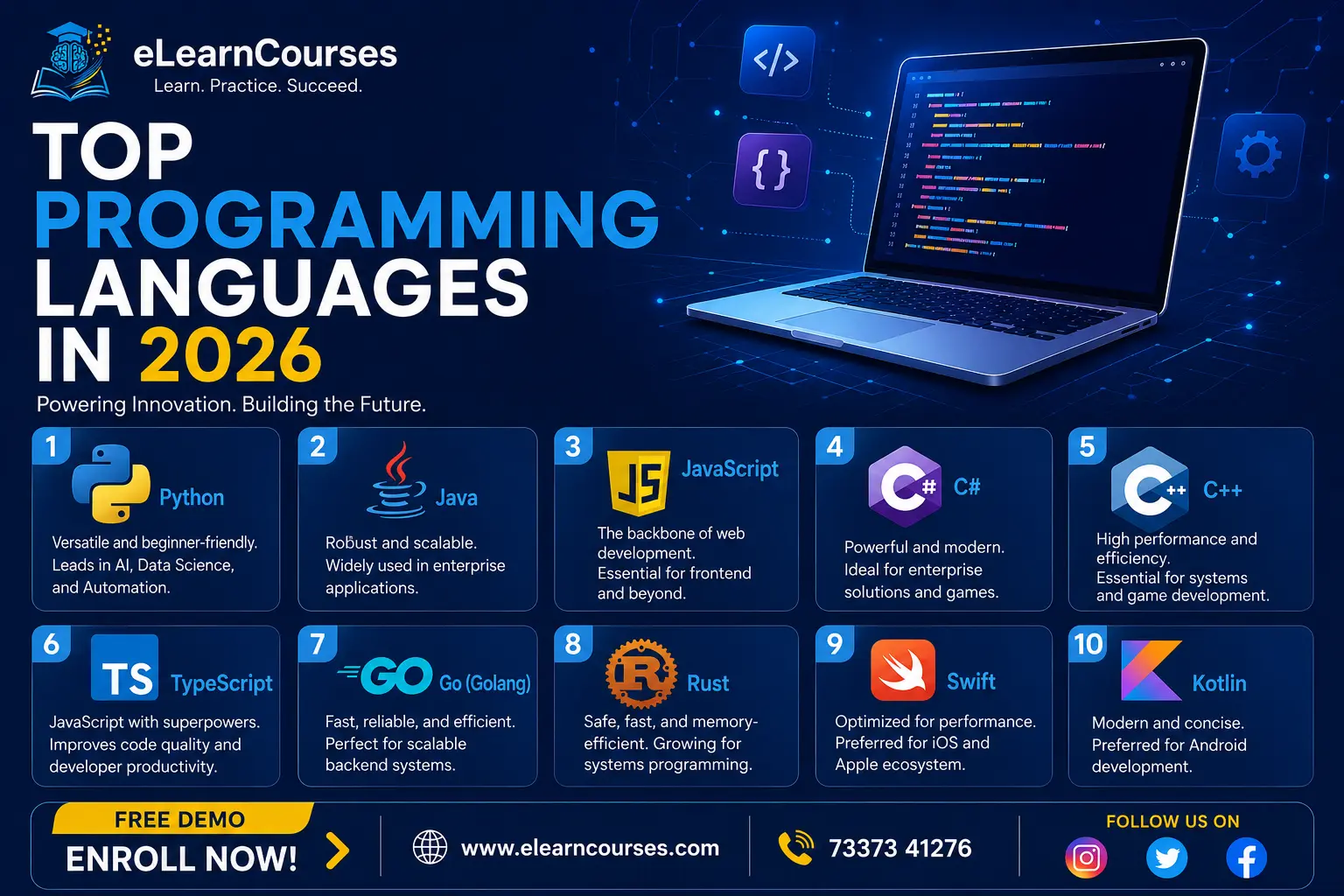
Top Programming Languages in 2026
Ask “what’s the most popular programming language” and you’ll get a different answer depending on which measuring stick you use. By raw developer usage, JavaScript still wins. By search and tutorial interest, Python has pulled ahead by a wide margin. By GitHub contributor growth, TypeScript is climbing faster than almost anything else. None of these rankings are wrong; they’re just measuring different things, which is exactly why a list of the top programming languages in 2026 needs to explain what’s actually being counted before handing you a ranked list.
This guide walks through where each major language actually stands right now, why it’s positioned there, and which one makes sense for you to learn next depending on what you’re trying to build.
How These Rankings Actually Work
Four sources get cited constantly in language popularity discussions, and they measure genuinely different things.
TIOBE Index counts how often a language is mentioned across search engines and related platforms, treated as a rough proxy for overall discussion and interest rather than actual usage. It’s the oldest and most frequently cited index, but it’s also known to swing noticeably from month to month, so a single snapshot can be misleading without looking at the broader trend.
PYPL (PopularitY of Programming Language) measures how often language tutorials are searched for on Google, which functions as a decent proxy for who’s actively trying to learn a language right now, skewing toward whatever’s currently attracting new learners rather than existing production usage.
Stack Overflow’s Developer Survey asks working developers directly what they use, which captures real-world, self-reported usage more directly than search-based indices, though it’s limited to whoever chooses to respond to the survey.
GitHub’s Octoverse report tracks activity across public and private repositories, contributor growth, and language usage in actual commits, which reflects what’s happening in real codebases rather than search interest or self-reporting.
Keeping these differences in mind matters because a language can rank very differently across all four at the same time, and that’s not a contradiction, it’s the whole picture.
Python: The Clear Leader by Most Measures
Python holds the top spot on both TIOBE and PYPL by a wide margin over whatever sits in second place, and it’s the language most developers say they want to learn or work with next. The reason isn’t mysterious: Python sits at the center of the AI and data science boom, with libraries like PyTorch, TensorFlow, and Pandas making it the default choice for machine learning work, while its readable syntax keeps it approachable for complete beginners at the same time.
Python’s use cases span data analysis and automation, backend web development through frameworks like Django and Flask, and scripting work across nearly every industry. If you’re picking a first language with the widest range of practical applications and the deepest current demand, Python remains the safest default in 2026, and our Python tutorial covers the fundamentals this entire ecosystem builds on.
JavaScript and TypeScript: The Web’s Backbone
JavaScript still leads by raw developer usage in the Stack Overflow survey, sitting well ahead of most other languages, simply because it remains the only language that runs natively in every web browser. Nothing on the horizon looks likely to displace it from that specific position, since the entire web platform is built around it.
TypeScript, JavaScript with an added static type system, has had one of the more notable growth stories heading into 2026, posting a sharp year-over-year jump in GitHub contributors and, by some measures, overtaking plain JavaScript in certain repository activity metrics.
Most product companies building anything beyond a small project have shifted to TypeScript specifically because static typing catches a meaningful category of bugs before code ever runs, which matters more as codebases and teams grow. If you’re starting fresh on frontend or full-stack web work, learning JavaScript fundamentals first and adding TypeScript shortly after has become the standard path rather than an optional upgrade. Our JavaScript interview questions guide and CSS tutorial cover the surrounding fundamentals for anyone building toward this stack.
Java and C#: The Enterprise Mainstays
Java has had a rougher run in recent rankings, dropping to its lowest-ever position on the TIOBE Index. That doesn’t mean Java is disappearing; it reflects a slower rate of new adoption relative to Python and JavaScript rather than an actual decline in existing usage. Java remains deeply embedded in enterprise backend systems, Android development, and large-scale financial and government software that isn’t getting rewritten anytime soon, which keeps demand for experienced Java developers strong even as its ranking share slips.
C# had the opposite trajectory, posting the largest year-over-year gain of any tracked language on the TIOBE Index and earning recognition as language of the year for it. Much of that momentum comes from continued strength in game development through Unity, along with Microsoft’s ongoing investment in .NET for cross-platform enterprise and cloud applications.
C and C++: Systems Programming Still Matters
C and C++ remain fixtures near the top of every major index, and for good reason: operating systems, embedded systems, game engines, and performance-critical infrastructure still depend on languages that give direct control over memory and hardware. Neither language shows the growth trajectory of Python or Rust, but neither is going anywhere either, since an enormous amount of the software the rest of the industry depends on, from Linux itself to major database engines, is written in one of these two languages and isn’t being rewritten wholesale.
Rust: The Fastest-Rising Language
Rust is the standout story in the 2026 rankings. It entered the TIOBE Index top 10 for the first time in the index’s history this year, climbing from well outside the top 20 in a relatively short span. Developers who use Rust consistently report the highest satisfaction and “would want to continue using it” scores of any major language, and it commands one of the largest salary premiums in the industry, reflecting both genuine scarcity of experienced Rust developers and the specialized, performance-critical nature of the work it’s typically used for.
Rust’s core appeal is memory safety without a garbage collector: it catches an entire category of memory-related bugs at compile time that have historically caused serious security vulnerabilities in C and C++ codebases. That’s driven adoption in systems programming, browser engines, and increasingly in parts of the cloud infrastructure space where both performance and safety genuinely matter.
SQL: The Underrated Essential
SQL doesn’t get talked about with the same energy as newer languages, but it’s climbed into TIOBE’s top 10 as well, and it’s arguably one of the most consistently useful languages to know regardless of what field you’re in. Every application with a database, which is nearly every application, eventually needs someone who can write a real query rather than relying entirely on an ORM’s generated SQL. Data analysts, backend developers, and data scientists all lean on SQL constantly, and unlike more specialized languages, it doesn’t really go out of style, since the relational model it’s built around has stayed foundational to how most applications store data for decades now.
Go: Built for Cloud and Infrastructure
Go doesn’t top the popularity charts, but it’s become the default choice for a specific, important category of software: cloud infrastructure tooling. Docker and Kubernetes, two of the most foundational tools in modern cloud computing, are both written in Go, and its combination of simple syntax, fast compilation, and built-in concurrency support has made it a common choice for backend services and infrastructure tooling at companies operating at real scale.
Other Languages Worth Knowing
PHP has declined significantly from its earlier dominance, but it still powers a massive share of existing websites, including large portions of the web built on WordPress, so PHP skills remain relevant for maintaining and extending that enormous existing footprint even without much new adoption.
Swift remains the standard for native iOS and macOS development, with no serious rival for that specific niche.
Kotlin has become Google’s preferred language for Android development, officially favored over Java for new Android projects.
Solidity, used for writing smart contracts on Ethereum and similar blockchains, is a genuinely niche language by usage volume but reports some of the highest median salaries of any language tracked, reflecting a small, specialized talent pool for blockchain development work.
Emerging Languages Worth Watching
A handful of newer languages haven’t cracked the major popularity indices yet but are worth knowing about heading further into 2026. Mojo, built specifically to combine Python’s familiar syntax with performance closer to C, is aimed directly at AI and machine learning workloads that have historically needed a separate, faster language underneath a Python-facing interface. Zig has attracted a dedicated following as a simpler, more modern alternative to C, with explicit control over memory and no hidden control flow, positioning itself for the same systems-programming niche Rust competes in, but with a different set of tradeoffs around simplicity versus safety guarantees.
Neither language shows up prominently in TIOBE or PYPL yet, and neither is a sensible first language to learn in 2026. But both illustrate a broader pattern worth watching: as AI workloads and systems-level performance concerns keep growing, new languages purpose-built for those specific pressures keep appearing, and a couple of them tend to break into the mainstream every few years, the way Rust and Go both did before eventually reaching their current positions.
Learning a Language vs. Learning a Framework
A common point of confusion, especially for beginners, is conflating a language with the frameworks built on top of it. “Should I learn JavaScript or React?” isn’t really a choice between two comparable things, React is a framework built in JavaScript, and you need the underlying language reasonably well before a framework built on it makes much sense. The same relationship holds for Python and Django or Flask, and for Java and Spring.
This matters for planning your learning path: frameworks change far more often than the languages underneath them. A developer who deeply understands JavaScript can pick up React, Vue, or whatever framework replaces them in five years relatively quickly, since the core language concepts transfer directly. A developer who only learned a specific framework’s patterns without the underlying language often struggles the moment they need to work outside that framework’s conventions, or when that framework eventually falls out of favor.
Prioritizing the language first, even though frameworks are what most job postings mention by name, tends to pay off more over a longer career.
How AI Coding Tools Are Reshaping Language Popularity
One of the more interesting dynamics shaping 2026 rankings is how AI coding assistants are influencing which languages thrive. These tools tend to perform noticeably better with languages that have enormous amounts of training data and clean, well-documented syntax, which gives Python and JavaScript an additional structural advantage beyond their existing popularity.
At the same time, this trend puts languages with smaller communities and less publicly available code, older or more niche languages like COBOL or Perl, at more of a disadvantage for new projects, since AI-assisted development works less reliably for them and fewer new developers are learning them in the first place. This doesn’t erase demand for maintaining existing systems written in those languages, but it does affect where new projects and new learners are heading.
Regional and Industry Differences Worth Knowing
Global rankings can obscure real regional variation. PYPL, for instance, publishes separate rankings for individual countries rather than just a single global number, and Python holds the top spot with a substantial lead in every major market it tracks, including the United States, India, Germany, the United Kingdom, and France. That consistency is part of why Python’s position feels less like a passing trend and more like a genuine structural shift in what companies are hiring for.
Below the top spot, regional differences show up more clearly. India shows unusually strong demand for Java relative to other major markets, reflecting the large enterprise and outsourcing sector built around it. European markets, particularly Germany, tend to show relatively stronger C++ and systems-programming demand tied to manufacturing and automotive industries.
Startups, regardless of region, skew more heavily toward JavaScript, TypeScript, and Python than large, established enterprises, which still run a disproportionate share of Java and C#-based systems built years or decades ago.
The practical takeaway: a global ranking is a reasonable starting point, but checking job postings specific to your target region and industry gives a far more accurate picture than any single worldwide index, since the gap between global averages and local hiring reality can be significant.
R and Julia: The Data Science Specialists
Python dominates general-purpose data science work, but two more specialized languages hold their ground in specific corners of the field. R remains deeply embedded in academic research, biostatistics, and pharmaceutical data analysis, where its statistical packages and visualization tools (particularly ggplot2) are considered best-in-class by many statisticians, and it’s recently climbed slightly in TIOBE rankings alongside SQL.
Julia, designed specifically for high-performance numerical and scientific computing, has a smaller but devoted following among researchers who need Python-like readability without sacrificing the raw computational speed closer to C. Neither language competes with Python for general popularity, but both remain the right choice for specific technical or academic niches where their specialized strengths outweigh Python’s broader ecosystem.
Common Mistakes When Choosing What to Learn
Chasing salary rankings instead of career direction. A high salary premium for a niche language like Rust or Solidity reflects scarcity for a specific, specialized type of work, not a shortcut to a high income for anyone who learns the syntax. Without the surrounding systems knowledge or blockchain domain expertise, the premium salary isn’t actually accessible.
Switching languages every time a new ranking shifts. These indices move month to month, sometimes significantly, and constantly restarting your learning in a new language chasing the latest ranking movement produces shallow knowledge across many languages rather than genuine depth in one.
Ignoring what’s actually in job postings for your target role. Rankings are a useful starting point, but nothing beats searching actual job postings for the specific role and companies you’re targeting and checking what they list as requirements directly.
Assuming a declining ranking means a language is dying. Java’s falling TIOBE position reflects slower new adoption, not shrinking real-world usage. Plenty of well-paid, stable careers exist maintaining and extending mature codebases in languages that no longer top the popularity charts.
Salary Trends by Language
Salary data varies significantly by source, location, and how experience level is factored in, but a consistent pattern shows up across multiple surveys: specialized, harder-to-hire-for languages tend to command a premium over broadly popular ones. Rust and Solidity developers frequently report among the highest salaries and the largest premiums over the general developer median, largely reflecting how few experienced developers exist relative to demand for that specific skill set. More broadly used languages like PHP tend to sit at the lower end of the salary range, partly because the pool of developers who know them is so much larger.
That said, it’s worth being careful about over-indexing on this data. Experience level, location, and specialization within a language typically matter more than the language itself. A senior Python or JavaScript developer with strong system design skills will often out-earn a junior developer in a higher-paying niche language, so treating salary rankings as a reason to chase an unfamiliar language purely for pay is usually the wrong takeaway.
Which Language Should You Learn First?
The honest answer depends entirely on what you want to build.
For AI, data science, or automation: Python, without much debate. Its ecosystem in this space is unmatched, and demand shows no sign of slowing down.
For web development: JavaScript first, then TypeScript once the fundamentals are solid. This combination covers frontend, backend (through Node.js), and nearly every modern web framework.
For mobile development: Swift for iOS, Kotlin for Android. If you need to target both platforms with a single codebase, frameworks built on JavaScript/TypeScript (React Native) or Dart (Flutter) are worth considering as well.
For systems programming or performance-critical work: Rust is the modern recommendation, offering memory safety without sacrificing the low-level control C and C++ have traditionally provided.
For enterprise backend roles: Java or C#, depending on whether the target company’s stack leans toward a Java-based or .NET-based ecosystem.
For data-adjacent roles of any kind: SQL, regardless of whatever other language you’re learning alongside it, since it’s close to unavoidable in practice.
Quick Comparison Table
| Language | Best Known For | 2026 Trend |
|---|---|---|
| Python | AI, data science, automation | Leading nearly every major index |
| JavaScript | Web development (all browsers) | Stable, still #1 in raw usage |
| TypeScript | Large-scale web applications | Fastest-growing on GitHub |
| Java | Enterprise backend, Android | Declining share, still high demand |
| C# | Game dev (Unity), .NET enterprise | Largest recent index gain |
| C / C++ | Systems, embedded, game engines | Stable, foundational |
| Rust | Memory-safe systems programming | Fastest-rising, highest salary premium |
| SQL | Databases and data work | Rising, historically underrated |
| Go | Cloud infrastructure, DevOps tooling | Steady niche dominance |
Frequently Asked Questions
Is Python really the most popular programming language in 2026? By TIOBE and PYPL, yes, by a wide margin. By raw self-reported developer usage in the Stack Overflow survey, JavaScript still leads. Both statements are accurate; they’re measuring different things, which is why “most popular” always deserves a follow-up question about which metric is being used.
Should I learn TypeScript instead of JavaScript? Learn JavaScript first. TypeScript is built directly on top of it, and understanding core JavaScript concepts, closures, the event loop, asynchronous patterns, makes learning TypeScript’s type system considerably easier afterward. Skipping straight to TypeScript without the underlying fundamentals tends to create gaps that show up later.
Is Rust worth learning if I’m not planning to do systems programming? It depends on your goals. Rust has a steeper learning curve than most languages on this list, largely due to its ownership and borrowing system, and that investment pays off most clearly in systems programming, performance-critical backend services, or roles specifically seeking Rust expertise. For general web or data work, the time might be better spent going deeper into Python or JavaScript first.
Is Java still worth learning given its declining ranking? Yes. A declining ranking reflects slower growth in new adoption, not disappearing demand. Enormous amounts of existing enterprise software run on Java, and companies maintaining and extending those systems need experienced Java developers regardless of what’s trending in new project starts.
How much do these rankings actually matter for career decisions? Less than people often assume. Rankings shift, sometimes significantly, from month to month and year to year, while switching your primary language every time a new ranking comes out is rarely a good use of time. A more reliable approach is picking a language that fits the type of work you want to do, then building real depth in it rather than chasing whichever language currently sits at the top of an index.
Why does Python’s ranking percentage seem to vary so much between different sources? Different snapshots in time and different methodologies both play a role. TIOBE’s own numbers have shown real month-to-month movement even for the top-ranked language, and PYPL, Stack Overflow, and GitHub each use entirely different data collection methods, so a specific percentage from one source at one point in time shouldn’t be treated as a fixed, universal figure. The consistent signal across all of them is Python’s relative position at or near the top, not any single exact number.
Are older languages like COBOL still worth learning in 2026? For most new developers, no, not as a primary language choice. But a smaller, well-paid niche still exists maintaining legacy COBOL systems in banking and government, particularly since fewer new developers are learning it and the existing systems aren’t disappearing anytime soon. It’s a reasonable specialization for someone already in a relevant industry, not a recommended starting point for a new developer with an open choice of what to learn.
Where to Go From Here
The top programming languages in 2026 split fairly clearly by what you’re trying to measure: Python for AI and data work, JavaScript and TypeScript for the web, Rust for systems programming and memory safety, and a handful of enterprise stalwarts (Java, C#, C++) that aren’t going anywhere despite slower growth in new adoption. The right one to learn depends far more on what you want to build than on any single month’s ranking.
If Python is your starting point, our Python tutorial covers the fundamentals. If you’re heading toward web development, our JavaScript interview questions guide and CSS tutorial round out that path. For the underlying ranking data referenced throughout this guide, the official TIOBE Index and PYPL Index are both worth checking directly, since both update regularly and the picture shifts over time.